Dustin
Beijing
Just saying we need a more educated populace isn't enough. We need a specific kind of educated populace -- mainly scientists and engineers. Unfortunately, elite institutions pump out legions of corporate lawyers and bankers. These parasitic professions don't do a whole lot for the nation as a whole. We need Bell Labs not Goldman Sachs.
choice
NH
The annual US defense budget is about $800 billion, before the upcoming Afghan escalation; speaking of penny-wise, pound-foolish, why not spend the fund at home, on education, healthcare, infrastructure, green tech?
LAS
Redmond, WA
American society is denying our gifted students the opportunity to develop the mathematical knowledge necessary to compete scientifically. American graduate schools are importing many of their science students because Americans students are at least five years behind the Europeans in math. Able students in France and Italy learn trigonometry in the sixth grade. They learn to prove theorems. Americans are taught watered down, applied math. High school students are often given abridged versions of advanced topics, which they learn by memorizing the computations without understanding the underlying meaning. Students are doing computations with the calculator instead of learning to estimate quantities in their heads. These problems have been known for more than 30 years and still nothing has changed. At the very least, gifted students should be allowed to leave the high school to take college courses, or colleges should send teachers to provide special instruction at the high schools. If this doesn't happen, then forget about Americans having the opportunity to succeed in physics, engineering or computational biology. A stimulus package that funded gifted education programs in math would pay for itself in the future, not to mention the advances in medicine that could eventually cure diseases and lower health care costs.
Morbius
St. Louis, MO
When I graduated from a state university in 1980, I had managed to accumulate around $1800 in student loan debt, over the course of 7 years of night school. I was able to repay this debt in a little over a year. Now, students must mortgage their future to get a college degree. I know personally of at least 4 people who have in excess of $80,000 each in student loan debt. The crisis in education that must first be addressed is the excessive cost, which has spiraled out of control in a manner reminiscent of healthcare cost inflation. Perhaps, as an economist, you could explain why, and suggest a remedy.
EtherNetzer
Oakland
How can one ignore the ignominious role that the NEA and the federal and state governments have already had in subverting the goals of public schools. Your solution is to throw more taxpayer dollars at it, blindly. Public schools have become parodies of didactic learning, just warehouses and temporary corrals for rambunctious youth; when teaching occurs, it's centered on politically correct cultural sensitivity and how to deal with bad feelings. Meanwhile, no learning of basic knowledge or useful skills occurs.
wt
east coast
Krugman wonders why American college students hold part-time jobs whereas their French counterparts don't. He concludes it's for lack of public funding.
Well, Mr. Krugman, take note: your employer, Princeton University, charges it's students $50k/year, whereas the Ecole normale superieure, Paris charges a few hundred dollars per semester. And...per student public funding of higher education in France is less than in the US--a lot less.
How do the French (and virtually all of Western Europe) provide world class education for pittance? Well, for starters, French faculty are civil servants paid on a national scale; they make a fraction of what you and your Princeton colleagues make. Professors are expected to teach first, and keep research and extracurricular activities second. Their athletics consist of intramural matches, not nationally televised games. Their facilities are spartan and crumbling, not country clubs. Every euro is stretched for the primary purpose of educating young students.
In short, our European friends do more for less. It's healthcare redux: Americans pay more, get less.

8.10.09
Obama and G-20 Summit world leaders gather for the official photo at the David L. Lawrence Convention Center in Pittsburgh, Pa., Sept. 25, 2009

Whodunit? Sneak attack on U.S. dollar
Eamon Javers Eamon Javers
It’s the biggest mystery in global finance right now: Who conducted a sneak attack on the U.S. dollar this week?
It began with a thinly sourced but highly explosive report Monday in a British newspaper: Arab oil sheiks are conspiring with the Russians and Chinese to quit using the dollar to set the value of oil trades — a direct threat to the global supremacy of the greenback.
Is it true? Everyone from the head of the Saudi central bank to U.S. officials scrambled to undercut the story, but no matter.
With the U.S. economy on the ropes and America by far the world’s biggest debtor, investors aren’t feeling as secure about the dollar as they used to. And the notion of second-tier economies ganging up on Uncle Sam didn’t sound so far-fetched.
For American officials, the possibility of the dollar losing its long-term dominance in global commerce is a nightmare scenario because it would likely mean sharply higher interest rates at home and a declining ability to finance the U.S. debt. No one believes it could really happen right now, but stories like the British report this week make it seem incrementally more likely.
So the piece by Robert Fisk of the Independent shocked currency traders around the world and almost instantly sent the value of the U.S. dollar spiraling downward and the price of gold skyrocketing to an all-time high, as a hedge against a weakened dollar.
The website drudgereport.com quickly amplified the impact of the story with a headline atop the site: ARAB STATES LAUNCH SECRET MOVES WITH CHINA, RUSSIA, FRANCE TO STOP USING DOLLAR FOR OIL TRADING ...
“You read that story, and you do two things: You sell the hell out of dollars and you buy gold,” said Les Alperstein, president of the financial research firm Washington Analysis. “The story has a lot of credibility, with some caveats.”
So who wanted dollars diving and gold rising? In other words, who is Fisk’s source, and why did he or she want to tank the dollar? It’s the global currency version of the old Washington parlor game of speculating on the real identity of Deep Throat.
No one knows.
But one thing is for certain: With the price of gold jumping to $1,048.20 per ounce, traders who moved early enough stood to make millions.
So in government circles in Washington, speculation immediately centered on gold traders: With the skyrocketing price of gold, they’d be the biggest beneficiaries of the article.
Fisk’s story itself isn’t much help in solving the mystery — it is sourced vaguely to “Gulf Arab and Chinese banking sources in Hong Kong,” and it included one blind quote, attributed to “a prominent Hong Kong broker.” That doesn’t narrow down the pool very much.
The story doesn’t name any officials who had allegedly participated in the secret meetings involving the Arab states. It didn’t say where the meetings occurred or when. Other than saying the plan is to stop using the dollar by 2018, there was precious little detail to the account.
Around the world, traders turned to Wikipedia to find out more about Fisk himself. There, they learned that Fisk is a legendary British foreign correspondent who has been based in Beirut for more than 30 years and has won a slew of journalism awards. They also learned that he is one of only a few journalists to have interviewed Osama bin Laden (three times) and that he has expressed doubts that the United States has told the full story about the Sept. 11 attacks.
An analyst’s report from the Royal Bank of Scotland concluded, “Fisk is a veteran of the Middle East. ... he is also increasingly associated with more radical theories thus weakening the credibility of the story.”
Beyond the specifics of the story, the geopolitical implications of the report sent shudders from Riyadh to London to Washington: Has the long-dominant American economy been so humbled by the economic crisis that these nations would mount a frontal attack on the dollar, the underpinning of the world’s biggest economy?
That question is on the minds of global investors, who are keeping a skittish eye on the weakening dollar. And over the past several months there has been a steady drumbeat of Chinese, Russian and other officials who have talked openly about finding a replacement for the dollar as the global economy’s default currency. Any effort to do that would be fraught with difficulty. But however unlikely, the possibility represents a threat to the American economy, which has come to depend on the significant advantages it reaps from minting the currency most used around the world.
In another era, the dollar could shrug off such a vaguely sourced, thinly detailed story.
But not anymore.
The dollar is weak and vulnerable to rumor-mongering because many traders believe it will only get weaker. “The fundamental reason why this occurred is that after 9.8 percent unemployment on Friday, nobody can say with certainty that the recovery is sustainable,” said one analyst familiar with the situation.
“In years past, when the U.S. economic dominance was more pronounced and emerging markets were marginal players in the global economy,” noted an analyst’s report from HSBC, “the debate on pricing commodities in currencies other than the [U.S. dollar] typically came down to the lack of practicality. ... Today, emerging markets are clearly wielding much more influence in the global economy, and they want more, as will be borne out in this week’s IMF meetings.”
And that means U.S. officials whose job it is to defend the dollar may have their work cut out for them in the months to come.
7.10.09
General McChrystal speaking out

I am reminded of the extraordinary influence on the white house such as occurred after Reagan was shot and general Haig said he was in control. The President has to remember he is the President far above being a military commander. The military influence over the American population is so pervasive, I call it a false religion. I fear political leaders are influenced in their decisions because of this. We Americans are weary and leery of warfare and voted for ending the war in Iraq and perhaps most want a deescalation of what is happening in Afghanistan. The will of the people was realized in the election of Obama and we expected action along those lines, so why hasn't it happened? Specifically in regard to General McChrystal speaking out, it showed the modern lack of political control over the military OR the latent fact thereof. The General should not have spoken publicly, but through the chain of command. Robert Gates desire to keep it PRIVATE however, is wrong and is contrary to the ideals of a true democracy we claim to be. I hope he didn't mean secret. Actually, I believe it is imperative the military and the political people be frank and public in their deliberations comparing same to parliamentary process. It is very important that the debate be public as the entire countries population is affected in psychy and in actual life and death. Everyone must know their place but treat each others views equally. The civilian control of the military must be vigorously protected and preserved. The political people must have the last word.
— Patrick
Gen. McChrystal should not appear to present Mr. Obama with only one option …it smacks of the all to public dispute between Truman and MacArthur during the Korean War…
McChrystal is on to one important issue that goes unreported… The Islamic Republic of Iran and the Taliban are bitter enemies due to the centuries old animus between the Sunni and Shi’a branches of Islam…
Further, a major debilitating problem in Iran, especially Tehran, is IV drug use and it is easy to figure out where the drugs come from …I’ve seen it first hand…
All in, Iran could be a very important natural ally to the U.S. and NATO forces in dealing with the Taliban in Afghanistan…
— Obama Voter
This is the wrong war as it is no longer “The War on Terror” which practically expired when the Taleban Government fell.
What the NATO forces are dealing with is the wishes of the Pashtun tribes to do away with the British imposed “Durand Line” that was drawn up in 1893 to protect “British India” which included present day Pakistan from the threats by Imperial Russia (as it stands now there are about 15 million Pashtuns in Afghanistan and 30 million in Pakistan).
Pashtuns in Pakistan command and enjoy substantial economic, political and military power and are determined to absorb the Pashtun provinces in Afghanistan into greater Pakistan.
Karzai Government on the other hand is trying to accomplish the opposite and the NATO forces are caught in the middle of this vicious power play….
This issue will NOT be resolved till both Pakistan and Afghanistan Governments agree to a settlement and deal with the wishes and aspirations of the Pashtuns!
It is with great sadness to witness the loss of life both of the Pashtuns and the NATO forces day in and day out.
The UN needs to take charge here, bring Afghan and Pakistan leaders along-with the Pashtun Elders to the table and arrange for a transition period either way….
This needs a political solution as NATO nor any Army for that matter will have sufficient resources to fight 45 million Pashtuns, the corrupt Afghan Government dedicated to milking the sponsors of the War on Terror and a Pakistan Government bent on destabilizing Afghanistan.
— Hassan Azarm
Failure to listen very carefully, and with an open mind, to the General’s recommendations would in my opinion be Presidential malpractice. Does anyone really believe that we can just ignore the Taliban and defeat al Qaeda? Or, is the President just looking for an excuse to mollify the left wing of his party. I hope there is no truth to the notion that Obama is “giving” them Afghanistan in return for abandoning single payer and government option in health care.
— Jake
I’m a heck of a lot more interested in McChrystal’s comments than I am in most of the idiots in the present administration or anyone from the Washington Post.
— Bill
The general is correct on one thing: either turning Afghanistan into a clone of East Texas is a goal to which we should be fully devoted regardless of any future cost in American lives and fortune, or we should get out. Personally I would vote for getting out. Those who profit from the war itself or who have a financial stake in future possible pipeline routes from Turkmenistan quite understandably might feel differently.
— Donald Surr
I want generals to tell the American public what they think. If they do, then the American public can decide whether or not the political leaders are acting wisely. I remember General Shinseki (I hope I am spelling his name correctly) explaining to congress why the plan to pacify Iraq was doomed to failure. He was right which one one reason I did not support the last administration’s Iraq policy. I want generals, who are after all the people who know how to fight a war, to explain to me what is and what is not. Then and only then can I form a sound view of the reality in any theater of war.
— Jeff
Yes, Gen. McChrystal is being treated like Gen. Shinseki, and Obama should not make the same mistake Bush made of attempting to muzzle a general who brings inconvenient news. Biden’s Rumsfeld2.0 plan would be a disaster, just as his harebrained plan to divide Iraq up into 3 countries would have been a disaster if implemented. Both McChrystal and Petraeus are apolitical and supporters of civilian control of the military, in spite some suggestions from the right that Petraeus should eventually enter politics. McChrystal is to be thanked for stimulating public debate on the options in Afghanistan. These need to be discussed vigorously before a decision on troop strength is made, and demonizing McChrystal is a mistake.
My major criticism of McChrystal’s speech was that it did not adequately deal with a huge military problem that is just as serious as political corruption in Afghanistan. This problem is that the Afghan army is overwhelmingly controlled by leftovers from the old “Northern Alliance.” These are largely Turkic people who have long competed with the non-Turkic Pashtun, who support or at least tolerate the Taliban. If this northern-alliance-led Afghan Army does not expand into a national army subject to significant Pashtun control and leadership, the Afghan army will never gain the trust of Pashtun tribespeople, who will continue to actively or passively support the Taliban. And if the Afghan army is not viewed as a friendly force by Pashtuns, then no amount of US power will be effective. Reform — not simply training — of the Afghan army is the most urgent problem of all from a military point of view. To Pashtun villagers, it is probably even more important than the voting fraud in the recent election.
— C.C.
It’s time to get the hell out of there, period. what is it about END OF EMPIRE our nation cannot accept?
all of a sudden, once again, everyone is becoming an expert on an ancient nation thousands of miles away that poses no threat to us.
once again the military is talking up spending our blood and treasure in a place it absolutely does not understand.
once again we are defending a claque of drug dealers in the name of national security.
only one thing is certain: there will be a definitive defeat for the US in Afghanistan. the only question is when, how much will be squandered along the way, and will it destroy obama as it did lbj.
— harvey wasserman

26.9.09
double edge sword of capitalist incentive
There should be no profit incentives when it comes to providing medicine or health care. Safety and efficacy of medications should be the only issues of interest to makers of drugs. Yet pharmaceutical companies have been shown time and time again to put their own financial gain, their quest to make a profit, above the safety of the consumer. There could be a million examples one could give on the actual "evils" of Capitalism.
For example, there are several New York Times' articles demonstrating how health care and the profit motive don't mix, google these recent New York Times articles: "Study: Alzheimer’s Drugs May Raise Death Risk in Elderly"; "Medical Papers by Ghostwriters Pushed Therapy"; "Document Details Plan to Promote Costly Drug"; The Evidence Gap - A Big Hypertension Study, and Its Minimal Impact"; "Experts Conclude Pfizer Manipulated Studies"; "The Evidence Gap - Quickly Vetted, Treatment Is Offered to Patients"; "A Device to Avert Strokes Lacks Proof That It Works"; "Drug Makers Near Old Goal: A Legal Shield".
You can read all these individual stories piecemeal or you can see how they're all about the same damn thing which needs changing. How many examples do you need to know that the profit motive and health care are not compatible? Everyone should see Michael Moore's movie recently released called "Capitalism - A Love Story" for examples of the incompatibility of the profit motive in other circumstances, not just health care. Capitalism is not good for anyone's health.
To learn about an alternative to Capitalism, how we can create a society without the profit motive, go to youtube and search for any video on "Jacque Fresco", an industrial designer, social engineer, author, lecturer, futurist, inventor extraordinaire. You can start with his interview on the Larry King show. Life doesn't have to be this way. Capitalism is unsustainable and we have to create a system without the profit motive which poisons everything it touches. Don't be content to continue to accept this system!
Angie
Bronx, New York
Angie@WhatNewsShouldBe.org
25.9.09
21.9.09
Just so we know them by name and physiognomy

President Barack Obama and Vice President Joe Biden pose with the full Cabinet for an official group photo in the East Room of the White House on Sept. 10, 2009.
Seated from left: Defense Secretary Robert M. Gates, Treasury Secretary Timothy F. Geithner, Secretary of State Hillary Rodham Clinton and Attorney General Eric H. Holder, Jr.
Standing second row, from left: Agriculture Secretary Tom Vilsack, Energy Secretary Steven Chu, Homeland Security Secretary Janet Napolitano, White House Chief of Staff Rahm Emanuel, Health and Human Services Secretary Kathleen Sebelius, U.S. Trade Representative Ron Kirk, U.S. Permanent Representative to the United Nations Susan E. Rice, Veterans Affairs Secretary Eric K. Shinseki, and Education Secretary Arne Duncan.
Back row, from left: Transportation Secretary Ray LaHood, Environmental Protection Agency Administrator Lisa P. Jackson, Commerce Secretary Gary Locke, Labor Secretary Hilda L. Solis, Interior Secretary Ken Salazar, Housing and Urban Development Secretary Shaun Donovan, Office of Management and Budget Director Peter Orszag, and Council of Economic Advisers Chair Christina Romer. (Official White House Photo by Chuck Kennedy)
it's time others said it how it is
no difference from an economic perspective, either
bergamo
italy
I am an Europeist, not an Atlanticist. Europe's defense should be in the hands of Europeans, not in those of the USA. And Russia is part of Europe. Europe's long term interest would best be pursued by weakening its alliance with the USA and strengthening it with Russia and China.
The USA, not Russia, is Europe's strategic enemy.
Before anyone begins accusing me of ingratitude, let it be clear that I am grateful to the USA for freeing Europe of Hitler. But that was 60 years ago. What do USA bases do in my country, Italy, NOW?
The reasons why Europe should do what I am suggesting are these:
1) the essential geopolitical treasure trove is the Eurasian landmass. Which is why the Pentagon has been trying to muscle its way in it, forging military alliances with the Caucasus, Central Asia and the "new" Europe.
2) NATO is a minor arm of the Pentagon. We Europeans are like the askars of old, the Numidians of the Roman army, subsidiary light cavalry. If at least the balance between the USA and the EU in NATO were fairer, one might argue for NATO to live on. But this is not the case. The USA calls the shots. Enough is enough. NATO should disappear, like the Warsaw Pact, and be replaced by a European army. The Pentagon should be invited to leave Europe and concentrate on Venezuela.
I know this proposal is not even on the table at the moment, but in the end even our notoriously confused and/or bought European politicians might see the light of day. Let's hope they do.
Where we are now, where we are headed
Jonathan
Chicago
Banking reform or not, it is our entire national soul and cultural fabric that is at crisis. We are a country without industry. We are forced to import our scientists and engineers, because we have an education system that dumbs down the math and sciences and encourages Business Administration majors over Chemistry. The typical college curriculum today is generally a high school curriculum in other developed countries, and which forces college grads into further degree inflation and massive educational debt. It now takes a masters and doctorate to do things that college-grads used to do. The only economy we will have left in a few more decades is one of restaurants, hair salons and Starbucks. And it will take a bachelor's degree to do it. How can this possibly be good or sustainable?
Our country is going downhill, with or without these banking reforms, and our pundits and leadership still don't get it.
Obama vs./& Moneyed interests
Cdr. John Newlin, USN (Ret.)
Vista, Calif.
The "Blue Dog" conservative Democrats in the Senate have already put together a plan that kills the consumer financial protection agency the president has been advocating.
The problem for President Obama is that he does not have the power of previous presidents. The enormous amount of money being spent by corporate lobbyists now puts the Congress in a financial straight jacket. And to add to America's woes, A federal appeals court overturned campaign finance reform regulations in a ruling recently that will make it easier for independent political groups to raise and spend money to influence elections. Which means higher and higher bidding for our congressional prostitutes.
Free speech as envisioned by the founders no longer exists. We are now living in a plutocratic system of government where the ruling mantra is the Golden Rule - he who has the gold rules. And our President, any president, is powerless to thwart the greed and need for power evinced by the members of congress.
And sadly, President Obama will lose battle after battle while the American middle class is drowned in a sea of debt, congressional greed and substandard health care.
It can only end badly for a truly gifted and sincere President. And it will certainly end badly for the vast majority of the American people. I weep for them.
R. Law
Texas
Alas and alack; the President acts as if he doesn't realize the people are with him. Since not one CEO of the top ten banks showed up for the President's Wall Street news conference, their arrogance is magnified.
Mr. Obama seems perhaps captive to his grandmother's experience as a community/regional banker and to his advisers instead of trusting his instincts and last week's snubs in dealing with Wall Street's bankers, who only a year ago presented the nation (and planet) with a one-page $700 billion extortion note.
If we don't break apart the too-big-to-fails and bring back Glass-Steagall, there will be a lot of risk analysts out of work - after all, there's no risk of failure if the government guarantees everything.
nancy johnson
in
Mr. Krugman, you don't honestly expect President Obama to " reform " his bosses, do you? Those financial mavens bankrolled his campaign, and he has already proven his allegiance to them.
There are people who would hold these criminals responsible -- men like Dennis Kucinich and Ron Paul, but they are certain to be granted no authority to do anything.
The bankers will continue to do as they please and grow rich beyond belief; and, President Obama will continue to smile and talk and talk and talk and talk.
Phil in the mountains of Kyushu
Japan
To focus on the ongoing ethical depravity of U.S. bankers:
Please remember, too, in a larger sense, that bankers only behave as they learned ethically OK. They know – all know – that U.S. corporate culture legally exists only as a massive bloodsucker. All in it have no ethics other than to extract what they can. Shareholder value entails no obligation to any ethics beyond those depersonalized all learn in biz schools, law schools, and most other. Corporate America has no obligation to any community of humans, nature, or anything living – humanity like nature a cipher to the idolatry of short-term profit for some.
Thanks for your hope that corporate-loving Obama may wake up, and bestir himself to a little regulating of his rich banker buddies. But so long as America’s schools so serve the larger bloodsucking corporate ethos, the world need not be surprised at Americans helpless before their institutional culture gone completely mad.
31.8.09
Ted Kennedy vs. Meritocracy
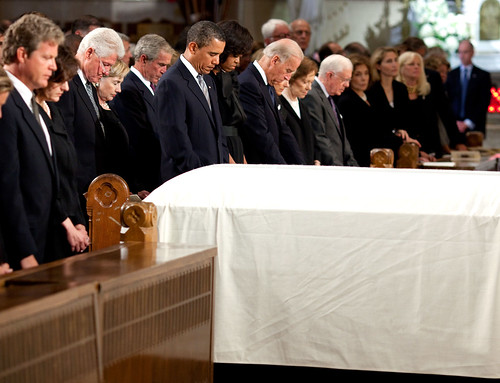
The white draped casket of Senator Edward Kennedy sits before (from left) the Senator's son Edward Kennedy Jr., his widow Vicki Kennedy, former President Bill Clinton, Secretary of State Hillary Clinton, former president George W. Bush, President Barack Obama and First Lady Michelle Obama, Vice President Joseph Biden and his wife Jill Biden, and former First Lady Rosalynn Carter and former President Jimmy Carter during funeral services at the Basilica of Our Lady of Perpetual Help in Boston, Mass. on Aug. 29, 2009.
As a youngster he didn’t have the grades to get into Harvard but his old man pulled strings to get him in. While he was there he paid a friend to take an exam for him and got caught and expelled. His first run for the Senate, which everyone called “JFK’s seat,” (as if it were the Kennedy’s by right), was interesting because he had no credentials to qualify for the job, which his opponent pointed out. Still, the bedazzled rubes, er, voters in Massachusetts went on to elect him anyway. Of course, we all know what happened in 1969. For anyone else, that would have been the end of one’s political career and would have no doubt required time in prison for at least manslaughter. Kennedy didn’t spend even an hour in jail. And the Massachusetts voters? They have continued to reward both his criminality, adultery, alcoholism and ineptitude ever since.
— Gigi
Pseudo-Capitalism = Redefinition of “meritocracy’” to = inherited wealth, which was most often accumulated based upon not merit, but corruption, taking advantage of a corrupt system, favortism/nepotism/connection, or luck.
And the silver-spoon-fed lecture the workers on “personal responsibility
The workers swallow the propaganda hook, line, and sinker, and therefore reject any “progressive” taxation, since it would “unfairly tax the rich,” for the common good.
And they call that…. democracy….
— Professor Dean Champion
24.8.09
on 401k
rg
Indiana
401k accounts are the greatest things to happen to corporations since corporate personhood. A 401k was never intended to be an individual's entire retirement savings; rather it was intended to help supplement an employer's pension plan and encourage individual saving towards retirement. But like most things corporate, and most things Wall Street, it was prostituted into subverting the defined benefits plan which used to be commonplace among businesses. Now, millions of Americans who would have otherwise been safely covered under defined pension plans are having to work longer or do without in their older years because the Reaganites and the corporatists managed to hoodwink them into believing that the market would safeguard them better in their retirements through 401k accounts. Hey, anybody out there still want to put Social security in the hands of the investment class, maybe Jim Cramer or Larry Kudlow? After our most recent economic debacle, any corporation, whether domestic or foreign, doing business in the U.S. and employing American workers, should be required by law to offer at least a base defined benefit pension plan and make the proper contributions to that plan very visibly every year. If the workers want to supplement it with a 401k, so much the better. But a 401k should never be primary, only supplemental. If a business doesn't have enough money to set aside for current and future retirees, then maybe it shouldn't be in business in the first place. Providing a pension should be part of the cost of doing business, no option.
Kate Madison
Depoe Bay, Oregon
How about those of us who have already retired, and find that our 401 Ks have been reduced by more than 25%--more like 40%! Add to that the impending reduction in social security and rising healthcare costs (yes, we get higher and higher premiums on our Medicare Advantage coverage every year)! That leaves those of us who are truly "middle income" up the proverbial creek!!!! It is easy to think about going back to work if you are 60 or even 65--but how about over 70 and partially disabled? We are caught in the middle of this dilemma, and there seem to be no answers--especially since the healthcare CEOs insist on taking home such extravagant pay--along with the rest of the psychopathic corporation executives! What a sick healthcare/financial system we have in America--the newest and most famous Third World Country~!
hh
California
Half my 401(k) was in "conservative" mutual funds, half in very low paying CDs. Have not lost a cent on the CDs. Have lost a lot on the supposedly "conservative" mutual funds, which changed their rules so they could invest in CDOs.
What bothers me deeply is that safe investments pay much less than they should, which forces people into the stock market, where their savings can either be nickle-and-dimed away through fees, or further depleted via big investors and their speed-trading programs. The game is rigged. Savers need a better option. The conventional wisdom about stocks being the best long term investment just isn't true any longer when the game is stacked so heavily against the small investor.
tc
washington
i have been contributing the maximum allowed (either as % of income or investment limit) on my 401k since i started working 13 years ago. following conventional wisdom, i invested in stock mutual funds: small & some large caps & international. then the dot com boom came and wiped out the gains and more, but i kept contributing, but this time into more conservative SP500 index funds. i was only just feeling good about my 401k when this latest stock market drop occurred. now i feel not even at square one because my 401k value is lower than my contributions and my employers' match. how discouraging... if 401k funds lose value with stock market drops and bond funds / savings accounts don't give enough gains to build a retirement on, and social security won't be around when i retire, what's a person to do?
j. johnson
vt
Anyone investing in American equities or debt, whether or not in a 401K, is a gambler, not an investor. All of the rules started to change last year. The losers were rewarded while the conservative investors were left to pay the bills. The President has set precedent in taking away the rights of secured bondholders. The only rule, now, is that the politically connected will be protected at taxpayer expense.
If you really expect things to get back to the 2005 version of " normal " , and for the rules on your 401K to remain stable, and for the American dollar to retain its value; you are living in pure fantasy or escapism.
Clyde Wynant
Pittsburgh, PA
The problem with 401K plans, indeed with any plan that puts the onus on the individual, is that they assume that all people are smart enough or motivated enough to make the right financial choices. Many are not. Many simply don't have the knowledge to invest wisely. Personally, I don't think we should punish them for that. They may be perfectly good fathers and mothers and workers, but perfectly horrid investors.
The loss of defined benefit plans has decimated an entire generation, my generation. When people ask my "when are you going to retire?" I have only one answer; never. I realize that's actually untrue, however, because I will, quite likely, be fired or downsized at some point. It will be cast as a "corporate decision," but I'll know it for what it really is, ageism.
And my now depleted 401K is low because I haven't been saving. The "real world" too often intercedes, by way of job losses and, as we've seen, the collapse of the Market. No one really saw it coming, but the truth is; what other choice did we have?
Mike
New York
PLEASE READ Alex Berenson's story in today's New York Times entitled, "Arrest Over Software Illuminates Wall Street Secret."
Goldman Sachs is making gazillions of dollars adding nothing to the world. It is simply gaming the system, trading milliseconds faster than others.
This is what the brilliance of private enterprise's most creative minds produces when allowed to function independent of morality.
We must acknowledge that at the heart of corporate greed is the fundamental nature of the corporation: ownership separated from management. Management has a license to behave immorally -- "We're duty bound to do what is in the best interests of our shareholders." Shareholders have a license to behave immorally -- "We're not running the show, we're just passive investors."
mhill29
California
I used to be editor of a business newspaper. The sole purpose of the 401(k)is to transfer money from your pockets to corporate pockets. The great stock market rise in the 1990s was due entirely to 401(k) funds floating the market. If you had looked at the P&E ratios, you'd would have seen none of the corporations were doing well. Studies in the '90s showed that you would have a better chance of raising retirement capital playing the craps table in Vegas than investing in a 401(k).
beaconps
PA
I have always been suspicious of the concept of a 401k although I contributed the max. The game is rigged by the Wall Street asset strippers. $01k savings was a huge pile of assets to strip. It is unclear how munch money pours into market every day, like an open faucet sourced from these automatic savings deduction plans. The market doesn't budge, analysts talk about this company or that company which would simply affect the distribution of money, not the total. Then Goldman reports another 100 million dollar trading DAY from shooting fish in a barrel.
There were old economists that felt that you can't save money, that money was temporary, that it decayed in worth and must be invested. Wall Street responded with instruments that we can invest in, but these instruments were not the investing considered by the old economists.
We have recently learned that value of a house is as permanent as a bushel of wheat. We are learning that the only money not perishable, buys, sells, and holds assets no longer than milliseconds. We have found that not all electrons are created equal, some arriving at targets faster than others; for a fee, of course.
on the significance of $9 trillion
the cumulative deficit projected over the next decade
Managing the debt will be tricky, but the real problem is how to deal with a politically unacceptable jobless recovery. It seems to me that we need two things:
1) A massive public/private infrastructure program insulated from political wants … perhaps something like the Rohatyn National Infrastructure Bank … to fill the demand gap.
2) Something other than tax cuts to rekindle “animal spirits” … perhaps an aggressive technological development program extending beyond clean technology, e.g. the “Internet of Things”, nanotechnology, organic electronics, atomic fusion, wireless power transmission,fuel producing bacteria and even space exploration.
— Sam Costanzo, Lovejoy GA
Federal debt is a problem. There is no ratioanlizing it or avoiding it. Ross Perot must be smiling a grim smile.
But it is true that it did not happen over night and we can eliminate it over time, actually relatively–relatively–painlessly if we do it properly. Politically it would be extemely difficult to pass, but the country would be solid for fifty years.
Over time, if we do nothing we will have an expanded GDP. We can reduce the federal debt to early post-Reagan numbers with some effort. We could do a number of things. For example:
We could decide whether we want to tax products coming in from forieign countries made by U.S. corporations, or establish a VAT tax.
We could raise the top rate, people with individual annual taxable incomes over $300,000 to 45% with a minimum of 29% after all deductions.
Third, we could simply also raise all income taxes by 5%. This means obviously that if you pay $20,000 per year, a fairly typical amount, you would pay $25,000. But if you are asking to top category to go up by about 7%, and a lot more money in actual dollars…which I would…then you must put some skin in the game.
Finally, we should regulate capital investment in a way that recapitalizes the system on a more regular basis. If we are capitalists then we are risk takers. If we are not, then we are something other than capitalists and we should modify the way with think of our free enterprise system.
If those who benefit from our financial system are not willing to reinvest in it, then we should begin to consider a different model, one more in the direction of the European systems, which are much more controlled and have much more cooperation between industry and government. If the investor class is not interested, then we should build a system in which the government participates in the generation of major industries.
I would prefer the former, but if I were in a position to push for it, I would not let many moons pass before I would insist on one or the other.
The one other thing I would do is start in 2010 to build our military from our needs for security. Zero-based budgeting. I would ask for a strategic justification for protecting Europe and Asia and military governments in Latin America. I would combine the Military and Homeland Security and make all of them one operation, including the NSA, CIA and FBI.
— Joseph O’Shaughnessy
Since the total “notational” value of “financial derivatives” is now $600 Trillion (can that really be right? That’s over ten times the combined GDP of every country on earth.), wouldn’t a simple tax of 1.5 percent on derivatives wipe out the entire national debt?
I mean what’s a measly 1.5 percent to Wall St. ?
If these pieces of paper, based on other pieces of paper, based on pieces of paper are really worth more than what every person on the world combined produces in a year, surely a tax of 0.015 couldn’t hurt?
Just asking.
— JimF
Ah, if only we were coming off an endeavor such as WW2 and the century’s major Depression to justify such debt. And if only there was in the nation a sense of cohesiveness and communal purpose to energize us. Alas, not the case. And alas, it appears most likely we won’t be dealing with this debt in a sane fashion.
Jon Jost
http://www.cinemaelectronica.wordpress.com
http://www.jonjost.wordpress.com
— Jon Jost
Additional debt is not a bad thing. It may be good or may be bad, depending on the state of the economy. If the Americans save too much or invest too little, new government spending (implying new government debt) is warranted to boost demand. This, at the same time, encourages investment.
If the federal debt grows, the creditors become wealthier. This increases their demand and renders new debt unnecessary. If you maintain full employment by government spending (or, perhaps even better, by adjusting taxes without regard to the public debt), the system is self-stabilizing.
The interest to be paid for public debt goes to the creditors. It is not lost, it generates additional income and expenditure–another route for self-stabilization. Further, the taxes required to offset interest payments in a growing economy will always be less than the interest payments themselves, as a larger public debt that keeps growing at the same rate as the economy grows (implying a constant fraction of debt to income) implies a larger new debt.
For a technical analysis see
http://epub.ub.uni-muenchen.de/2143/2/schlicht-public-debt-13-RP.pdf
— Ekkehart Schlicht
Yeah right, this figure conveniently ignores debt service which is a matter or confidence. When no one believes you can repay expect the short end of the curb that needs to be rolled over to cost double or triple due to interest rate spikes. Debt to GDP is one thing, service payments as a % of total budget figures is quite another.
— Mark
Unfortunately, that’s not the case; 9 trillion dollars in debt is greater then the current gross domestic product; you see, when inflation happens, it devalues the inidivudal currency significantly; simply put the worse inflation is, the worse things are for the poor, and the more the governments spends for less effect. A 9 trillion dollar debt, with the rising rate of inflation would put the United States goverment farther into debt then it’s ever been in it’s history; and the inflation isn’t 2% right now; it’s about 35%, again, probably the worst it’s been in quite awhile.
Simply put, not only is the current rate of inflation and government spending not sustainable… The programs allegedly being created to help the poor to justify it will end up harming them more then ever. The average tax burden on the poor and middle class (especially the middle class, who by themselves pay 93% of the taxes in the US despite only having roughly 40% of the income) are really going to be hurt, if the trend continues.
If people want to help the poor, and help the economy, the solution’s pretty simple. Stop spending. The average middle class American right now puts in 7350 dollars a year just in property taxes. there are people who, as hard as this may be to believe, receive less then that a year from government welfare programs. Time and time again, when the spending increases, the money used for doing everything but generating debt decreases.
— Aaron
A) If it is “possible to deal with” don’t look at Italy, Greece or Japan for a solution. As far as I can see, they are not dealing with it, but just kicking the can down the road. They have been quite successful at it these last 20 years, but only with the full wind of the global credit bubble flowing on their back. Now that USA destroys demand instead of creating it, things are not going to be that easy.
B) Things were “dealt with” at the end of WW2 through a very nasty bout of negative interest rates, and practically all significant USA competitors for industrial goods having their production capacity eradicated by war damages (with, incidentally, close to 0% recovery for Germany and Japan Govt. Bonds in real terms). THIS was the recipe for bringing Debt to GDP ratio from 120% to 60% in 10 years.
One's job is to find a roadmap that is better than the WW2 plan. Good luck with that ! By the way, hoping for 2.5% GDP growth for 10 years is more than a bit delusional, check Japan’s trajectory…
— Charles Monneron
70% of the GDP sum is consumption. So only 30% of the GDP generates any wealth, unless I am missing something?
Not to mention the unfunded liabilities of around $ 60 trillion and well as the fact that the $9 trillion needs to be added on to this plus the existing national debt of around $12 trillion. So in 10 years’ time the deficit will be getting on for $100 trillion (the way we are going).
But never mind those trivialities, I will try and demonstrate how big a number $9 trillion is.
* If you had $100 for every human who has ever walked the earth you’d have around $9 trillion
* It would take 5,000 lifetimes just to count to 9 trillion
* If you piled 9 trillion dollar bills on top of each other you’d have a stack 650,000 miles high (nearly three times further than the moon)
Hope that helps!
— Nick Thomas
At the end of World War II, the manufacturing capacities of Europe and Japan were significantly reduced by the war, and China and India were not competitive at that time. Much of the US manufacturing capacity had been producing war products for many years: almost no cars had been produced. This created consumer demand
All of this left the US in a position unequaled in world history in our ability to manufacture consumer products without competition. The government sent all GIs that wanted a college degree to college for free and provided a working class that was unequaled in the world.
The situation is reversed now. We have an oversize financial system that is too large a percentage of GDP, college that is too expensive, tremendous competition from Asia and a very small manufacturing component of GDP.
The government debt on top of personal and corporate debt, unlike the situation after WW2 will be impossible to pay back.
— Eric Neikrug
I think a mixed economy would help this situation. If we were to remove the profit motive, (i.e., nationalize), certain sectors of the economy that are out of control, like the so-called “defense” industry, oil industry, and transportation, costs could be lowered, and there would be a return on the public investment. This is not to be confused with handing several trillion dollars to Wall Street. Why the latter is considered acceptable but the former is not is a testament to the manipulation of public opinion by Big Capital. We need fundamental change in our approach to governance. Bring back the Sherman Anti-Trust Act, the Fairness Doctrine, an SEC with some teeth, and quit letting Big Capital and the wacko right-wing control the conversation.
— Doug Harvey
The world economy crashed in July 2008 when oil prices spiked at $150. The world economy will sputter at the existing $70 and crash again with the next spike to $150. World growth for past 100 years has averaged 3% with oil prices averaging $20 in 2008 dollars. There will be no world economic growth until there is an energy source to power it. There is not enough oil production capacity now to even power the 2008 demand level and that capacity is now shrinking Solar and Biomass must replace Coal and Oil before humans on this Earth can resume technical progress and economic growth all historically powered by cheap oil.
We can talk about all the other “important issues” forever and the world will just spiral into the next dark ages. The only thing that matters now is a new energy source.
— Jet
self interest & the healthcare debate
Paul M Coopersmith
Inverness, California
The longer this debate about health care "reform" continues along the lines it's been going, the more embarrassing it becomes to be an American. The rest of the developed world looks at us and shakes their heads in disbelief, astonished at what fools we are. Voting against our own best interests, over and over again!
I never thought I'd say it. But now I will. Ralph Nader had a point in the 2000 election. Democrat or Republican, all we seem to get is same old, same old.
marik7
wailiku, hi
Unfortunately, the middle class does not pay much attention to its own economic welfare when the government is involved.
The middle class would rather see the rich get richer while the middle class stagnates than actually follow economic statistical fluctuations.
That is the nail Reagan hit on the head.: the desire for ignorance found in the American middle class.
Mitch Gitman
Seattle
As much as I fear the Democrats are susceptible to Reaganism, my greater fear with health insurance reform is Emanuelism. As in Rahm Emanuel.
I fear that political calculation will win the day over a holistic, sophisticated understanding of what does and doesn't work, and Obama and the Democrats will cave and settle for health insurance reform without the public option or its equivalent.
Yes, it would still be "the greatest progressive legislative accomplishment in four decades," to use Matthew Yglesias's description in "The Daily Beast." But just to compare, you could also describe convincing Congress and the American people to go to war in Iraq as the neo-conservatives' greatest political accomplishment ever, and how did that work out? We followed the Rumsfeld doctrine of just enough troops to lose, and the neo-cons' great victory became their great defeat.
Democrats, don't repeat that mistake. Health insurance reform without stiff competition for the private insurers will be just enough reform to lose. And in a few years as costs continue to spiral for lack of a real marketplace, the Obama administration will learn the political costs (not to mention the dollar costs) of taking the politically expedient route.
Dan Bosko
New York, NY
The best argument for the public option is that private insurers are rabidly opposed to it. What does that tell us? We can be sure that their opposition to it is not based on a love for their customers. Rather, it is that they want to maintain their monopolistic stranglehold over us. They are, after all, entities that refuse coverage to those with preexisting conditions. Heaven forbid that customers might have elsewhere to go in a health care-reformed America.
Efforts for reform have just received an unfortunate blow from Senator Joe Lieberman, who considers a recessionary period a poor time to enact health care change. Though I never trusted his motives, now I doubt his intelligence as well. Does he not understand that the fiasco which passes for health care in this country is one of the major factors in our economic torpor? Apparently not.
And one final point. For health insurance to work, everyone needs to buy into it. Imagine if Social Security were optional. Just think if, having calculated that you wouldn't be needing it down the line, you could opt out of your payroll tax. Where would that leave the system that most Americans have come to rely upon in their senior years? It would leave it in the same mess that health care has found itself in, without doubt.
Stan D.
Salt Spring Island, BC
Could it be that as of now not enough Americans have reached the level of suffering that would compel serious action for change?
19.8.09
On the recent US vs. Swiss/UBS tax evasion scandal
Greenpoplar
New York, NY
We don't negotiate with self proclaimed "terrorists", but we do with tax evading crooks? Outrageous! It's people like this who corrupt the world and bring it to its knees. Terrorists are mere reactions to these criminals' selfish doings all over the globe.
Nelson Alexander
New York City
Americans' must get used to the idea that, yes, we do have a class society. The Swiss bank account is one clear indication. Even in the High Middle Ages, nobles insisted that they did not have to pay taxes. The attitude held for the American upper class in the Gilded Age. Today the U.S. plutocratic class still considers taxes an injustice, since they can live in several countries and do not require most public services, such as public schools or commercial airlines.
Unfortunately, the concept of class struggle has been so distorted in the U.S. that is is now employed primarily by the right wing, such as commenter no. 25. Through sheer repetition, the right wing has linked "rich" and "liberal" through classic behavioral conditioning. I hope this UBS investigation will eventually get around to former Senator and UBS director Phil Gramm. Hard to believe he wasn't into this up to his shifty eyeballs.
Arlington, VA
Invading privacy, painting tens of thousands of Americans guilty until proven innocent, imposing upon another nation's sovereignty and primary industry, and all for political purposes. And this is OK?
It will generate some great press releases and conferences as the IRS and administration can point to more scapegoats from the rich, but this will not generate a lot of revenue.
Of course, this is being addressed primarily and it appears entirely a political matter. There is no discussion in analyzing what is driving so many Americans to set up off-shore accounts or what will be the future consequences affecting future revenues.
Let's not forget that the wealthy pay a vast majority of all taxes in the United States. If the government is going to be so determined to increased their tax burden and go to such great lengths to make sure that they pay all of it, lets not forget all of this is paying for programs and services that they decreasingly benefit from, are all of these individuals going to sit idly bye and happily pay more and get shoved around by the government ensuring that they do?
If I had the wealth and means to protect my property from it being squandered by politicians, I would seriously consider doing so and without remorse because I am confident that I would be investing and allocating my money and property much more efficiently and effectively than the government. Property is the right of the individual, not the government.
I'm sorry, but the best incentive to decrease tax avoidance is to lower taxes and ensure that tax dollars are spent wisely and efficiently. Unfortunately, it is much easier to raise taxes on the rich while persecuting and prosecuting them.
I don't see how this improves anything. This course of action is going create more incentives for those with the means to move themselves and their property out of the country. Why would they want to stick around to finance the bulk of government operations while that same government confiscates more and more income meanwhile persecuting you for being wealthy enough to pay so much to begin with?
Garth
RI
This nonsense of the Swiss providing legal cover for their money laundering operations needs to end forcefully. In a global modern world where the wealthy oligarchs are impoverishing the world's citizens as they create a new feudal economic order, these bastions of deception and deceit must be torn down and destroyed.
Kindame
Oslo, Norway
Great news this is. Switzerland bank secrecy is nothing but immoral; the holocaust victims gold and cash deposits, the horrible dictators from the most needy countires' hauls and rich folks dodging their responsibilities to contribute in societies where they've made their wealth.
This also seems to be a country that wants to profit from the world without being part of it; parasitic. Their hype about protecting banking secrecy is nothing but a front for money laundering of looted riches and I hope their banks and businesses can be given the choice of either joining the rest of the world or burying what they've already looted in their freezing cold alpine bunkers.
Not even sure whether they are in the UN; and why are many UN agencies headquatered in their cities and generating all the money for a people that are skeptical of being part of the world.
Stephan Loeb
Basel, Switzerland
First of all, shame on the NYT for such sloppy journalism: This is not about a settlement between UBS and the IRS. This is about an agreement between the Swiss and the US governments. The consequences of the agreement are:
- The civil case filed by the justice department on behalf of the IRS will be closed.
- Based on certain non-disclosed criterions defined in the treaty UBS will hand over information about 4450 US bank clients to the Swiss financial department
The US will respect Swiss law and therefore use the foreseen legal procedure that is the US justice department will request legal assistance from the Swiss government
- In the treaty the Swiss government promises to process the 4450 accounts within a year, but only and exclusively within the Swiss legal framework. This means that all 4450 US clients can sue against the final decision of the Swiss financial department at the Federal Administrative Court ("Bundesverwaltungsgericht").
For folks who want to understand what this is about:
http://www.admin.ch...
http://www.ejpd.admin.ch...
R. P.
Zurich
This is not necessarily about tax avoidance by US citizens; this is about the Swiss constitution, where the freedom rights of the individual are second to none.
Of course, some people or companies (Swiss and foreign) misuse the Swiss freedom rights. But that's the price the Swiss society is willing to pay for the freedom rights of the individual.
Swiss Government Agencies are not powered with intrusive rights - as long as there is no clear evidence of criminal activity going on.
Presumably this kind of constitution only works well in a small democratic country. But I guess it would be mind-blowing for many Americans to come over and see how a truly democratic society works. And if more Americans felt secure and content in their country, there would be less temptation to misuse foreign systems as a personal tax avoidance scheme.
New York, NY
We don't negotiate with self proclaimed "terrorists", but we do with tax evading crooks? Outrageous! It's people like this who corrupt the world and bring it to its knees. Terrorists are mere reactions to these criminals' selfish doings all over the globe.
Nelson Alexander
New York City
Americans' must get used to the idea that, yes, we do have a class society. The Swiss bank account is one clear indication. Even in the High Middle Ages, nobles insisted that they did not have to pay taxes. The attitude held for the American upper class in the Gilded Age. Today the U.S. plutocratic class still considers taxes an injustice, since they can live in several countries and do not require most public services, such as public schools or commercial airlines.
Unfortunately, the concept of class struggle has been so distorted in the U.S. that is is now employed primarily by the right wing, such as commenter no. 25. Through sheer repetition, the right wing has linked "rich" and "liberal" through classic behavioral conditioning. I hope this UBS investigation will eventually get around to former Senator and UBS director Phil Gramm. Hard to believe he wasn't into this up to his shifty eyeballs.
Commenter #25: JD, Pottwtown, PaTodd
Lot's of rich Liberal folks in the NE and California who voted for this administration because of guilt feelings will now be sorry when their names are plastered in the public.
Arlington, VA
Invading privacy, painting tens of thousands of Americans guilty until proven innocent, imposing upon another nation's sovereignty and primary industry, and all for political purposes. And this is OK?
It will generate some great press releases and conferences as the IRS and administration can point to more scapegoats from the rich, but this will not generate a lot of revenue.
Of course, this is being addressed primarily and it appears entirely a political matter. There is no discussion in analyzing what is driving so many Americans to set up off-shore accounts or what will be the future consequences affecting future revenues.
Let's not forget that the wealthy pay a vast majority of all taxes in the United States. If the government is going to be so determined to increased their tax burden and go to such great lengths to make sure that they pay all of it, lets not forget all of this is paying for programs and services that they decreasingly benefit from, are all of these individuals going to sit idly bye and happily pay more and get shoved around by the government ensuring that they do?
If I had the wealth and means to protect my property from it being squandered by politicians, I would seriously consider doing so and without remorse because I am confident that I would be investing and allocating my money and property much more efficiently and effectively than the government. Property is the right of the individual, not the government.
I'm sorry, but the best incentive to decrease tax avoidance is to lower taxes and ensure that tax dollars are spent wisely and efficiently. Unfortunately, it is much easier to raise taxes on the rich while persecuting and prosecuting them.
I don't see how this improves anything. This course of action is going create more incentives for those with the means to move themselves and their property out of the country. Why would they want to stick around to finance the bulk of government operations while that same government confiscates more and more income meanwhile persecuting you for being wealthy enough to pay so much to begin with?
Garth
RI
This nonsense of the Swiss providing legal cover for their money laundering operations needs to end forcefully. In a global modern world where the wealthy oligarchs are impoverishing the world's citizens as they create a new feudal economic order, these bastions of deception and deceit must be torn down and destroyed.
Kindame
Oslo, Norway
Great news this is. Switzerland bank secrecy is nothing but immoral; the holocaust victims gold and cash deposits, the horrible dictators from the most needy countires' hauls and rich folks dodging their responsibilities to contribute in societies where they've made their wealth.
This also seems to be a country that wants to profit from the world without being part of it; parasitic. Their hype about protecting banking secrecy is nothing but a front for money laundering of looted riches and I hope their banks and businesses can be given the choice of either joining the rest of the world or burying what they've already looted in their freezing cold alpine bunkers.
Not even sure whether they are in the UN; and why are many UN agencies headquatered in their cities and generating all the money for a people that are skeptical of being part of the world.
Stephan Loeb
Basel, Switzerland
First of all, shame on the NYT for such sloppy journalism: This is not about a settlement between UBS and the IRS. This is about an agreement between the Swiss and the US governments. The consequences of the agreement are:
- The civil case filed by the justice department on behalf of the IRS will be closed.
- Based on certain non-disclosed criterions defined in the treaty UBS will hand over information about 4450 US bank clients to the Swiss financial department
The US will respect Swiss law and therefore use the foreseen legal procedure that is the US justice department will request legal assistance from the Swiss government
- In the treaty the Swiss government promises to process the 4450 accounts within a year, but only and exclusively within the Swiss legal framework. This means that all 4450 US clients can sue against the final decision of the Swiss financial department at the Federal Administrative Court ("Bundesverwaltungsgericht").
For folks who want to understand what this is about:
http://www.admin.ch...
http://www.ejpd.admin.ch...
R. P.
Zurich
This is not necessarily about tax avoidance by US citizens; this is about the Swiss constitution, where the freedom rights of the individual are second to none.
Of course, some people or companies (Swiss and foreign) misuse the Swiss freedom rights. But that's the price the Swiss society is willing to pay for the freedom rights of the individual.
Swiss Government Agencies are not powered with intrusive rights - as long as there is no clear evidence of criminal activity going on.
Presumably this kind of constitution only works well in a small democratic country. But I guess it would be mind-blowing for many Americans to come over and see how a truly democratic society works. And if more Americans felt secure and content in their country, there would be less temptation to misuse foreign systems as a personal tax avoidance scheme.
13.8.09
Anna
New York
How can one live in a society of such monumental corruption? Children are drugged to death for profit, adolescents are thrown into prisons for profit, the adults are enslaved and/or thrown literally into the streets for profit, the elderly are tortured to death for profit, etc.
We must, must, must bring back history. Teach history of mankind; teach history of societies; teach history of uses and abuses of religion, science, art; teach history of demagoguery, teach history of exploitation.
No, teaching elementary school students how to write manipulative memos and how to worship the Trumps of the world isn't education - it's manipulation. Bring back history and all other disciplines - geography, mathematics, physics, chemistry, biology etc. and start a real education, not creation of corporate zombies.
American psychobabbling "we teach how to think" (sure, soooo many thinkers around) and replaced with solid education.
We hit the bottom.
How else to deal with the opponents of healthcare reform?

President Barack Obama feigns a punch while talking about health care reform with Nancy-Ann DeParle, Peter Orszag, Phil Schiliro and Larry Summers in the Outer Oval Office, July 13, 2008
9.8.09
more angles into the healthcare debate
“AUGUST is a challenging time to be president,” said Andrew Card, the former Bush White House chief of staff, as he offered unsolicited advice to his successors in a television interview last week. “I think you have to expect the unexpected.”
He should know. Thursday was the eighth anniversary of “Bin Laden Determined to Strike in U.S.,” the President’s Daily Brief that his boss ignored while on vacation in Crawford. Aug. 29 marks the fourth anniversary of Hurricane Katrina’s strike on the Louisiana coast, which his boss also ignored while on vacation in Crawford.
So do have a blast in Martha’s Vineyard, President Obama.
Even as we wait for some unexpected disaster to strike, Beltway omens for the current White House are grim. Obama’s poll numbers are approaching free fall, we are told. If he fails on health care, he’s toast. Indeed, many of the bloviators who spot a fatal swoon in the Obama presidency are the same doomsayers who in August 2008 were predicting his Election Day defeat because he couldn’t “close the deal” and clear the 50 percent mark in matchups with John McCain.
Here are two not very daring predictions: Obama will get some kind of health care reform done come fall. His poll numbers will not crater any time soon.
Yet there is real reason for longer-term worry in the form of a persistent, anecdotal drift toward disillusionment among some of the president’s supporters. And not merely those on the left. This concern was perhaps best articulated by an Obama voter, a real estate agent in Virginia, featured on the front page of The Washington Post last week. “Nothing’s changed for the common guy,” she said. “I feel like I’ve been punked.” She cited in particular the billions of dollars in bailouts given to banks that still “act like they’re broke.”
But this mood isn’t just about the banks, Public Enemy No. 1. What the Great Recession has crystallized is a larger syndrome that Obama tapped into during the campaign. It’s the sinking sensation that the American game is rigged — that, as the president typically put it a month after his inauguration, the system is in hock to “the interests of powerful lobbyists or the wealthiest few” who have “run Washington far too long.” He promised to smite them.
No president can do that alone, let alone in six months. To make Obama’s goal more quixotic, the ailment that he diagnosed is far bigger than Washington and often beyond politics’ domain. What disturbs Americans of all ideological persuasions is the fear that almost everything, not just government, is fixed or manipulated by some powerful hidden hand, from commercial transactions as trivial as the sales of prime concert tickets to cultural forces as pervasive as the news media.
It’s a cynicism confirmed almost daily by events. Last week Brian Stelter of The Times reported that the corporate bosses of MSNBC and Fox News, Jeffrey Immelt of General Electric and Rupert Murdoch of News Corporation, had sanctioned their lieutenants to broker what a G.E. spokesman called a new “level of civility” between their brawling cable stars, Keith Olbermann and Bill O’Reilly. A Fox spokesman later confirmed to Howard Kurtz of The Post that “there was an agreement” at least at the corporate level. Olbermann said he was a “party to no deal,” and in any event what looked like a temporary truce ended after The Times article was published. But the whole scrape only fed legitimate suspicions on the right and left alike that even their loudest public voices can be silenced if the business interests of the real American elite decree it.
You might wonder whether networks could some day cut out the middlemen — anchors — and just put covert lobbyists and publicists on the air to deliver the news. Actually, that has already happened. The most notorious example was the flock of retired military officers who served as television “news analysts” during the Iraq war while clandestinely lobbying for defense contractors eager to sell their costly wares to the Pentagon.
The revelation of that scandal did not end the practice. Last week MSNBC had to apologize for deploying the former Newsweek writer Richard Wolffe as a substitute host for Olbermann without mentioning his new career as a corporate flack. Wolffe might still be anchoring on MSNBC if the blogger Glenn Greenwald hadn’t called attention to his day job. MSNBC assured its viewers that there were no conflicts of interest, but we must take that on faith, since we still don’t know which clients Wolffe represents as a senior strategist for his firm, Public Strategies, whose chief executive is the former Bush White House spin artist, Dan Bartlett.
Let’s presume that Wolffe’s clients do not include the corporate interests with billions at stake in MSNBC and Washington’s Topic A, the health care debate. If so, he’s about the only player in the political-corporate culture who’s not riding that gravy train.
As Democrats have pointed out, the angry hecklers disrupting town-hall meetings convened by members of Congress are not always ordinary citizens engaging in spontaneous grass-roots protests or even G.O.P. operatives, but proxies for corporate lobbyists. One group facilitating the screamers is FreedomWorks, which is run by the former Congressman Dick Armey, now a lobbyist at the DLA Piper law firm. Medicines Company, a global pharmaceutical business, has paid DLA Piper more than $6 million in lobbying fees in the five years Armey has worked there.
But the Democratic members of Congress those hecklers assailed can hardly claim the moral high ground. Their ties to health care interests are merely more discreet and insidious. As Congressional Quarterly reported last week, industry groups contributed almost $1.8 million in the first six months of 2009 alone to the 18 House members of both parties supervising health care reform, Nancy Pelosi and Steny Hoyer among them.
Then there are the 52 conservative Blue Dog Democrats, who have balked at the public option for health insurance. Their cash intake from insurers and drug companies outpaces their Democratic peers by an average of 25 percent, according to The Post. And let’s not forget the Democratic Senate Campaign Committee, which has raked in nearly $500,000 from a single doctor-owned hospital in McAllen, Tex. — the very one that Obama has cited as a symbol of runaway medical costs ever since it was profiled in The New Yorker this spring.
In this maze of powerful moneyed interests, it’s not clear who any American in either party should or could root for. The bipartisan nature of the beast can be encapsulated by the remarkable progress of Billy Tauzin, the former Louisiana congressman. Tauzin was a founding member of the Blue Dog Democrats in 1994. A year later, he bolted to the Republicans. Now he is chief of PhRMA, the biggest pharmaceutical trade group. In the 2008 campaign, Obama ran a television ad pillorying Tauzin for his role in preventing Medicare from negotiating for lower drug prices. Last week The Los Angeles Times reported — and The New York Times confirmed — that Tauzin, an active player in White House health care negotiations, had secured a behind-closed-doors flip-flop, enlisting the administration to push for continued protection of drug prices. Now we know why the president has ducked his campaign pledge to broadcast such negotiations on C-Span.
The making of legislative sausage is never pretty. The White House has to give to get. But the cynicism being whipped up among voters is justified. Unlike Hillary Clinton, whose chief presidential campaign strategist unapologetically did double duty as a high-powered corporate flack, Obama promised change we could actually believe in.
His first questionable post-victory step was to assemble an old boys’ club of Robert Rubin protégés and Goldman-Citi alumni as the White House economic team, including a Treasury secretary, Timothy Geithner, who failed in his watchdog role at the New York Fed as Wall Street’s latest bubble first inflated and then burst. The questions about Geithner’s role in adjudicating the subsequent bailouts aren’t going away, and neither is the angry public sense that the fix is still in. We just learned that nine of those bailed-out banks — which in total received $175 billion of taxpayers’ money, but as yet have repaid only $50 billion — are awarding a total of $32.6 billion in bonuses for 2009.
It’s in this context that Obama can’t afford a defeat on health care. A bill will pass in a Democrat-controlled Congress. What matters is what’s in it. The final result will be a CAT scan of those powerful Washington interests he campaigned against, revealing which have been removed from the body politic (or at least reduced) and which continue to metastasize. The Wall Street regulatory reform package Obama pushes through, or doesn’t, may render even more of a verdict on his success in changing the system he sought the White House to reform.
The best political news for the president remains the Republicans. It’s a measure of how out of touch G.O.P. leaders like Mitch McConnell and John Boehner are that they keep trying to scare voters by calling Obama a socialist. They have it backward. The larger fear is that Obama might be just another corporatist, punking voters much as the Republicans do when they claim to be all for the common guy. If anything, the most unexpected — and challenging — event that could rock the White House this August would be if the opposition actually woke up.
Readers' comments:
Charles
MA
Frank, I think you try too hard to characterize Washington as a giant sausage factory. There are actually some solid facts available on which to base rational health care reform, but Obama, Sibelius, Baucus and his Gang of Six, and others are consciously misleading the American people about the choices we actually have.If you do a little research or live abroad for a while, it is crystal clear that some form of single-payer health care coverage is the dominant direction in the economically advanced nations. There is no doubt about it, and the record shows that single-payer systems save money and provide better coverage for ordinary citizens. The US system is excellent if you are in the top income brackets, but third-world-like for the rest of us. Places like the Mayo Clinic, praised as one model for reform by the New Yorker article, are great...if you have the money. The Mayo Clinic doesn't take medicare or other public coverage schemes, and even Sen. Baucus had to pay out of his own pocket for his treatment there.
The choice is stark. Either we continue a for-profit health care system whose costs are growing so quickly that Obama is reduced to talking about shaving a small margin off the rate of cost *increase* or we show guts and choose serious health-care reform. As other nations around the world have shown, single-payer coverage works and if done well can be very simple and flexible, allowing greater patient freedom.
Frank, why do you continue the near-blackout on serious discussion of single-payer systems in the mainstream media? You are adding to the confusion and ignorance about single-payer and thereby contributing only to the nihilistic meat-grinder theory of American politics. A lot of us who supported Obama's initial health care statements are fed up with his avoidance of the "inconvenient truth" that single-payer works. Even if single-payer has to be implemented incrementally in the US, its principles and track record must be discussed seriously, not demonized.
Just passing a bill labeled "Health Reform" is not acceptable. If the bill does not have a robust public option that gives all Americans, not simply those with no insurance, a choice between public and private coverage, then it should be defeated. We have a moral duty to extend coverage to all Americans, but if the "reform" contains no public option which could be built on later and expanded into a wider single-payer coverage system, the bill will be a Trojan Horse that will simply strengthen the stranglehold of the private health insurance system, which will always put profit before people and will never bring costs seriously under control.
Frank, please take a stand and tell us your view about whether a health care reform bill without a robust public option -- and such a bill is a real possibility -- would be worth passing or whether it should be defeated and the whole effort restarted and done right later.
7.8.09
A call to Democrats in reply to the protests against Obama's healthcare plan
Ehkzu
Palo Alto, California
My fellow Democrats: We're in for the fight of our lives. I know more about what we're up against than most Democrats, because I'm married to a staunch Republican, attend a church that's 90+% Republican, and have many friends among them. I'm also a sociologist by training and a debater by practice.
Based on all this, here's some heartfelt advice:
1. Don't call them racists.
It's a Rovian trap to do so--one set by the Republican leadership and their healthcare denial industry paymasters. They never, ever say "We hate Obama because he's black," even if everything they do would make it reasonable to think so.
But when you call them racists, you've just changed the topic from healthcare reform to a territory they can defend. And while you're trying to prove they're racists, the RNC will be rubbing its hands, as the topic of healthcare is forgotten.
2. Don't let them call Obama and the Democratic Party and you socialists.
And they will. Count on it. I usually say: "Socialism means ownership of business by government. Democrats don't want to own it. We just want to regulate it. We tried business without regulation twice in the last century. It got us the Great Depression and now the worst recession since that. But help me out. Republicans seem to want ownership of government by business. What do you call that?"
And as Krugman points out, they don't want "socialized healthcare" but they're often on Medicare.
The other advanced countries--all democracies--have everything ranging from heavily regulated private systems to mostly socialized ones. All of them are far cheaper than our system; all of them have better health outcomes than our system. And not one of those countries' electorates have ever shown the slightest interest in adopting our system.
Guess why? They don't want to die while some for-profit insurance company denies your request for a new kidney, hoping that if they slow-foot your claim you will in fact die before they're forced to honor it.
And by the way...cops and firemen are "socialized safety."
3. They'll say most Americans are happy with their current healthcare.
I say wait 'till you or a loved one gets really sick. After all, if you ran a health insurance company, and your only goal was profit, what would you do when a customer got really, really sick?
You'd get rid of him, using your army of bureaucrats whose main job is to find excuses for recission--that's cutting off someone's insurance by saying you didn't dot an "i" somewhere on your application.
That's why I call these companies the "Healthcare denial industry." Very few people who've actually had catastrophic illness are happy with their healthcare insurance. And even those who say they're happy may not have noticed how their healthcare premiums have doubled in the last few years, because it's why you didn't get a raise--it's often hidden in your overall compensation.
4. They'll say they don't want the government telling them when to die, and as Krugman points out, even Republican congressmen are saying this.
People this far gone can rarely be reached, but I just say "The people you think are on your side are actually vampires sucking your blood; the people you think are out to destroy you and America are actually trying to save you--and you're throwing away the life vest they've thrown you because the predators pretending to be your friends told you it's a bomb."
Bottom line: the Republican healthcare plan is the alternative to the Democrats' attempt at healthcare reform. What's that plan, you say? Easy. It's the healthcare reform plan Congress passed during the 12 years the Republican Party controlled Congress and the six years it controlled all three branches of government:
[nothing]
That's right, folks. That's their healthcare reform package. Nothing. Excuse me if I don't include their pharmaceutical industry giveaway that masqueraded as Medicare drug assistance. Other than that phony plan that ordered government agencies to pay whatever price the drug companies chose to charge...nothing.
The healthcare denial industry has grown to swallow up 1/6 of the entire American economy, gutting our competitiveness on the world market, through keeping things exactly as they are. Without healthcare reform the current system will take up 1/3 of the entire economy in a few years.
It's unsustainable. You think Medicare and Social Security are headed for trouble? That's nothing compared to this.
Most of all, the Republicans want their rank and file to think we Democrats are their enemy; that we want to turn America into some alien place they won't recognize.
And they want Democrats to treat Republican rank and file as their enemy, so we'll never realize we both have the same enemy: the bloodsucking billionaires who pull the strings in the shadows. They're practicing divide and conquer. And they're very, very good at it.
So remember who the real enemy is.
http://www.blogzu.blogspot.com
6.8.09
on rent seekers
Radio Free America
By NANCY SINATRA
Los Angeles
WHEN I hear great American standards on the radio, I think of all the songwriters, artists and musicians whom my father, brother and I have worked with over the years. It reminds me that every recording has two parts, the composition and the performance. It also reminds me how many wonderful artists and musicians have not been paid fairly for their work.
Songwriters and publishers are paid when their tunes are played on the radio, but none of the artists or musicians who bring the music to life receive even a penny. The Senate Judiciary Committee is holding a hearing today on legislation that will right this wrong, which dates back to the early days of sound recordings.
My father, Frank Sinatra, and singers like Tony Bennett, Bing Crosby and Perry Como fought for years for performance royalties from radio stations, arguing it was unfair that performers are not paid and citing cases like Helen Forrest that show the harsh side of this injustice.
Helen was one of the most gifted singers of the 1940s. Known as the “Voice of the Name Bands,” she had hits like “I Cried for You” and “I Had the Craziest Dream.” Sadly, Helen spent her last years practically destitute because she received nothing when her songs were played on the radio.
This fight isn’t just about featured artists. There are thousands of background singers and session musicians who deserve to be paid for their work, too.
Radio station owners argue that artists receive free promotion from airplay of their records. This is simply untrue. Most of the music played on AM and FM radio is at least two years old. And the practice of “backselling” — mentioning the name and performer of the song that was just played — has fallen into such disuse that a decade ago the nation’s largest radio station operator, Clear Channel, asked for $24,000 per title to mention the song’s artists on the air. It’s no surprise that companies unwilling to even recognize artists on the air would also be averse to paying performance royalties.
Terrestrial radio is the only radio platform that still doesn’t have to pay these royalties. Internet radio and satellite radio pay artists when they play their records, so do cable television music channels. In fact, AM and FM radio stations that stream their signal online pay performance royalties.
The United States is one of a small number of countries where artists and musicians are not compensated when their music is played on over-the-air radio. Because the United States doesn’t have performance royalties, radio stations in countries that do collect them do not have to pay American artists. In many of these countries, American artists make up as much as 50 percent of radio airplay, and this prevents millions of dollars — industry estimates are $100 million a year — from flowing into our economy.
I believe in a performance royalty because recording artists and musicians from every generation deserve to be compensated for their art.
My father became an icon by putting his inimitable stamp on songs from “My Funny Valentine” to “My Way” and “Come Fly With Me.” When he sings, “Weatherwise it’s such a lovely day” in “Come Fly With Me,” he lingers on the word “lovely,” and you can actually imagine yourself floating in a blue sky on a lovely day.
He brought music to life with his own style just as every artist does when he takes notes and words on a page and sings or plays them in his own way. Singers and musicians, as much as songwriters, create something when they perform — and we should make sure all artists are paid when their creations are heard on the radio.
Nancy Sinatra is a singer.
Reader comments:
squibs
Cleveland, OH
Here's an idea, Nancy. Make radio stations pay you "performance royalties" and then do all your concerts and give away all your records for free!
Airplay IS---and always has been-- promotion for the more lucrative endeavors of record sales and live performances. Your father, as I recall, did not die a poor man. And that was to a large extent because his music was heard on the radio.
As a "one-hit wonder" Nancy, I realize you'd like to squeeze a little more coin out of "Boots." But most artists would rather get airplay to sell CDs and concert tickets than a dime every time one of their songs are played.
OldStone50
Stratford, NH
"[...] how many wonderful artists and musicians have not been paid fairly for their work."
What, exactly constitutes "fair" payment? I helped build a unique house once. I even had a part in its design. Without my contribution, it would not have been the unique structure that it is today. Is it, then, "fair" that I am not paid every time a new resident - or even guest - enters the house? What if a magazine should publish a picture of the house? Should I receive a royalty?
I do know we feel we underpay artistry in our culture, but I am entirely unconvinced that the intellectual property model currently used - and advocated by some as "fair" - is appropriate. I do appreciate how attractive it might be to continue to receive payments for work years or decades after the work was completed, but that model is suggestive of a worker who has become parasitic on society. Rather than demand the continuation and extension of the current and rather extortionist model, we should be advocating innovative systems of payment that support artists according to the value of their time.
walt A.
North Calais, Vt
It would be interesting not to mention ironic if Ms. Sinatra's concern for her father and the other artists listed began making a difference in the way music money is distributed. As I recall many of the huge hit songs of the 50s and 60s were whitened versions of rhythm and blues standards considered too "black" to garner much attention. Little Richard scared people.......Pat Boone on the other hand..........well, was Pat Boone. As accurate as this piece is, it's difficult to empathize with the likes of Frank, Tony and Perry given the long standing injustice
perpetrated on African American artists.
bookishproud
nyc, ny
There may be some truth to what she says, but isn't a Sinatra the wrong one to complain about these issues?
squibs
Cleveland, OH
Last weekend, I paid $150 for two tickets to see/hear Bob Dylan, Willie Nelson, and John Mellencamp. Who would know who ANY of those people were without airplay?
The deal for decades has been that radio stations paid the SONGWRITERS and that the artists benefited from the promotion of their work to sell records and concert tickets.
Ms. Sinatra has not done anything notable in 40 years, so she has nothing left to promote. But I guarantee you that, if she ever again did anything worthwhile and saleable, she would be glad to hear it on the radio. For free.
I'm sure Willie would rather get the $75 a toss for his concert than getting a nickel when a station in Peoria played "On The Road Again."
Todd Souvignier
New Orleans
This is an issue, and a desire, that dates back to the beginning of radio. The question was settled back in the '40s by the US Supreme Court, in the Whiteman case. Judge Learned Hand rejected the notion that record labels and artists should have a private tax on radio airplay. Songwriters and publishers were able to establish performance rights, and secure a revenue stream from radio airplay, but labels and artists failed. Unable to directly harvest revenue from radio, labels and artists resorted to treating radio as a promotional vehicle (as opposed to unfair competition) and set about courting and bribing broadcasters. Call it a quirk of history - in other countries labels and artists HAVE been able to establish performance rights, and get money from airplay – but the US Supreme Court didn't think it was appropriate. Here today, radio is culturally irrelevant due to homogenized corporate programming, and technologically obsolete thanks to Internet etc. Soaking broadcasters for more money, to line the pockets of record labels and a small coterie of superstar artists, sounds like a good way to push the few remaining independent broadcasters, and most music programming, right off the air.
Subscribe to:
Posts (Atom)


It is not as you say "that one man can't change" that system Obama is part of that system -- he doesn't want to change it, it benefits him and his friends . Obama acts as though he is a full-time employee of the NYC banking establishment -- not a public servant.
I think , with your predictions, that you are underestimating the intelligence and the anger of the regular hard-working, tax-paying citizen.
One year from now, if the NYT is still publishing, you will be writing a column asking " what happened ? " . That is my prediction
Demeter
NY
Even before the election, and we voted for Obama, my husband and I did not believe that he was the kind of "reformer" that the headlines made him out to be. He has spent a lifetime walking a line: getting ahead as someone who is really smart ought to be able to do and making "nice" to the gate keepers and the power brokers, most of whom are corporate white guys. It's hard to be a reformer without rubbing people the wrong way. Roosevelt could do it because he was one of the elite white guys, because the nation was truly on its knees and corporate America was looking at the specter of fascism and communism. And Roosevelt was still roundly criticized by many, both publicly and privately. On the other hand, it's really hard to reform anything these days when we seem to be well on our way to corporate oligarchy. If reforms aren't made soon, all the nasty monetary chickens will come home to roost and nobody will be happy, least of all corporate America.