31.1.11

Reflections on our Egypt ways and means

Paolo Martini
Milan, Italy

This is not the first time that the US has supported a brutal dictatorship abroad in the interests of denying its "enemies" control, however legitimate. The opposition, largely Islamic but not fanatical, is smart not to try to cash in on its popular base immediately, as the US and Israel don't want them in power, and it would give them an excuse to support a military takeover. A secular figure now and the Islamic Brotherhood after the first truly free election. Does the US really value democracy outside its own borders, or does it take a more pragmatic approach (voting's good, but not when you elect someone we don't like, like Hamas or Allende)? We shall see.
Iqbal
Karachi, Pakistan
Many of the readers’ comments (albeit not the majority of comments on the Times’ blogosphere) indicate that they are viewing the current events in Egypt either through the prism of what happened in Iran or its likely impact on Israel. Many of these commenters who assume that the Islamists will be triumphant in Egypt, as well they might be in a free and fair election but this is certainly not a given are, I dare say, probably ignorant of the difference between a Shia or Sunni Muslim (Iran having largely a Shia population and Egypt largely a Sunni one) or the fact that in many of the larger Islamic countries (by population) in which elections have been held the Islamists have not fared well. To wit, in Indonesia the share of the Islamic parties in parliamentary elections declined from 38 percent in 2004 to under 26 percent in 2009. In Bangladesh the share of the vote in the 2008 parliamentary elections for the right wing Jamaat-e-Islami was under 5 percent. And in that poster boy for Islamic extremism, my country Pakistan, the share of the vote bank for the out-and-out Islamic parties in 2008 was a resounding 3 percent, down from the 10 percent high water mark that the religious right attained in 2002. The point here is that people may profess any religion but when push comes to shove they vote on ‘bread and butter’ issues especially in countries where the bulk of the population is living on the margins of bare survival.

Let us also remember that the much reviled rule by the Ayatollahs in Iran was not an inevitable historical outcome. Events might have evolved differently if successive US governments had not given the Shah of Iran and his dreaded goon squad, Savak, a free hand to stifle all dissent and murder and/or torture all opponents after the toppling of the elected government of Mohammad Mosaddegh in 1953 with the assistance of the CIA. Maybe, just maybe, Iran would have traveled along a different historical trajectory sans the Shah’s reign of terror.

And this is not about Israel and its relationship with Egypt. This is about the Egyptian people’s struggle to restore their fundamental right to democratic freedoms and human dignity. If Israel wants security and stability in the region then it must make a sincere attempt to negotiate with the Palestinians for the formation of a viable Palestinian state. So far they have not done so as is amply demonstrated by the contents of the leaked ‘Palestine papers’ published by the Guardian. Anything less will only store up problems for the future till such time that another ‘black swan’ event erupts.


Burkeman111
Boston
Gee- pretty soon- the only "Islamic totalitarian" governments will be those allied with the US- like those that were installed by the US in Iraq and Afghanistan. Tell us again all you serious and responsible two party lock-steppers- all you mainstream liberals and conservatives- tell us all about how the US is bestest most moralist greatest number one-ness country in the world that just acts out of the goodness of our bigger and better hearts for the whole wide world? Still gonna tell yourselves that fairy tale?

And where are our "leaders" on this? Well- given the fact that American leaders actually have the nerve to demand that their puppets in Afghanistan and Iraq thank America for invading them- and tell them that they must "earn our presence" in the countries- well- let's just say- that reality and common human decency are not evident in Washington (or much of America for that matter.)
Tom
St. Louis
Who was the moron who shipped tear gas canisters to Egypt with "Made in the USA" stamped all over it? Now we've got Egyptians picking the darn things up in the street and showing them to the international press and the world. If you are planning on providing the tools to autocratic regimes to crush democratic movements (which I don't advocate), at least show a little Machiavellian craft and stamp something like "Made in China" or "Made in North Korea" on them. Really, there isn't much left these days that is stamped "Made in the USA"....let's not be known for not producing much more than tear gas canisters anymore.
SqueakyRat
Providence RI
It's not easy to see how thousands of prisoners could have broken out of four different prisons without the government's acquiescence.
Neocynic
New York, NY
Is the American agenda in the Middle East doomed?

In order of importance: for Israel, Iraq, Iran, Saudi Arabia, Lebanon, and incidentally, even Afghanistan, all major foci of American interests and diplomatic initiative, this populist coup d'etat bodes nothing but disaster and defeat for US hegemony, and its principle agents, in the region.

Israel now faces alone the real prospect of a two-front future war with the loss of its last "partner in peace", and thus must begin to make huge domestic sacrifices in preparation for same; Shiite Iraq and Iran, enjoying the rock-solid support of their people (with the every-ready and convenient cement of anti-Americanism), will now encourage further "people's revolutions" in subversion of their Sunni American stooge rivals; Saudi Arabia, one of the most brutal, backward, and authoritarian (hence, unstable) regimes in the world, must be even now stocking up on tear gas and tasers in anticipation of this "democratic fever" infecting its people; Hezbollah in Lebanon and Hamas in Gaza must be near giddy at the prospect that their truly majoritarian populist support will now, finally, democratically, bring them almost immediate political power. Indeed, the aftershocks of this Egyptian earthquake shall be felt as far afield as Kabul, where similarly corrupt and despotic Quislings, on seeing America unable to maintain so major a player as Mubarak in power (what with billion-dollars bribes and Pentagon protegees), are now busily googling extradition-free bailiwicks to which to absquatulate to with billions of our tax dollars.

Let freedom ring!

Power to the People!

It has never, ever been a good thing for America's militarist elite wherever and whenever such chants have broken out in earnest and with real effect and meaning.
Tynan Kelly
Beirut, Lebanon
Be very, very wary of progress in Egypt. It's problems are far deeper than a corrupt government. Egypt can't move on alone. It can't with even the help of a unified Arab world. Please don't think "Facebook" has led to people being able to change things more quickly. Rather, it allows them to demonstrate how angry many are. ElBaradei may be well educated, but most Egyptians are not (even those with a college degree). It's far easier to be loud and angry, to criticize than it is to know how to implement such change. Does anyone remember the "popular revolution" in Lebanon five years ago? Things are different now, because Syria is gone, but there are many views on the quality of this difference. Don't only think of Egypt in the weeks to come, but what it is going to be in five years.
WillT26
Durham, NC
We are a secular society in America. That is why people work on Christmas Day (which is a Christian religious holiday) and Easter. We are so secular that Christian churches pay taxes (wait a minute- they don't). And none of our leaders preach their religion to the public. Our Courts do not consider, or post, the Ten Commandments (yes they do) and our leaders do not swear on a Bible (yes they do). Our national songs, and money, do not reference a Christian god (yes they do).
So what if Egyptian democracy means Muslims (Islamists) get elected? We elect Christians all the time. Many people here, in America, vote for the most Christian candidate. Last time I checked Israel elects Jewish leaders.
I just cannot understand the fear of Muslims and Islam. I live in a country where 90+% of the convicted murderers in prison are Christian. Should Christians be afraid of themselves? Timothy McVeigh was a Christian. Should we ban Christians from holding office? Our Christian Presidents have started every war in our history. Our Christian leaders have owned people like property. Why just single out Islam?
Give the Egyptians the chance to elect a representative government. They may surprise us and vote for leaders who will be concerned about helping the people. They at least deserve the chance to try.
Our leaders aren't very good at taking care of our country- why should they be allowed to have any say in Egypt?
postgradny
New York
Before anyone gets too excited by the gesture of the Islamists to support a secular leader, and "democracy," let us not forget the Iranian experience. A similar scenario was launched by the Iranian Islamists wherein they “partnered” with the democracy and freedom seeking university students and professors, along with the communists and the Islamists, (tricking them all), only to have the rug pulled out from under them as the real agenda took hold, the academics and the communists were suppressed and then swept aside once the Islamists took control of the military and police.

Iran today is a brutal totalitarian theocracy worse than what it replaced, with women's rights turned back to the middle ages, where women are stoned to death for adultery, where people who engaged in protests or who challenged the regime in any way are jailed or disappear, or are labeled spies or traitors and executed. Where Iran was a center of learning and higher education with a vibrant professional class and economy prior to the takeover by the ayatollahs, and a staunch ally of the US and the west, the Islamic extremists now in control have turned Iran into the major facilitator of terror and instability in the region, creating a network of satellite client states and client terror operatives with a stagnant economy, despite its immense energy wealth.

What is needed in Egypt is to defuse the emotional momentum and rush to change and bring about a measured, sequential process where a transition to real democracy can take place without the risk of it being hijacked by the Muslim Brotherhood. Some kind of national transitional congress proportionately representing the different components of Egyptian society should be convened over the next several months, after being carefully formed through interim meetings with the reconfigured version of the current government. The current government should commit itself to such a process leading to democracy, including a clear and definitive outline of the steps so as to defuse the emotions and transform them into positive, constructive actions.
RT
New York, NY
According to a friend that was in Tahrir yesterday and reached via landline last night, Baradei's back was to the majority of protesters and his face was toward journalists. The reason for the crowd to "surge toward Baradei" was because of the assembled reporters. Why twist these facts in the story? Baradei is largely unknown in Egypt, and those that know him often mention his love of five-star hotels. 
*********************************
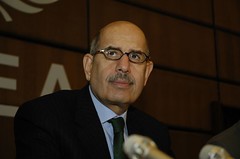
IAEA Director General Mohammad El-Baradei WASHINGTON — When President Obama unexpectedly won the Nobel Peace Prize in 2009, one predecessor was quick to applaud his selection for the award.

“I could not have thought of any other person that is more deserving of the Nobel Peace Prize than Barack Obama,” Mohamed ElBaradei, then the director general of the International Atomic Energy Agency, said in a videotaped statement. He went on to praise Mr. Obama’s commitment “to restore moral decency” to the lives of people around the world.

But on Sunday, Mr. ElBaradei, now a prominent face of the opposition on the streets of Cairo, was sounding a different tune. “The American government cannot ask the Egyptian people to believe that a dictator who has been in power for 30 years will be the one to implement democracy,” Mr. ElBaradei told CBS’s “Face the Nation.” He called the United States’ refusal to openly abandon President Hosni Mubarak of Egypt “a farce.”

Mr. ElBaradei, 68, had a fractious relationship with the Bush administration, one so hostile that Bush officials tried to get him removed from his post at the atomic watchdog agency. But as Egypt’s powerful Muslim Brotherhood and the secular opposition on the streets of Cairo have increasingly coalesced around Mr. ElBaradei to negotiate on their behalf, the Obama administration is scrambling to figure out whether he is someone with whom the United States can deal.

********************************

29.1.11

After Tunisia, Egypt is shaking; What is the US official line?
Apparently, that democracy can only be for capital(ists)!

President Obama, say the 'D-Word'


US appears to shy away from talk about democracy in Middle East, despite historic anti-government rallies in ally Egypt

Mark LeVine

Obama has 'sought to equate Egypt's protesters and government as equally pitted parties in the growing conflict' [AFP]

It's incredible, really. The president of the United States can't bring himself to talk about democracy in the Middle East. He can dance around it, use euphemisms, throw out words like "freedom" and "tolerance" and "non-violent" and especially "reform," but he can't say the one word that really matters: democracy.

How did this happen? After all, in his famous 2009 Cairo speech to the Muslim world, Obama spoke the word loudly and clearly - at least once.

"The fourth issue that I will address is democracy," he declared, before explaining that while the United States won't impose its own system, it was committed to governments that "reflect the will of the people... I do have an unyielding belief that all people yearn for certain things: the ability to speak your mind and have a say in how you are governed; confidence in the rule of law and the equal administration of justice; government that is transparent and doesn't steal from the people; the freedom to live as you choose. Those are not just American ideas, they are human rights, and that is why we will support them everywhere."

"No matter where it takes hold," the president concluded, "government of the people and by the people sets a single standard for all who hold power."

Simply rhetoric?

Of course, this was just rhetoric, however lofty, reflecting a moment when no one was rebelling against the undemocratic governments of our allies - at least not openly and in a manner that demanded international media coverage.

Now it's for real.

And "democracy" is scarcely to be heard on the lips of the president or his most senior officials.

In fact, newly released WikiLeaks cables show that from the moment it assumed power, the Obama administration specifically toned down public criticism of Mubarak. The US ambassador to Egypt advised secretary of state Hillary Clinton to avoid even the mention of former presidential candidate Ayman Nour, jailed and abused for years after running against Mubarak in part on America's encouragement.

Not surprisingly, when the protests began, Clinton declared that Egypt was "stable" and an important US ally, sending a strong signal that the US would not support the protesters if they tried to topple the regime. Indeed, Clinton has repeatedly described Mubarak as a family friend. Perhaps Ms Clinton should choose her friends more wisely.

Similarly, president Obama has refused to take a strong stand in support of the burgeoning pro-democracy movement and has been no more discriminating in his public characterisation of American support for its Egyptian "ally". Mubarak continued through yesterday to be praised as a crucial partner of the US. Most important, there has been absolutely no call for real democracy.

Rather, only "reform" has been suggested to the Egyptian government so that, in Obama's words, "people have mechanisms in order to express legitimate grievances".

"I've always said to him that making sure that they are moving forward on reform - political reform, economic reform - is absolutely critical for the long-term well-being of Egypt," advised the president, although vice-president Joe Biden has refused to refer to Mubarak as a dictator, leading one to wonder how bad a leader must be to deserve the title.

Even worse, the president and his senior aides have repeatedly sought to equate the protesters and the government as somehow equally pitted parties in the growing conflict, urging both sides to "show restraint". This equation has been repeated many times by other American officials.

This trick, tried and tested in the US discourse surrounding the Israeli-Palestinian conflict, is equally nonsensical here. These are not two movements in a contest for political power. Rather, it is a huge state, with a massive security and police apparatus that is supported by the world's major superpower to the tune of billions of dollars a year, against a largely young, disenfranchised and politically powerless population which has suffered brutally at its hands for decades.

The focus on reform is also a highly coded reference, as across the developing world when Western leaders have urged "reform" it has usually signified the liberalisation of economies to allow for greater penetration by Western corporations, control of local resources, and concentration of wealth, rather than the kind of political democratisation and redistribution of wealth that are key demands of protesters across the region.

Al Jazeera interview says it all

An Al Jazeera English interview on Thursday with US state department spokesman PJ Crowley perfectly summed up the sustainability of the Obama administration's position. In some of the most direct and unrelenting questioning of a US official I have ever witnessed, News Hour anchor Shihab al-Rattansi repeatedly pushed Crowley to own up to the hypocrisy and absurdity of the administration's position of offering mild criticism of Mubarak while continuing to ply him with billions of dollars in aid and political support.

When pressed about how the US-backed security services are beating and torturing and even killing protesters, and whether it wasn't time for the US to consider discontinuing aid, Crowley responded that "we don't see this as an either or [a minute later, he said "zero sum"] proposition. Egypt is a friend of the US, is an anchor of stability and helping us pursue peace in the Middle East".

Each part of this statement is manifestly false; the fact that in the midst of intensifying protests senior officials feel they can spin the events away from openly calling for a real democratic transition now reveals either incredible ignorance, arrogance, or both.

Yet this is precisely an either/or moment. Much as former US president Bush declared in the wake of the 9/11 attacks, we can either be "with or against" the Egyptian people. Refusing to take sides is in fact taking sides -the wrong side.

Moreover, Crowley, like his superiors, refused to use the word democracy, responding to its use by anchor al-Rattansi with the word "reform" while arguing that it was unproductive to tie events in Egypt to the protests in other countries such as Tunis or Jordan because each has its own "indigenous" forces and reasons for discontent.

That is a very convenient singularisation of the democracy movements, which ignores the large number of similarities in the demands of protests across the region, the tactics and strategies of protest, and their broader distaste and distrust of the US in view of its untrammelled support for dictatorships across the region.

Systematic silence

Ensconced in a system built upon the lack of democracy - not just abroad, but as we've seen in the last decade, increasingly in the US as well - perhaps president Obama doesn't feel he has the luxury of pushing too hard for democracy when its arrival would threaten so many policies pursued by his administration.

Instead, "stability" and "reform" are left to fill the void, even though both have little to do with democracy in an real sense.

Perhaps Obama wants to say the D-word. Maybe in his heart he hopes Mubarak just leaves and allows democracy to flourish. By all accounts, the president is no ideologue like his predecessor. He does not come from the political-economic-strategic elites as did Bush, and has no innate desire to serve or protect their interests.

Feeling trapped by a system outside his control or power to change, maybe president Obama hopes that the young people of the Arab world will lead the way, and will be satisfied by congratulations by his administration after the fact.

But even if accurate, such a scenario will likely never come to pass. With Egyptians preparing to die in the streets, standing on the sidelines is no longer an option.

A gift that won't be offered again

The most depressing and even frightening part of the tepid US response to the protests across the region is the lack of appreciation of what kind of gift the US, and West more broadly, are being handed by these movements. Their very existence is bringing unprecedented levels of hope and productive activism to a region and as such constitutes a direct rebuttal to the power and prestige of al-Qaeda.

Instead of embracing the push for real democratic change, however, surface reforms that would preserve the system intact are all that's recommended. Instead of declaring loud and clear a support for a real democracy agenda, the president speaks only of "disrupting plots and securing our cities and skies" and "tak[ing] the fight to al-Qaeda and their allies", as he declared in his State of the Union address.

Obama doesn't seem to understand that the US doesn't need to "take the fight" to al-Qaeda, or even fire a single shot, to score its greatest victory in the "war on terror". Supporting real democratisation will do more to downgrade al-Qaeda's capabilities than any number of military attacks. He had better gain this understanding quickly because in the next hours or days the Egypt's revolution will likely face its moment of truth. And right behind Egypt are Yemen, Jordan, Algeria, and who knows what other countries, all looking to free themselves of governments that the US and its European allies have uncritically supported for decades.

If president Obama has the courage to support genuine democracy, even at the expense of immediate American policy interests, he could well go down in history as one of the heroes of the Middle East's Jasmine winter. If he chooses platitudes and the status quo, the harm to America's standing in the region will likely take decades to repair.

Mark LeVine is a professor of history at UC Irvine and senior visiting researcher at the Centre for Middle Eastern Studies at Lund University in Sweden. His most recent books are Heavy Metal Islam (Random House) and Impossible Peace: Israel/Palestine Since 1989 (Zed Books).

James S.
Seattle, WA
I think it is mistaken in calling these massive protests "revolutions," even in the case of Tunisia where the head of state was actually thrown out.

A revolution isn't throwing out a government; it's what happens after you overthrow the government. It requires a balancing act of carrying out the mandate of the people while retaining order. A spontaneous uprising can be the beginning of a revolution, but it's not the end or even the middle of a revolution. If you don't have anything to replace the ousted regime with, you'll simply end up with another authoritarian to fill the vacuum.

In a previous article Cohen compared the speed of mobilization in Tunisia with Castro's years in the Sierra Maestra, arguing that social networking technology did in days what it took years to happen in Cuba. But this comparison is deeply flawed. Castro spent those years creating a sustained popular momentum, building lasting political alliances/networks, defeating utterly Batista's forces, establishing a new military force to replace them, carrying out tentative reforms in the countryside and planning for the post-war period That's the kind of work that goes into any lasting revolution.

Since the end of the Cold War, US policy makers have leaped at every opportunity to call any government-toppling mass uprising a "revolution," especially when they were favorable to us (as in the former Eastern Bloc/Soviet satellite countries). This has now extended to our authoritarian allies in the Arab world. But all of these so-called revolutions are already in danger of petering out or being crushed under tighter restrictions from new and existing authoritarian governments. And that's because few of them have the leadership, ideology or planning in place to permanently take charge and implement reform--I hope for the best in Egypt, but I think it's going to go the way of Iran, the last "revolutionary" hot spot. All the social networking technology in the world isn't going to change that. Only by building real, permanent alliances, creating comprehensive programs, and sustaining long-term public action will these groups become true revolutionaries--and that's not going to happen through Facebook alone.

I do believe that all this can be the beginning of revolutions, especially with the heavy-handed suppression tactics we're seeing from the states. As any historical revolutionary will tell you, it's often the brutality of the state against reformists and protesters that leads to more radical and subversive action from the people. Spontaneous uprisings are important in a revolution, but they're only one component of the larger public struggle.

It's simply too early to call what we're seeing in North Africa revolutionary. There were people claiming that the post-election protests in Iran were part of a revolution, and we see how that worked out. The events unraveling now are, at most, the first tentative steps toward revolutions.

27.1.11

On being competitive

Obama had a dream, or was told so.  It's about competitiveness.  Here's the grassroots level view:

Barbara Rubin
Ca.

Forgive my economic naivete but it would appear that 'competitiveness' is effectively being quashed by industry itself. The monopolization of major industries by transnational corporations appears to view the world as a single trough from which only their approved subsidiaries can feed. Trade associations agree to offer inferior products of a uniform nature to the public at prices set for declining levels of income. Falling wages are arranged by the same groups which serve as major employers around the world. If true competitiveness were the goal, wages would reflect the desire for consumers to have more disposable income.

Until farmers can re-use seeds and their own crops (potatoes are grown from potatoes), they aren't able to compete with one another. Their revenues are always going to belong largely to the vendor of those seeds and attendant technologies required to bring them to 'fruition' in chemically laden fields. Feudalism lives in modern times.

As agribusiness and energy cartels dictate changes to our very eco-system, other industries deal with that 'fall-out'. Developers are dealing with contaminated lands and diminishing supplies of clean water. Building trades are dependent upon inexpensive toxic construction materials from the US and China to house increasingly impoverished populations with low budgets for housing units. These materials can't be exported to Europe where they've learned the costs of ignoring safety (largely through providing universal health care).

Clothing manufacturers, producers of processed foods - what industry can actually boast a large array of competitive businesses falling under these major umbrellas? Competition lies in who can pay the least to workers, offer the fewest benefits and substitute cost-saving chemical treatments to make products look shiny. Worker benefits are provided by the public in medicaid and housing vouchers for working families! Low 'competitive' prices of toxic goods and services are made up with costs paid in physician offices and tax funded disability insurance.

I hope President Obama speaks to competitiveness among 'modest' businesses which will benefit from employing local residents. Seeing that transnational corporations pay taxes in every nation offering them markets is a start. Ending NAFTA requirements that nations pay companies for losses of profits if harmful products are banned is another way to end the stranglehold of monopolies ready to sue nations for such reasonable measures.

Competitiveness lies with dreams of earning a mere million in profits rather than billions. Companies used to compete to achieve sustainability of their operations for future generations. Now a golden parachute rewards those aiming to make a 'quick killing' and get out while they can do so.

Quick killing indeed. The cemeteries are filling up quite nicely.

Barbara Rubin
www.armchairactivist.us


Rod Adams
Forest, VA

My hope is that President Obama is thinking about lessons learned on the basketball court when he is talking about competitiveness. I also hope that he figures out a way to tell Americans that becoming competitive in a given endeavor is not magical, not easy, not not quick. It is, however, one of the most rewarding things you can do.

If you are wondering why America seems to be having some difficulty of late, I highly recommend reading Amy Chua's book titled "Battle Hymn of the Tiger Mother". If you do not have time to read the book, at least read the article that she published last week in the Wall Street Journal titled "Why Chinese Mothers are Superior." When you read either one, look past the specific stereotypes and consider how much work it takes to encourage and enable achievement. Think about the fact that China has about 700 million "Chinese mothers."

Then think about what you personally did in school or what you did to encourage your own children to learn to achieve. Take some responsibility if you recognize that you have been a part of a very lazy period in American history when people have taken for granted that we are a "rich country" and have acted a bit like privileged royalty without investing much effort into becoming capable of competing.

We certainly have some hard working achievers remaining. Apple, Google, and Facebook engineers are creating wonderful technological marvels, college football players invest many hours of sweat and muscle strain, and Westinghouse engineers are creating marvelous nuclear power plants that are being sold all around the world. However, there are also a lot of soft minds and bodies out there.

There is no reason in the world why a third world teenager should be able to out-compete an American worker who had access to at least 12 years of taxpayer supported schooling. If nothing else, the American worker should have a huge advantage by being able to speak and write the English language with native fluency.

English is, after all, the world's business language. Our math and science achievement should be second to none; we probably control at least half of the world's total computing power. If it is not, we should not blame the government or even our teachers - they are providing adequate learning opportunities; it is up to the students and the parents to make sure that the experience takes and knowledge gets transferred.

I grew up as part of the American generation inspired to compete by Sputnik. We raced to the moon, built more that 140 nuclear powered submarines in less than 10 years and built enough nuclear power stations to supply more electricity than the entire grid supplied in 1960 in just 2 decades. Then we got complacent. We stopped studying quite as hard, stopped taking the "hard" courses like calculus and physics, and started giving all participants a trophy.

We can change, we can compete, and we can refuse to put our pension funds or 401Ks into the hands of people who invest in companies like GE that send our jobs overseas. We do not need to become a larger exporter, we simply need to become more self-sufficient, proud of NOT taking a handout, and proud of contributing our fair share to the development of our communities.

That includes recognizing that paying taxes is a responsibility; we need our various levels of government to function well in order to enable the general prosperity, ensure healthy education systems, ensure transportation networks that can deliver goods and services on time, and ensure that we are not choked by our own refuse. I am not blaming American workers so much as blaming the managers and executives who have been taking the easy path and think that capturing as much taxpayer money as possible is the right way to run their businesses. No self-respecting competitive athlete thinks that they can win a championship by outsourcing their work outs.

I hope that is the competitiveness pep talk that President Obama has in mind, though his recent additions to his team do not give me much optimism. He needs to up his game with regard to the drafting process.

Rod Adams
Publisher, Atomic Insights


Tim Kane
Mesa, Az

Competitiveness is not the problem -at this time.

A quick look at the CIA World Factbook online almanac shows that the United States has the greatest productivity in the world, other than the world itself, and the highest per capita productivity in the world for any nation with over 7 million people.

The problem is a lack of demand. We have a lack of demand because we've had 30 years of supply side bias policies that have caused wealth, money, to be sequestered -according to Reagan's former budget director, David Stockman, that's $40 trillion dollars (up from $9 trillion 30 years ago) from the commercial economy by the uber-wealthy in this country.

This is a nation based on one governing principle: free contract.


In any society based upon free contract, only one thing matters: bargaining power.

What you earn, is, quite frankly a function of your bargaining power.

From 1945 to 1972, productivity went up 100% and all segments of society advanced equally. The reason being - bargaining power. For workers that meant labor unions. Since 1972, GNP has gone up 150% yet the median wage is flat.

The problem again is bargaining power. Working class and middle class people have been coaxed into surrendering their bargaining power over to the uber-wealthy in the illusive pursuit of cultural war issues.

The word chumps comes to mind. Take abortion: many middle class people vote Republican over the idea of prohibition of abortion alone, even though the nation that has the lowest rate of abortion in the world, the Netherlands, abortion is both largely legal and largely free.

Chumps, I dare say: The culture wars ended in 1790 with the passage of the Bill of Rights amendments to the constitution: you and everyone else gets to do what they like so long as it doesn't affect anyone else, that is to say your right's end where another's begin, and that includes privacy. Yet people freely vote to surrender their bargaining power over culture war issues.

Here's another curious aspect of this: values (and that would include morals) is a middle class phenomenon. As the movie "It's a Wonderful Life" suggested, when the middle class contracts, immorality expands. So while people are surrendering their bargaining power over moral issues, they are actually causing the middle class to contract, and as a result they are actually causing immorality to increase.

The founding father's knew all about this. They gave us the Bill of Rights to end the culture wars. They gave us a system based on free contract that would ensure that there would be a permanent class war. But they also gave us democracy to ensure that the playing field upon which bargaining would take place would be fairly level. In essence, Democracy is political socialism: one man, one vote.

For 80 years the system worked. In 1860 the U.S. had the broadest distribution of wealth the world had ever seen - despite 3 million of its citizens being bound in servitude. In 1860, we went to war to free up those 3 million. Yet, 25 years after the successful freeing of the slaves, wealth was more concentrated than ever. What happened? The invention of the modern limited liability corporation, in 1862 - remember, Lincoln was a republican and a lawyer to railroad interests. The founding father's hadn't anticipated corporations.

Corporations are an ownership collective. As a collective, they have immense bargaining power over individuals. Their creation caused an immediate imbalance in the distribution of wealth which we are still struggling with today.

And the founding fathers couldn't imagine the ability of corporation's (and the uber-wealthy that they spawned) ability to use their vase resources in unimaginable ways (including buying up most media outlets) to influence people into undermining their own bargaining power. Some how they've managed to convince large swaths of people that collective ownership is virtuous, but collective labor is evil.

Want to fix the economy? Increase demand. Want to increase demand? work on redistributing bargaining power back to the people. You know, we the people. Yes, the 'we the people' that's in the preamble of the constitution. Please note, there is no mention whatsoever of corporations in the constitution - therefor they have no claim to rights over citizens, at all.

The problem is, I'm not sure Obama fathoms any of this at all, and if he does, I'm not sure he comes down on the side of the public (people) on this. He just extended tax cuts to the uber-rich for the slightest of pretext - keeping unemployment insurance going (as if Republicans would let a nation of gun owners loose out on the streets with no jobs, no income and nothing left to lose). By the way those weren't really tax cuts - you can't cut taxes when you have a deficit, what Obama, and Bush before him, really did was use the faith and credit of the United States government to underwrite a loan from communist China on behalf of the rich.

3.1.11

The social construction of US economic revival and its discontents

According the a select few, the US economy will continue its improvement into 2011...


EdB
Livermore, CA

The NY Times and Washington mistake a collection of vague nice-sounding buzz words for leadership. The effectiveness of recent similarly vague policies has consistently evaporated in spite of the power attributed to their awesome dollar amounts. That's because policies that would solve our problems aren't just about money and marketing. The solutions actually have to attack real systemic issues, not merely paint them over.

Has Obama achieved a lot? In name perhaps, but not in reality. DADT? Mostly irrelevant in this time of economic hardship. Financial reform? Formerly big banks are now bigger banks, with about the same level of risk. Health care reform? Well, it's more expensive, anyway. Campaign finance reform? Immediately ejected like the political gambit it apparently was. Housing? Many formerly unaffordable houses are *still* unaffordable, and the best the government can seem to do is throw money at the problem and pray. As far as I can tell, it won't be over until there's no more cash to squeeze from anyone who was trying to be prudent.

This dark joke is getting darker, but not funnier. If I were you NY Times editorial board, I'd drop the dreamy editorials and start pushing your people to dig in the dirt a lot harder. There is a world of corruption to root out in our New Byzantium, and you have yet to admit that to yourselves.


Eric
Wisconsin

We have reached a point where there is little consensus on what will work to fix the economy. In a big part we are ignoring the reality of what the world is like in 2011 and pretending that it is 1955 and think that we dominate the world almost completely from an economic standpoint.

If you look at the articles about ending the filibuster people think that if we just do things it will fix things. Legislative actions can make things worse. If you look at the bills that the news media hailed as triumphs of bipartisanship, they were filled with dirty deals that are part of our troubles.

The extension of the tax cuts included a deal to extend ethanol subsidies and increase the allowable levels in gasoline to 15%. And this is just after Al Gore admitted his 1998 tie breaking vote in the Senate to continue subsidies back then was a fraud only used to try to promote his 2000 presidential bid among farm voters. Science and economics don't matter when it comes to ideology on either side of the political divide. It only matters to stand for the principle of getting elected or reelected.

We ignore the fact that health care and higher education are getting too expensive for people to afford regardless of how we pay for it. Unlimited insurance mandates from the states sound good until you realize that they price people out of coverage. Providing student loans to pay for tuition that has risen at almost twice the rate of health costs over the last 30 years creates debts too high for many people to ever payback and have a life style even equal to what their parents had.

We pretend that the longer lifespans we now enjoy won't bankrupt us or make the math on social security, medicare, and pension fund solvency faulty.

Building expensive and unreliable wind turbines that help jack up the cost of power hurts manufacturing competitiveness is a phony solution to environmental problems. Just look at how Scotland is importing electricity from France because their big reliance on Wind has proven hugely unreliable.

Fantasy thinking does not work. Part of that is our politicians thinking that 3000 page bills can even create workable rules to run our country. They don't seem to mind since these unworkable bills create plenty of work for their fellow lawyers while they crush the lively-hood opportunities for the rest of us.

Unfortunately we may need a greater collapse to clean out the unrealistic excesses of the last 40 years. I just see a lot of pain before we decide to what is necessary.


Karen Garcia
New Paltz, NY

The inequality in this country is literally killing people, but to hear the politicians and the pundits blather, prosperity is just around the corner. Corporate profits were up 20 percent last quarter, Christmas retail sales spiked by 5 percent and Congress passed a whole bunch of legislation at the last minute to much media fanfare and shameless self-congratulation.

Despite the so-called health care reform legislation passed last year, the number of uninsured Americans has increased to more than 50 million, according to the U.S. Census Bureau. The main factor leading to this major loss of coverage is loss of employer-funded health care. While almost 17 percent of the population at large is now uninsured, it gets worse further down the income scale; Census figures reveal that fully a quarter of people with incomes under $25,000 have no health coverage at all.

When President Obama made his back-room deals with the for-profit insurers and drug companies to get his watered-down bill passed, he traded away universal coverage - right away - for a smooth ride through Congress and future corporate campaign donations. So we are worse off than ever, because widespread benefits won't take effect until 2014. People with pre-existing conditions can't afford to buy into those much-touted high risk pools. Sick people still can't afford to go to the doctor and are getting sicker and dying at higher rates than even before "reform." And all to please some corrupt politicians and their corporate puppet masters - all to worship at the altar of fiscal responsibility by making suffering people wait another three years before getting government subsidies to further enrich the insurance companies - which, by the way, remain immune from anti-trust laws.

But perhaps that's the whole idea - make people wait long enough,and maybe a lot of them will conveniently die. There's a name for what the United States calls its joke of a safety net, and it's Social Darwinism. We should probably just give up the pretense and rename Washington, D.C. : "Wall Street-upon-Potomac."

But there is one ray of hope: the first Boomers are hitting retirement this year, and the vast majority of them think the country is headed down the tubes. They'll have plenty of time on their hands to relive the glory days of anti-government protests. Never underestimate the intelligence and clout of the over-60s to bring about that change we can all believe in. Perhaps the retirees can embark on second careers as civil disobedience mentors to the unemployed Gen Xers. Trusting government is no longer an option. Believing in ourselves and our own power is the only sane choice we have left. There is one percent of them, and 99 percent of us.


wannabeworker
USA

I completely agree with these findings ['Want a happy, healthy country? Focus on reducing inequality.'] I've been looking for work for nine months and am feeling more estranged and disconnected from society than I ever thought I could. All of my relationships are strained--family, friends, people I network with, people I used to work with--because they have jobs, money, and an identity, and I do not. They are stable, independent, and happy. I am not. They participate in society. I do not. We previously had plenty enough in common to enjoy one another's company. Now, what on earth do we have to talk about?

The wealthy also have much richer lives than ever before because more is possible today than ever before--wealthy people are enjoying all the unbelievable achievements of modern man, including every wonderful gadget you could ever imagine, age treatments, medical advances, travel anywhere and everywhere, great clothes, great cars, etc. But poor people today are just as poor as poor people ever were. The lifestyles of the working and the non-working are so vastly different, they might as well be living on different planets.

My heart aches every day for the return of jobs in America. This topic should remain in NYT headlines until that happens.

24.12.10

A British take on an American [...]

The myth of Woodrow Wilson the Princeton sage who tried to bring peace and democracy to the world is a set piece in the Yank liberal narrative. The man who set up concentration camps for dissidents in the USA, who was a serial invader of Latin America, who tried to bully his way into Chinese markets with US Marine divisions, and who even sent troops to invade the Soviet Union, is pictured as some benevolent idealistic don whose efforts to uphold the League of Nations were frustrated by evil imperialists abroad and sort-sighted congressmen at home.
The list of countries that Woodrow Wilson the "League of Nations" peace-lover invaded is longer than almost any other US president's:
Mexico
China
Nicaragua
Panama
Dominican Republic
Haiti
Cuba
Guatemala
Honduras
Phillipine
Yugoslavia
the U.S.S.R.
Major General Smedley Butler, the 4-star Marine general who was the most decorated soldier in US history, had this to say about Wilsonian "idealism:"
I was a racketeer, a gangster for capitalism…. I could have given Al Capone a few hints….. I helped make Mexico safe for American oil interests in 1914. I helped make Haiti and Cuba a decent place for the National City Bank boys…. I helped in the raping of half a dozen Central American republics for the benefits of Wall Street…. I helped purify Nicaragua for the international banking house of Brown Brothers…. I brought light to the Dominican Republic for American sugar interests in 1916. In China I helped see to it that Standard Oil went its way unmolested."

nucular games in a nuclear world

C.I.A. Secrets Could Surface in Swiss Nuclear Case NYTimes Article »

An effort to hide the C.I.A.’s relationship with a Swiss family hit a snag when a magistrate recommended charging the men with nuclear smuggling.
Ike Solem
CA

It seems some of the background in this case has been left out - namely, that the CIA had previously (and unwittingly) provided other states with detailed blueprints for nuclear weapons - specifically, information key to constructing the high-explosive lens and positioning them around the plutonium sphere that sits at the center of nuclear weapons.

There are allegations that some designs were previously provided as part of a CIA sting operation, and that certain key components were mis-drawn on the blueprints - but this latter fact was apparently known to the recipients - see NYT Reporter James Risen in "State of War." Excerpted here:

http://www.guardian.co.uk...

However, Iran has no capacity to construct plutonium cores - that tends to require a dedicated reactor - technically:

"Weapon-grade plutonium (WGPu)-plutonium that typically contains 6 percent or less of the isotopes Pu-240 and Pu-242, isotopes that makes design of nuclear weapons increasingly more difficult. WGPU is created when U-238 is irradiated in a nuclear reactor for only a short period of time."

In order to make a powerful nuclear weapon that can fit on a missile, it is generally thought necessary to use tritium as a booster - technically:

"To fission more of a given amount of fissile material, a small amount of material that can undergo fusion, deuterium and tritium (D-T) gas, can be placed inside the core of a fission device. Here, just as the fission chain reaction gets underway, the D-T gas undergoes fusion, releasing an intense burst of high-energy neutrons (along with a small amount of fusion energy as well) that fissions the surrounding material more completely. This approach, called boosting, is used in most modem nuclear weapons to maintain their yields while greatly decreasing their overall size and weight."

(Technologies Underlying Weapons of Mass Destruction, December 1993, OTA-BP-ISC-115)

The key point here is that Iran has neither Pu-239 nor tritium generating capabilities (unlike perhaps the other nuclear powers - Israel, Pakistan, and India) - and hence is no more of a "nuclear threat" than Iraq was, despite the hype.

Why does this matter? It means that the U.S. claims about the need to protect Europe from assault with ballistic missiles from Iran "tipped with chemical, biological or nuclear weapons" is just as implausible as similar claims about Iraqi WMD potential. The only reasons such claims are being floated is to justify the grotesque expense of a useless "missile defense shield" - something neocons have been pushing ever since the 1980s, but now with Obama's support. Insane.

This also raises another question regarding the current Swiss case: who ultimately provided these designs? Consider the following Risen excerpt:

"Operation Merlin has been one of the most closely guarded secrets in the Clinton and Bush administrations. It's not clear who originally came up with the idea, but the plan was first approved by Clinton. After the Russian scientist's fateful trip to Vienna, however, the Merlin operation was endorsed by the Bush administration, possibly with an eye toward repeating it against North Korea or other dangerous states."

Did they perhaps try this scheme a second time, with the same results?

More to the point, Switzerland is in a rather strange position with regards to nuclear energy, being something of a large investor in nuclear power concerns. See this from the Swiss ambassador (Aug 2008)

"On India’s nuclear deal with the US, Mr Dreyer said that his government recognised the importance of nuclear energy for India’s economic growth, but his country had not decided whether it would support the deal in the nuclear suppliers group (NSG) meeting later this month. “Government of Switzerland is very much in favour of India developing nuclear energy but it is also concerned about problem of non-proliferation,” he said talking to the media on Friday."

http://economictimes.indiatimes.com...

The actual nature of the deal with India is that it violates the Non-Proliferation Treaty. The U.S. Congress tried to sidestep this issue by saying the deal only applies to India's "civilian reactors", not to its military reactors (the ones engaged in irradiating U238 to create P239 for use in weapons production). Note also that India and Pakistan refuse to sign the NPT, and the U.S. won't pressure them to.

The terms of this deal are strange indeed:

"In a major success for India’s nuclear ambitions, the 46-member Nuclear Suppliers Group (NSG) on September 6, 2008 granted it a crucial waiver enabling India to carry out nuclear commerce and ending 34 years of isolation which started after the 1974 Pokharan nuclear tests. The decision to grant India a waiver is unprecedented in the history of the NSG since India has neither signed the Nuclear Non-Proliferation Treaty (NPT) nor the Comprehensive Test Ban Treaty (CTBT)."

Now, Iran - which has signed the Non-Proliferation Treaty - is again being portrayed as a nuclear weapons threat. This is a ridiculous assertion, not backed by any reliable evidence - much like the false claims about Iraqi WMDs. They have no means of producing plutonium - something the U.S. won't discuss. Also, under the NPT terms, Iran has a right to join the Nuclear Suppliers Group and sell enriched uranium to countries with nuclear power stations.

As far as Assange and Wikileaks, that looks more and more like some kind of covert propaganda campaign - for example, the 'leaked' diplomatic cables from Arab states urging military action against Iran?

"The fact of the leaks is not necessarily a bad thing," said Laipson. "It is part of the way Iran gets the message that within the region that they will look to the United States and outside to protect them. Iran does not want us to have such a robust presence in the region."

That would be Ellen Laipson, Member, President’s Intelligence Advisory Board - supporting the Wikileaks agenda? Strange days indeed.

The real goals, as usual, probably have more to do with the U.S. desire to control fossil fuel production and sales in the Middle East and Central Asia, and keep Iran from delivering natural gas to India via a trans-Pakistan pipeline - much as the real goals in Iraq were all about the control of Iraqi oil output.

Given this state of affairs, it's no wonder the U.S. State Department or the CIA doesn't want to see the Swiss bring up Operation Merlin or anything related to it.

17.12.10

more lessons, still

Paul Krugman writes about:

Wall Street Whitewash
The financial crisis has provided a teachable moment, all right, but not the one first expected.

His last 2 sentences are:
Never mind relearning the case for bank regulation; what we learned, instead, is what happens when an ideology backed by vast wealth and immense power confronts inconvenient facts. And the answer is, the facts lose.


W in the Middle
New York State


Paul, the lesson was - and still is - there for the learning. But you've got to lose the ideological lens.

Your last couple of sentences could've been a conservative's observation instead of a liberal's - except about ObamaCare or global warming, instead of banking.

The non-ideological lesson should be:

> That things go down in a market faster than they go up (except toward the peak of a bubble), is because the dynamic is different. Investing begets greed begets fear begets panic. And this has been the case, for a long time.

> What's different now are two things:

1. We can make things go up and down faster, using computers.

2. We can make things go up and down more often, using computers.

The first is simply running things on Internet time. The second is more insidious - it's like beating the surface of a still lake with a big paddle to create white water where there shouldn't be any. And then charging $50/day for whitewater raft rentals, instead of $10/day for canoe rentals.

With the second, financial folks no longer need big bubbles to grab the cash. They can simply keep skimming the false frothiness they create - even in a sideways market - to separate the small fish from their money.

False frothiness can take many forms.

> An overdraft fee that is several times the size of the average transaction - and engineered to trigger as many times as possible - for the same set of transactions.

> Put/call options that are several-times overpriced, because of the elegant self-consistency of Black-Scholes (i.e. if I falsely jiggle the market up and down, the price basis for options increases - which a broker can then use as evidence that options are a great investment, increasing the demand and the broker premium).

> Derivatives markets engineered - like option ARM mortgages - with exorbitant overcommissions, that become self-sustaining. Because of the army of willing brokers they enlist, who are willing to be the bad apple at the bottom of the transaction chain - while the banks point at their lawyers, rating agencies, and regulators, with the deniability borne of complexity, and say: "wewuzjustdoinwhattheysezwecoulddo".

But here's how badly we're not learning.

We'd had payday loans and company stores, for a long time.

Except now our banks are trying to attain the margin structure of payday lenders. And we continue to let them do so (there is hope - I saw the proposed fee structure for debit cards...a glimmer of daylight).

On the other hand, Walmart is the antithesis of the company store. Yet, we won't them obtain a bank charter, or sell to our poorest inner-city folks.

Go figure.

the left is a step short to even count

Neiman03
McKeesport, Pa


Democrats, liberals, and progressives -- whatever that ilk wants to call themselves -- cannot blame conservatives and true believers in government-is-always-the-problem for having lost the framing battle. The financial industry is getting away with all of this because the left seems too busy whining about the media or lamenting the lack of sophistication in the public. The left simply hasn't used its base in universities, among public servants, and among communities of color to match the militancy of the right -- at least not in recent years. At a time when public institutions are weaker than they've been in decades, we have a conservative movement that has convinced Americans are oppressed by public institutions. While individuals have never been more vulnerable to the whims and wild conduct of profit-seeking firms, conservatives, with the able assistance of an activist, conservative Supreme Court majority, have mobilized a movement which holds that it is their governments that are the main threat to their well being. Ever since GOP rent-a-mobs showed up at Florida election registrar offices to disrupt that state's recount, progressives have failed to match the vigor and ruthlessness of their opponents. Liberals keep bringing ping pong paddles to a street fight. I dearly respect Krugman, but I'm frustrated that his formidable abilities are not directed at inspiring the direct action we need, focused on the appropriate targets. Please someone help us to waken enough Americans to the fact that they're being played for suckers, again and again and again.

15.12.10

propaganda and a way to influence your emotions and behavior

U.S. Rethinks Strategy for the Unthinkable
By WILLIAM J. BROAD

The Obama administration wants to convey how to react to a nuclear attack but is worried about seeming alarmist.


Reactions:

Laughingdragon
California


Funny story...I was working at Sandia National Labs in Livermore, CA 1993-1996 as a technical information specialist/librarian and then acting librarian. And this is no secret...
One day, one of the secretaries came in to talk to me. And she said that she had boarded a plane, traveling as a private individual. And that, as the aircraft was ready to take off, someone came onto the plane and made a production of finding her and ordered her to deplane, while holding the plane and all the passengers. And that no one explained or said anything to her about it but they took her into the terminal and held onto her for awhile. Eventually they let her board the plane again and they let the plane and all it's passenger's take off. No one said anything to her and no one gave her an explanation. She was still slightly shook-up when she told me this and she asked me what I thought of it. Now I'd been a low level analyst in the military and I had known people on spoofing teams, the kind that test security on military bases so I told her then..."I don't know why but they were testing something. They chose you because you work here, at the lab, and if you wanted to make a fuss they could influence you not to. But I have no idea why." And that's where it lay. Until I saw what happened post 9/11.
My opinion, now, is that there were "civil defense" research projects going then to see just how docile people were. And what kind of reactions could be expected if the government wanted to order them around. And I don't like this nonsense about nuclear shelters and such, as protection from nuclear attack.
Because, you can bet your bottom dollar that if nuclear attack ever comes...you will be out there, unprotected and without refuge. Just as the people in New Orleans were under Hurricane Katrina.
Everything else is just propaganda and a way to influence your emotions and behavior.


pm
brooklyn


The Bush 9/11 tactics, TSA, and now this... I'm more angry than I could ever be afraid.


Community Gardens
Plum Tree


This sounds bad... Is this how he plans to stay in power? Perhaps the creation of a situation like this?


Maria
NY


I was a young elementary school girl and lived through those days. Marched out into the hall to stand in perfect silence, away from doors and windows. It created a backdrop of anxiety that it was possible we could be blown away at any time.


matt
long island


How interesting that this story coincides with Israel's announcement that its missile defenses will not protect civilian targets, only military ones. we are indeed cannon fodder.

Here is UPI story (copyright, I'm sure)

Israel general drops missile defense bombshell

by Staff Writers
Tel Aviv, Israel (UPI) Dec 14, 2010
Maj. Gen. Gadi Eisenkot, commander of Israel's northern front, has dropped a bombshell by disclosing that the anti-missile systems the defense industry has developed are intended to protect the country's military installations, not its cities and civilian population.

"The residents of Israel shouldn't be under the illusion that someone will open an umbrella over the heads" in the event of a massive missile and rocket
attack by Israel's enemies, he declared in a speech Sunday at the University of Haifa.

"The systems are designed to protect military bases, even if this means that citizens suffer discomfort during the days of battle."


ShowMe
Missouri


The last straw!!! The lies that have been promulgated by many in government and the media make me believe that a little nuclear attack may be the strategy for the unthinkable, when free citizens of the USA are finally sheep-herded into complete control by the plutocracy.


chris leide
upstate NY


Other explosion results: Lots of good comments about the cold war, bomb shelters, and the need to recognize shelter should you see a blast in the distance. No one seems to be talking about other results nuclear explosions.
Many think that the next war involving nuclear weapons will not be ground attacks that devastate cities and parts of countries, but will be a few strategic atmospheric blasts sending electro-magnetic pulses (EMP's) that will disable computers and electronic systems, either in a smaller scale as explosions over the US or the Russia or China, or that may disable systems globally.
EMP's disable electronic devices. With computers and all things controlled by microprocessors, our known world may end. No micro waves ovens, no cars controlled by computers. No TV's, no sewer processing plants, no DVD players. No iPods, no government action. NO CELL PHONES!!!! The end might not come from radiation poisoning, or direct destruction from the actual explosions, but from our reliance on computers and micro processor that will be disabled by the EMP's.
Cities will go black, ships will founder at sea, and planes will fall from the sky.
It will be cold and dark in the hell that we created. Death will come slowly to many of us accustomed to modern conveniences.
Sorry for the gloomy future cast. Just analyzing well-known options that few seem to want to discuss.

6.12.10

Assange, Wikileaks & US

I don't think Assange has that many chances to survive into 2011.  This is most unfortunate because whatever trace is left in people's minds about the image of the US is going to be blown into pieces.  The world will turn cynical, I fear for much worse.

 If  we wanted a better course of action, we should have thought as if the Cold War were still going on.  Then we should have thanked Mr. Assange in whatever terms, retired Mrs. Clinton for her request for spying on the UN officials, and returned to work by filling in whatever gaps wikileaks has been exposing in our whole system.

As for the justice coming from the Swedes, or our own private and self-appointed law enforcers (Amazon, PayPal, etc.), what more can I say?  ...true to form.

Marianne Ny: Making an arse of Swedish law.

Written By: - Date published: 4:28 pm, December 4th, 2010 - 66 comments
Categories: International, activism, us politics - Tags: , ,
With all of the drama surrounding the Wikileaks release of US government diplomatic wires which I and others do not find surprising. What has been intriguing me more is the behavior of the Sweden’s director of public prosecutions, Marianne Ny. The available information on her charges and actions against Julian Assange, the founder and head of Wikileaks, indicates that she is driven more by the politics than any respect for the law. Assange’s current lawyer compares her to role of the infamous Beria in Stalins 1930′s show trials – and from what I can see I’d have to agree. Similarly I fail to see why Interpol is involved for such a minor charge
Apparently the charge is question is something pretty weird called “sex by surprise”
Assange’s London attorney, Mark Stephens, told AOL News today that Swedish prosecutors told him that Assange is wanted not for allegations of rape, as previously reported, but for something called “sex by surprise,” which he said involves a fine of 5,000 kronor or about $715.
This would not be regarded as being rape here or apparently anywhere else apart from Sweden. Specifically in this case it appears to revolve around the use of condoms. I’d have to point out here (probably with too much information) that I was conceived because of a condom failure. Over the years I have had a few failures of condoms and failed to use condoms when I should have. It happens in the passion to the best of us. Fortunately I haven’t had the consequence of either issue or STD’s.
The facts of the case do not appear to be in any dispute by either side.
Assange arrived in Sweden on Aug. 11 to speak at a weekend seminar sponsored by the Social Democratic Party and arranged to stay at a Stockholm apartment belonging to the event organizer, a member of the branch of the party who would become one of Assange’s two accusers.
According to a police report obtained by the Daily Mail in August, she and Assange had sex, and at some point the condom broke. While she was apparently not happy about the condom breaking, the two were seen the next day at the seminar, and nothing appeared amiss.
While in Sweden Assange had sex with another woman a few days after meeting her at a function hosted by the first woman.
The woman and Assange also reportedly had sex. According to the Daily Mail account, Assange did not use a condom at least one time during their sexual activity. The New York Times today quoted accounts given by the women to police and friends as saying Assange “did not comply with her appeals to stop when (the condom) was no longer in use.”
The woman discovered that Assange had sex with both of them, and a few days later went to the police. This is where the legal system in Sweden gets somewhat strange and muddled.
Based on what was said to police, the on-call prosecutor, Marie Kjellstrand, decided to issue an arrest warrant on charges of rape and molestation, and the next day the story hit the Swedish paper Expressen and newspapers all over the world.
Kjellstrand’s decision was overruled the following day by a higher-level prosecutor, Eva Finne, who withdrew the arrest warrant and said she did not see any evidence for rape allegations.
Then, on Sept. 1, a third prosecutor, Ny, re-opened the rape investigation, implying that she had new information in the case.
The best information about what was going on comes from Melbourne barrister James D. Catlin, who acted for Julian Assange in London in October. Of course this is one-sided. However there appears to be nothing to contradict this in the media storm raging in Sweden with statements from the prosecutors or the woman or their lawyer.
The women here are near to and over 30 and have international experience, some of it working in Swedish government embassies. There is no suggestion of drugs nor identity concealment. Far from it. Both women boasted of their celebrity connection to Assange after the events that they would now see him destroyed for.
That further evidence hasn’t been confected to make the charges less absurd does Sweden no credit because it has no choice in the matter. The phenomena of social networking through the internet and mobile phones constrains Swedish authorities from augmenting the evidence against Assange because it would look even less credible in the face of tweets by Anna Ardin and SMS texts by Sofia Wilén boasting of their respective conquests after the “crimes”.
In the case of Ardin it is clear that she has thrown a party in Assange’s honour at her flat after the “crime” and tweeted to her followers that she is with the “the world’s coolest smartest people, it’s amazing!”. Go on the internet and see for yourself. That Ardin has sought unsuccessfully to delete these exculpatory tweets from the public record should be a matter of grave concern. That she has published on the internet a guide on how to get revenge on cheating boyfriends ever graver. The exact content of Wilén’s mobile phone texts is not yet known but their bragging and exculpatory character has been confirmed by Swedish prosecutors. Niether Wilén’s nor Ardin’s texts complain of rape.
But then neither Arden nor Wilén complained to the police but rather “sought advice”, a technique in Sweden enabling citizens to avoid just punishment for making false complaints. They sought advice together, having collaborated and irrevocably tainted each other’s evidence beforehand. Their SMS texts to each other show a plan to contact the Swedish newspaper Expressen beforehand in order to maximise the damage to Assange. They belong to the same political group and attended a public lecture given by Assange and organised by them. You can see Wilén on the YouTube video of the event even now.
Of course, their celebrity lawyer Claes Borgström was questioned as to how the women themselves could be essentially contradicting the legal characterisation of Swedish prosecutors; a crime of non-consent by consent. Borgström’s answer is emblematic of how divorced from reality this matter is. “They (the women) are not jurists”. You need a law degree to know whether you have been r-ped or not in Sweden. In the context of such double think, the question of how the Swedish authorities propose to deal with victims who neither saw themselves as such nor acted as such is easily answered: You’re not a Swedish lawyer so you wouldn’t understand anyway. The consent of both women to sex with Assange has been confirmed by prosecutors.
So why exactly is there a red notice lodged with Interpol over this? In the 188 countries that are part of Interpol, there are a bit over five thousand notices given each year for murderers, fraudsters, actual rapists, and other serious crimes. A crime that has a maximum penalty of USD715 and no potential jail time is a minor offense, and appears to be more a case of social ineptitude on both sides than anything else.
Why did Interpol accept it? There isn’t even an arrest warrant against Assange in Sweden. Apparently because Sweden’s director of public prosecutions, Marianne Ny claimed that Julian Assange had ‘fled’ to avoid answering questions. However  the facts that have not been disputed by the Swedish prosecutor or her staff is that Julian Assange has made statements to both the police and the prosecutors after staying in Sweden to do so, was given permission to leave the country by the prosecutors, and has offered to answer questions in Britian including at the Swedish embassy.
Of even more concern is the conditions attached to the red notice. When it was issued on November 18th it requested that Assange would be
…held incommunicado without access to lawyers, visitors or other prisoners..
Quite simply this looks like a politically motivated legal move to grab Julian Assange on a legal pretext, to shut him up, and to get moved to a country with a sympathetic prosecutor for extradition. I’d be extremely interested in finding out what communication has been going on between the conservative government in Sweden  before and after the election on September 19th with the government in the US.
But it is pretty clear that Marianne Ny is not acting for the law in Sweden – she is using the law and the Interpol process on the flimsiest pretext. It is clear that you can’t call this rape despite what the prosecutors in Sweden say and has been blasted all over the US media.
Sure, Assange should probably answer more questions – if only to get this on again, off again, on again accusation settled. But there is no reason that cannot be done in the relative safety of the embassy in London. Since the charges do not carry a custodial sentence then there should be no reason to put Assange in prison to answer questions. That just makes him an easy to get at target for the various groups that are proposing to kill or imprison him on trumped up charges from countries like the US to which he owes no duty.
Bearing in mind the US policies of grabbing suspects from friendly states with poor legal systems and throwing them into concentration camps like Guantanamo Bay for interrogation, I can see why Assange would not want to put in the control of a show trial prosecutor like Ny.
Marianne Ny is just making an arse of Swedish law and holding it up as a laughing stock to the rest of the world.
BTW: If anyone is having problems accessing Wikileaks, then try this link

3.12.10

http://www.guardian.co.uk/world/blog/2010/dec/03/julian-assange-wikileaks

Fwoggie
I'll start the ball rolling with a question. You're an Australian passport holder - would you want return to your own country or is this now out of the question due to potentially being arrested on arrival for releasing cables relating to Australian diplomats and polices?

Julian Assange small Julian Assange:
I am an Australian citizen and I miss my country a great deal. However, during the last weeks the Australian prime minister, Julia Gillard, and the attorney general, Robert McClelland, have made it clear that not only is my return is impossible but that they are actively working to assist the United States government in its attacks on myself and our people. This brings into question what does it mean to be an Australian citizen - does that mean anything at all? Or are we all to be treated like David Hicks at the first possible opportunity merely so that Australian politicians and diplomats can be invited to the best US embassy cocktail parties.
girish89
How do you think you have changed world affairs?
And if you call all the attention you've been given-credit ... shouldn't the mole or source receive a word of praise from you?

Julian Assange small Julian Assange:
For the past four years one of our goals has been to lionise the source who take the real risks in nearly every journalistic disclosure and without whose efforts, journalists would be nothing. If indeed it is the case, as alleged by the Pentagon, that the young soldier - Bradley Manning - is behind some of our recent disclosures, then he is without doubt an unparalleled hero.
Daithi
Have you released, or will you release, cables (either in the last few days or with the Afghan and Iraq war logs) with the names of Afghan informants or anything else like so?
Are you willing to censor (sorry for using the term) any names that you feel might land people in danger from reprisals??
By the way, I think history will absolve you. Well done!!!

Julian Assange small Julian Assange:
WikiLeaks has a four-year publishing history. During that time there has been no credible allegation, even by organisations like the Pentagon that even a single person has come to harm as a result of our activities. This is despite much-attempted manipulation and spin trying to lead people to a counter-factual conclusion. We do not expect any change in this regard.
distrot
The State Dept is mulling over the issue of whether you are a journalist or not. Are you a journalist? As far as delivering information that someone [anyone] does not want seen is concerned, does it matter if you are a 'journalist' or not?

Julian Assange small Julian Assange:
I coauthored my first nonfiction book by the time I was 25. I have been involved in nonfiction documentaries, newspapers, TV and internet since that time. However, it is not necessary to debate whether I am a journalist, or how our people mysteriously are alleged to cease to be journalists when they start writing for our organisaiton. Although I still write, research and investigate my role is primarily that of a publisher and editor-in-chief who organises and directs other journalists.
achanth
Mr Assange,
have there ever been documents forwarded to you which deal with the topic of UFOs or extraterrestrials?

Julian Assange small Julian Assange:
Many weirdos email us about UFOs or how they discovered that they were the anti-christ whilst talking with their ex-wife at a garden party over a pot-plant. However, as yet they have not satisfied two of our publishing rules.
1) that the documents not be self-authored;
2) that they be original.
However, it is worth noting that in yet-to-be-published parts of the cablegate archive there are indeed references to UFOs.
gnosticheresy
What happened to all the other documents that were on Wikileaks prior to these series of "megaleaks"? Will you put them back online at some stage ("technical difficulties" permitting)?

Julian Assange small Julian Assange:
Many of these are still available at mirror.wikileaks.info and the rest will be returning as soon as we can find a moment to do address the engineering complexities. Since April of this year our timetable has not been our own, rather it has been one that has centred on the moves of abusive elements of the United States government against us. But rest assured I am deeply unhappy that the three-and-a-half years of my work and others is not easily available or searchable by the general public.
CrisShutlar
Have you expected this level of impact all over the world? Do you fear for your security?

Julian Assange small Julian Assange:
I always believed that WikiLeaks as a concept would perform a global role and to some degree it was clear that is was doing that as far back as 2007 when it changed the result of the Kenyan general election. I thought it would take two years instead of four to be recognised by others as having this important role, so we are still a little behind schedule and have much more work to do. The threats against our lives are a matter of public record, however, we are taking the appropriate precautions to the degree that we are able when dealing with a super power.
JAnthony
Julian.
I am a former British diplomat. In the course of my former duties I helped to coordinate multilateral action against a brutal regime in the Balkans, impose sanctions on a renegade state threatening ethnic cleansing, and negotiate a debt relief programme for an impoverished nation. None of this would have been possible without the security and secrecy of diplomatic correspondence, and the protection of that correspondence from publication under the laws of the UK and many other liberal and democratic states. An embassy which cannot securely offer advice or pass messages back to London is an embassy which cannot operate. Diplomacy cannot operate without discretion and the
protection of sources. This applies to the UK and the UN as much as the US.
In publishing this massive volume of correspondence, Wikileaks is not highlighting specific cases of wrongdoing but undermining the entire process of diplomacy. If you can publish US cables then you can publish UK telegrams and UN emails.
My question to you is: why should we not hold you personally responsible when next an international crisis goes unresolved because diplomats cannot function.

Julian Assange small Julian Assange:
If you trim the vast editorial letter to the singular question actually asked, I would be happy to give it my attention.
cargun
Mr Assange,
Can you explain the censorship of identities as XXXXX's in the revealed cables? Some critical identities are left as is, whereas some are XXXXX'd. Some cables are partially revealed. Who can make such critical decisons, but the US gov't? As far as we know your request for such help was rejected by the State department. Also is there an order in the release of cable or are they randomly selected?
Thank you.

Julian Assange small Julian Assange:
The cables we have release correspond to stories released by our main stream media partners and ourselves. They have been redacted by the journalists working on the stories, as these people must know the material well in order to write about it. The redactions are then reviewed by at least one other journalist or editor, and we review samples supplied by the other organisations to make sure the process is working.
rszopa
Annoying as it may be, the DDoS seems to be good publicity (if anything, it adds to your credibility). So is getting kicked out of AWS. Do you agree with this statement? Were you planning for it?
Thank you for doing what you are doing.

Julian Assange small Julian Assange:
Since 2007 we have been deliberately placing some of our servers in jurisdictions that we suspected suffered a free speech deficit inorder to separate rhetoric from reality. Amazon was one of these cases.
abbeherrera
You started something that nobody can stop. The Beginning of a New World. Remember, that community is behind you and support you (from Slovakia).
Do you have leaks on ACTA?

Julian Assange small Julian Assange:
Yes, we have leaks on the Anti-Counterfeiting Trade Agreement, a trojan horse trade agreement designed from the very beginning to satisfy big players in the US copyright and patent industries. In fact, it was WikiLeaks that first drew ACTA to the public's attention - with a leak.
people1st
Tom Flanagan, a [former] senior adviser to Canadian Prime Minister recently stated "I think Assange should be assassinated ... I think Obama should put out a contract ... I wouldn't feel unhappy if Assange does disappear."
How do you feel about this?

Julian Assange small Julian Assange:
It is correct that Mr. Flanagan and the others seriously making these statements should be charged with incitement to commit murder.
Isopod
Julian, why do you think it was necessary to "give Wikileaks a face"? Don't you think it would be better if the organization was anonymous?
This whole debate has become very personal and reduced on you - "Julian Assange leaked documents", "Julian Assange is a terrorist", "Julian Assange alledgedly raped a woman", "Julian Assange should be assassinated", "Live Q&A qith Julian Assange" etc. Nobody talks about Wikileaks as an organization anymore. Many people don't even realize that there are other people behind Wikileaks, too.
And this, in my opinion, makes Wikileaks vulnerable because this enables your opponents to argue ad hominem. If they convince the public that you're an evil, woman-raping terrorist, then Wikileaks' credibility will be gone. Also, with due respect for all that you've done, I think it's unfair to all the other brave, hard working people behind Wikileaks, that you get so much credit.

Julian Assange small Julian Assange:
This is an interesting question. I originally tried hard for the organisation to have no face, because I wanted egos to play no part in our activities. This followed the tradition of the French anonymous pure mathematians, who wrote under the collective allonym, "The Bourbaki". However this quickly led to tremendous distracting curiosity about who and random individuals claiming to represent us. In the end, someone must be responsible to the public and only a leadership that is willing to be publicly courageous can genuinely suggest that sources take risks for the greater good. In that process, I have become the lightening rod. I get undue attacks on every aspect of my life, but then I also get undue credit as some kind of balancing force.
tburgi
Western governments lay claim to moral authority in part from having legal guarantees for a free press.
Threats of legal sanction against Wikileaks and yourself seem to weaken this claim.
(What press needs to be protected except that which is unpopular to the State? If being state-sanctioned is the test for being a media organization, and therefore able to claim rights to press freedom, the situation appears to be the same in authoritarian regimes and the west.)
Do you agree that western governments risk losing moral authority by
attacking Wikileaks?
Do you believe western goverments have any moral authority to begin with?
Thanks,
Tim Burgi
Vancouver, Canada

Julian Assange small Julian Assange:
The west has fiscalised its basic power relationships through a web of contracts, loans, shareholdings, bank holdings and so on. In such an environment it is easy for speech to be "free" because a change in political will rarely leads to any change in these basic instruments. Western speech, as something that rarely has any effect on power, is, like badgers and birds, free. In states like China, there is pervasive censorship, because speech still has power and power is scared of it. We should always look at censorship as an economic signal that reveals the potential power of speech in that jurisdiction. The attacks against us by the US point to a great hope, speech powerful enough to break the fiscal blockade.
rajiv1857
Hi,
Is the game that you are caught up in winnable? Technically, can you keep playing hide and seek with the powers that be when services and service providers are directly or indirectly under government control or vulnerable to pressure - like Amazon?
Also, if you get "taken out" - and that could be technical, not necessarily physical - what are the alternatives for your cache of material?
Is there a 'second line' of activists in place that would continue the campaign?
Is your material 'dispersed' so that taking out one cache would not necessarily mean the end of the game?

Julian Assange small Julian Assange:
The Cable Gate archive has been spread, along with significant material from the US and other countries to over 100,000 people in encrypted form. If something happens to us, the key parts will be released automatically. Further, the Cable Gate archives is in the hands of multiple news organisations. History will win. The world will be elevated to a better place. Will we survive? That depends on you.

Blog Archive