11.7.13

the disposition and incentives to support wars to retain political and professional credibility

The International Relations Academy and the Beltway “Foreign Policy Community”—Why the Disconnect?


Glenn Greenwald uncovers a very interesting sentence in Les Gelb’s Democracy essay [.pdf] on the Iraq war and the media:
gelb
Leslie Gelb:  My initial support for the war was symptomatic of unfortunate tendencies within the foreign policy community, namely the disposition and incentives to support wars to retain political and professional credibility.

I had to read that two or three times to unpack all that’s going on in there.  The question obviously being begged is where does the disposition, and where do the incentives “to support wars to retain political and professional credibility” come from?
Consider: There are two groups of people, the Foreign Policy Community (FPC) in Washington and New York, centered around the national-security bureaucracy and think tanks that produce orthodox foreign policy hands like Brookings, AEI, and CFR.  There is a second group of people, international relations academics.  The two groups have, in most cases, similar training (PhDs from top schools) and in the course of obtaining such training have been exposed to many of the same theories and topics.
Yet the two groups have been wildly at variance in terms of their views on important public policy issues.  Take the Iraq war, for example.  As anyone who was in Washington at the time knows, the FPC was extremely fond of the idea of invading Iraq.  To oppose it was to marginalize oneself for years.  Indeed, those who promoted the disastrous adventure have prospered, while those who (bravely or stupidly, depending on your point of view) opposed it remain huddled in the chilly, dusty alcoves of popular debate.
In the academy, meanwhile, there was hardly any debate over Iraq–almost 80 percent of IR academics opposed the war. [.pdf] To the extent academics did enter the public debate on the issue, it was to pay for an advertisement in the New York Times warning against the war. [.pdf] The only academics who spoke out in favor of the war (to my knowledge, anyway) were IR liberals like Anne-Marie Slaughter, who sought policy positions in Washington.  (Slaughter, of course, was rewarded with a spot as Director of Policy Planning at the State Department, while to my knowledge none of the academic opponents of the war have gained Washington policy jobs.)
So what is going on here?  Why is there such a profound disconnect between the two groups that look so similar on paper?  The first, most obvious answer is that the academy tends to be more liberal (in the domestic political sense), so academics tend to have more peacenik-y views.  The problem with that argument is that the domestic-political liberals in the FPC supported the war just as strongly as their conservative brethren, which means that domestic political views don’t work as a determinant of support for war.
My sense is that the giant national-security bureaucracy in Washington that has emerged over the last 65 years has shaped incentives in a manner such that it is next-to-impossible to “get ahead” by advocating for restraint.  Put differently, restraint isn’t in anybody’s interest except the country’s, and there’s nobody in Washington representing broad national interests as opposed to their own parochial ones.  Every neoconservative or liberal imperialist in DC has someone’s interests behind them.  The Don Quixotes like myself and my colleagues here, by contrast, want to cut the defense budget, slow the opportunities for rent-seeking among contractors, etc, etc, etc.  As Wall Street Journal editorial page editorPaul Gigot once derisively referred to us, we’re just “four or five people in a phone booth.”  But we were right about Iraq, which is more than Gigot can say for himself.
For the legions of IR journal editors who are reading this post, I am completing an article draft examining this idea in more detail.  But for now you can cast an eye on a Steve Walt blog post that makes an argument very similar to my own:
…America’s role in the world today is shaped by two imbalances of power, not just one. The first is the gap between U.S. capabilities and everyone else’s, a situation that has some desirable features (especially for us) but one that also encourages the United States to do too much and allows others to do either too little or too many of the wrong things. The second imbalance is between organized interests whose core mission is constantly pushing the U.S. government to do more and in more places, and the far-weaker groups who think we might be better off showing a bit more restraint.
I’m open to different theories on this matter, but I think we should agree that at the very least, it’s an interesting puzzle.

Maureen Dowd gives a taste of sour grapes (part II)

multum non multa: Maureen Dowd gives a taste of sour grapes; Her readers know betterComparatives inventories of American perspectives on few things French

Maureen doesn't quit, even after the flood of readers' comments pointing to her distorted view of things French. As if to put such cries to rest, she veers into a bit of tabloidism, not without the nonchalance that grows in you when you get to expense your trip to France under the guise of journalism. A few quotes, miles away from their context, from a politician and voilà!, we have some aura of objectivity. Or do we? Here we have her 2nd installment:


dowd 3
Agent Saboteur?

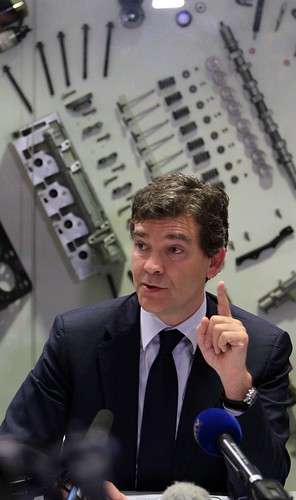
PARIS — I am sitting across from Arnaud Montebourg, a free-market villain and romantic hero, the pol selected by Frenchwomen in a new French Elle magazine poll as a top candidate for having “a vacation love affair.”

The tall, elegant Montebourg, dressed in a black suit and black tie and flanked by black leather couches and two BlackBerrys, sits in a chic office above the Seine, charged with the quixotic task of reviving French industry.

He famously sent sales of Breton sailor tops surging when he posed in one to promote his “Made in France” campaign. The 50-year-old bachelor’s love life has been avidly chronicled, including the night he and his former girlfriend, the attractive black TV journalist Audrey Pulvar, were attacked by racist thugs.

Montebourg became the Socialist kingmaker after a surprisingly strong result in the 2011 presidential primary on an anti-globalization platform against Ségolène Royal, a former boss, and her former partner, François Hollande.

“I failed the first time, but it doesn’t mean I’ll fail the second,” he said about the presidency, speaking in a mix of French and British-accented English.

The Economist called him “the Enfant Terrible” for fencing with foreign capitalists with such ferocity that he almost got sacked. His apache dances with moguls are at odds with the government’s “Say Oui to France” campaign designed to lure foreign investment and stop France from dissolving into Greece.

Montebourg’s defenders say he represents the French tradition of dirigisme, wanting a king, desiring direction from the top, even though the government now, as part of the European Union, has fewer tools. His matador boldness, contrasted with Hollande’s blandness, plus his anti-corruption crusades and suspicion of the market economy — he even suggested temporary nationalization — have made him a champion to those who want a Charles de Gaulle de gauche.

Some of his irritated colleagues at the Finance Ministry at Bercy refer to the Minister for Industrial Renewal as “the madman on the third floor.” It’s hard to fathom how he can be for deglobalization and foreign investment at the same time. But as he looks for unrealistic solutions to problems that may be insoluble, many “Les Misérables” here admire him for keeping his dukes up, which keeps their hopes up. A bit of an outsider himself — he did not get into the top political school, his grandfather was a wealthy Algerian and he calls the Algerian war and colonization unresolved — he relishes sticking it to the bourgeoisie.

As a young lawyer, he helped defend Christian Didier, the killer of René Bousquet, the Vichy chief of police who went above and beyond Nazi instructions to send Jews, including thousands of children, to death camps. In 1995, he nearly forced then-Prime Minister Alain Juppé out of office over the legality of his apartment. In 2001, he petitioned to impeach President Jacques Chirac, under investigation for financial malfeasance. In 2011, he demanded that the louche Dominique Strauss-Kahn apologize to Socialists.

He got into a sizzling row with the American tire titan Morry “The Grizz” Taylor after Taylor said he would not rescue a French factory because French workers are “lazy, overpaid and talk too much.” Montebourg dismisses that as “nonsense,” and told me that “in Germany, one works less than in France, this needs to be known,” providing booklets to back it up. But, given conflicting French statistics, he may be living up to the sobriquet he awards himself: “professor of optimism.”

The French have to learn that if employers can’t fire someone for not working, they’ll never hire anyone. It’s hard to believe that the country that gave us a musical based on Victor Hugo’s revolutionaries really needs the government to guard against the latest Disney remake of a bikini beach movie. But Montebourg defends the French threat to blow up the European-U.S. economic talks because they want to keep barriers to U.S. movies and television. Then he concludes, charmingly, “We love American movies.”

I ask him about another contentious move: blocking Yahoo’s Marissa Mayer from buying a controlling stake in DailyMotion, the French version of YouTube, which was denounced in a Times editorial as protectionism “grounded in meaningless nationalism.”

“I didn’t say no to Yahoo,” he insists. “I said let’s make it 50/50. Let’s go together and not let the big eat the small.” He told Yahoo it was not in such great shape and had “made several companies disappear.”
Arnaud Montebourg
And to think Jean-Baptiste Colbert, Louis XIV’s finance minister, asked businessmen how the government could help. “Laissez-nous faire,” one replied, giving birth to the term.

“I agree with Romain Gary, who said that nationalism is to hate others, patriotism is to be proud of ourselves,” Montebourg says. Asked about the French malaise, he says: “The problem comes from us. We doubt ourselves too much.”

He says he trusts President Obama to “clean up the mess” on N.S.A. snooping. “I blame Facebook, Google and all the Internet giants who agreed to spy on us,” he said, “so Europe is going to be tougher on these companies.”

French business leaders are howling about Hollande’s wishy-washy economic policies. And Nicolas Sarkozy, once excoriated by Montebourg as “a spoiled brat who uses France as a toy that does not belong to him,” is dropping a handkerchief.

Can Sarko make a comeback?

“Maybe,” Montebourg replies roguishly. “Maybe in handcuffs.”


Joseph Huben upstate NY
This column has evoked a reflexive derision of the French. A reflex patently congruent with the propaganda of the far right in this country. By these standards, what American would want to pay 10% more in taxes for universal university education, health care, and an affordable wage? What American does not want the unemployed to suffer so they do not stop looking for a job or take a substandard job that pays less? Have we become a nation of somnambulants who resent the higher standard of living afforded our French allies because we envy our rich masters? and hate those with lesser means? and march in step to detest food stamp recipients: children, the elderly, and the disabled, the primary recipients of this "European" socialist program? Perhaps, because the French or Germans or the British do not recoil in horror at the mention of socialism we consider them depraved. Americans believe, without evidence or thought, that socialism is a bankrupt disincentive to innovation, growth and prosperity.
As time passes, we all come to recognize that the cause of the financial collapse, and the stupid crippling austerity programs are thinly veiled corporate subversions that punished nations and then hobbled people with debt and a lower standard of living in the name of their entitled right to profit by any means. Governments can be corrupted but as the number of people exploited grow governments fall.
The French are not done as long as the French people take to the streets.


John McBrideSeattle, WA
My father's mother was a Caron; her ancestors were sent to "the new world," aka, Canada, from Breton in the early 18th century. I've always had a predeliction for France, especially after cementing the affection with a 3 month stay there in 1990, and several returns since.

Still, Maureen, your column exhibits a certain, ... a certain.... je ne sais quoi.

Monsieur Montebourg is, probably, charming to you in "a vacation love affair” sense; but there is nothing you reveal about him that leads me to conclude he's France's next Napoleon.

if the French select him, fine, but based on what I've learned, my pragmatism leads me to be wary and to suspect that DeGaulle, for his many faults, would likely suit France better, raised up from his grave.


art seaman Kittanning, PA
There is always this idea the Ms. Dowd knows something we do not. She is so in tune with the a vante-garde that we do not know. It is tiresome. I give up. What is she talking about?
Who are these people, and who cares?


Mike Roddy Yucca Valley, California

I like this man, especially when he talks about nationalization. That's what we need to do with our own out of control oil companies.

Montebourg is also correct about establishing limits on American cultural intrusions. The French realize that our television programs, especially the ones on cable (Real Housewives of New Jersey, anyone?) will make you dumber, and cause some of us to crack up.

We need someone like him over here, since our top pols are all preselected by the corporations, and self censor even in their dreams. The French will be fine.


Liam Jumper South Carolina

Marcel Pagnol, the late but critically important French film producer and author, placed emphasis on content of an image. He didn't use it only as a tool to tell a story.

This is an apt metaphor for France versus the corporatist West. France tries to be a national culture that values the human experience. The corporatist West does not. They see humans as mere tools. This is the problem in our democracy. Our democracy was supposed to be a government where people could find a balance between profit-focused economics and the human experience. At the moment, we're be corralled into being tools - tools where a third of our children live in poverty, tools where amassing obscene fortunes is celebrated while a third of the population cannot afford healthcare, tools who are intentionally priced out of quality education.

Montebourg's 50/50 split is to preserve the French identity while being part of the mainstream. This isn't new. The French have long worked to protect French language from morphing into English with a French accent.

Of course Montebourg wants ability to reject American film and TV trash.

A few years ago a fellow at my favorite Wisconsin coffee shop was extolling French fries being re-named Freedom Fries. I told him I agreed and we should immediately march up to the high school and demand they rename the French class Freedom class.

Freedom is a mix of economics that serves the people with a strong dose of valuing the quality of human experience ahead of tools.


charles san francisco
“I blame Facebook, Google and all the Internet giants who agreed to spy on us..."

Whatever the merits of the other points made here, this one is on the mark. We get outraged over government spying, but it was enabled, indeed made inevitable, when we allowed those companies to pursue business models based entirely on spying on their customers. We can only pray the Europeans do indeed stick to their guns on privacy--someone has to!


Kenneth Bergman Ashland, OR
Monsieur Montebourg's spirit is admirable, and so is his willingness to tell international corporations that France doesn't want to be taken over by them. He seems to recognize that international corporate largess always comes with strings attached, and that the corporate mindset these days is exploitive, not constructive. Unless they are controlled in some way, these corporations move into a country, privatize their profits while socializing the costs, then move on at their whim after having saddled the country with burdensome debt. (Here, I'm including financial institutions as well as outfits that actually make or mine something.) That's already happened in South America and in some of the smaller European nations like Portugal, Spain, and Ireland (Greece is a special case). Now, these corporate exploiters are moving on to richer countries where they hope to get a bigger bang for the buck.

So I'm glad to know that Montegourg is offering some resistance to corporate greed. There's not many nations that are willing to do that in these times.


Pat Choate Washington, Va.
Montebourg is making national industrial policy -- the approach to economics that has worked so well for Japan, South Korea, Taiwan, Singapore, and most of all China.

Would he consider becoming an American and participating in our paralyzed political system?


Rob DL Connecticut
The French Revolution changed the world. What France needs now is some of that pride and spirit to break away from the fundamentally flawed and ill-conceived European Union.

It is ironic that the country most instrumental in making the European Union a reality, also seems to be the country suffering most from it's existence.

French culture is in a stranglehold, and the biggest single culprit is the common currency -- a currency that has become symbolic of their plight. France, and the rest of Europe, thought that ratifying the Lisbon Treaty would enable them, once again, to act with one voice on the world stage, but instead it's drowned that voice out and turned it into a political sideshow where you can be guaranteed a bureaucratic debacle (or a summit!) every other month.

The European Union was, among other things, an attempt by France and Europe to augment and consolidate their power, but instead it has diminished them to resemble a pathetic soap opera with Paris garnering one of the leading roles.

The French people got it right when they rejected the EU constitution in 2005, shocking the rest of Europe in the process. They'd be wise to try find more of that spirit of rebellion today; their future and culture literally depends on it!


Paul Nevada
"It's tough to be French", hey it's tough to be a US Citizen. I even have health care and a root canal/crown is going to be close to $2000. Ten years ago the combo might have been $800 or so with insurance. The little guy continues to get squeezed. Bourgeoisie businesses like doctors keep entrance out with a combination of licensing and the colleges do the rest with gouging tuition. I say let the flood gates open and issue a visa to anyone from any county with a medical license. Since we bluster so much about "free markets" let the medical profession squeal a little when the wages drop due to competition from foreign labor. Now what was this article about? Oh year, it's tough to be American, I mean French. It is all about perspective: plutocrats see it one way, we see it the other.


Doug Broome Vancouver
Quel audace! The nerve, the chutzpah!
The U.S. has completely surrendered to parasitic plutocrats who create nothing but financial destruction with their funny money games. American workers have entirely relinquished the proceeds of their doubling of productivity to the one per cent.
And Montebourg rejects the robber baron model.
He thinks workers should share in productivity increases! He says "Non!" to vulture capitalists.

He doesn't understand that globalization means inevitable misery for workers and endless trillions for fiancial parasites. It reminds one of de Gaulle telling Monaco he would cut off their electricity and water if they did not immediately reveal the specifics of tax evasion by rich French based in Monaco. He completely failed to appreciate how tax evasion by billionaires helps the cheated country.

Maureen, I don't know how to give you the news of dirigisme. You see, the elite of the French elite goes to a sort of super-college called the Ecole Nationale d'Administration. The French completely fail to understand how robber barons represent the national interest. Au contraire, they think that people trained in public policy have a better conception of the national good than, say, a CEO of Goldman Sachs whose interest is narrow and greed-focussed.
And they will intervene in the market when the market harms the country! They expect the rich to pay! They say non to suspect deals.
Guess what? French workers have done much better than American workers!


Doug Terry Maryland, DC Metro area
What has long been amazing to me is that anything gets done in Europe. In Paris, in particular, long lunches with lots of flowing wine are almost required. When an American company went over to France to help produce a French version of a crime drama, they were shocked to find that the whole crew, actors, camera people, everyone, expected to break down and stop for a two hour lunch. They were accustomed to working straight through and hoping they'd be done before midnight

Europeans generally get a lot of vacation time, about double what American's take. As vacation rolls around, whatever work the person had been doing is dropped. Too bad. It can wait.

A few years ago, I turned on French television in my hotel room. There were urgent bulletins being broadcast about who might leave at what time. For a few minutes I thought Paris was being evacuated because of a terrorist threat. Only after watching for awhile did I put 2+2 together: It was August and the bulletins were for the vacation evacuation. Parisians with different numbered license plates were being told when they could join the mad rush to the beach and mountains. Soon, the town would be empty. For the whole month.

Yet, work does happen. Sometimes. Look at the stunningly beautiful Millau bridge in southern France if you don't believe the French are still capable of great accomplishments. It is just that work isn't allowed to interfere with one's personal life so much as it does here.


gma Telluride, Colorado
Meanwhile Airbus is selling tons and tons of airliners. It is nearly August Maureen. Follow the crowds and leave Paris. Lots of stuff going on elsewhere, esp. in Toulouse.


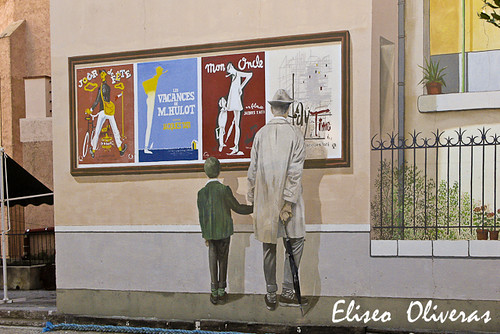
Jacques Tati in Cannes


7.7.13

Maureen Dowd gives a taste of sour grapes; Her readers know better
Comparatives inventories of American perspectives on few things French

Sour Grapes


PARIS — VERSAILLES lived again at haute couture week, as designers paraded their let-them-eat-cake creations, hand-stitched with gilt embroidery and trimmed with guiltless fur — frousfrous that no real women can wear and few can afford.

On Friday night, Christian Lacroix offered his homage to Elsa Schiaparelli, but even high fashion couldn’t lift Paris from its low mood. “Liberté, égalité, morosité,” Le Monde declared.

Joie de vivre has given way to gaze de navel. The French are so busy wallowing in their existential estrangement — a state of mind Camus described as “Should I kill myself, or have a cup of coffee?” — that they don’t even have the energy to be rude. And now that they’re smoking electronic cigarettes, their ennui doesn’t look as cool. It’s not that they’ve lost faith in their own superiority. They’ve lost faith that the rest of the world sees it. The whole country has, as Catherine Deneuve says of her crazy blue moods, une araignée au plafond — a spider on the ceiling.

On Place Vendome, Christian Lacroix was dispatching models in black crepe chiffon peplum basques — whatever they are — while on Avenue Hoche, Lacroix’s dentist was bemoaning the black crepe City of Lights. Holding a cigarette in a waiting room filled with Picasso-print pillows, Dr. Gérard Armandou told how his patients, always prone to pessimism, are even more filled with malheur now as they sit in his chair contemplating tous les problèmes, including “not going anymore on holiday to Egypt.”

“Cocteau said the French are Italians in a bad mood, but now there is more morosity,” he said. “We are connecting with nostalgia. What is nostalgia? Where the present doesn’t agree with the hope that you got in the past.”

He said there are widening chasms between sectors of French society — old and young, natives and immigrants, “smokers and nonsmokers, homosexuals and non-homosexuals.”

“Enter conflict, where before there was none,” he said. “The French people, maybe they think too much. The happy stupid don’t see the problem.” People with joie de vivre, after all, are simply not paying attention.

“It’s not the end of the world,” Dr. Armandou said with a Gallic shrug. “It’s the end of one world.”

The French have higher rates of taking antidepressants and committing suicide than most other Europeans. And while arguing about how to move forward, they feel trapped in the past, weighed down by high unemployment and low hopes, the onerous taxes that drove Gérard Depardieu to flee, conflicts with immigrants, political scandals, Hollande fatigue, Germany envy, economic stagnation, a hyperelitist education system, and cold, rainy weather that ruined the famous Paris spring. Instead of confronting the questions at hand — how to adjust to globalization and compete with the Chinese — the French are grieving their lost stature and glorious past, stretching back to the colonial empire, the Lumières, the revolution, Napoleon, even the Jazz Age writers and artists. They’re stuck in a sentimental time warp as vivid as the one depicted in Woody Allen’s “Midnight in Paris.”

“In 1945, France was on the losers’ side, but this reality has long been masked by the political speeches of General de Gaulle and François Mitterrand: they both maintained, in their own way, the idea that it remained a great power promised to an exceptional destiny,” the historian Christophe Prochasson told Le Monde. “After they left office, the French continued to live on that belief.” Today, he added, this illusion is disappearing gradually and “France is a country in mourning.” What is lacking now in France, he said, is the music of history, “the capacity to contemplate tomorrows that sing.”

It doesn’t help that as they come to grips with their dashed illusions of grandeur, the French find out that their own government and America’s have them under the spyglass. “L’Oncle Sam se comporte très, très mal” (Uncle Sam behaves very, very badly), Le Monde scolded in a front-page editorial last Monday.

“I know we can be unbearable but not to the point where you are entitled to put mics at our place,” said Philippe Manière, the managing partner of Footprint management consultants.

A 2011 BVA-Gallup poll conducted in 51 countries revealed that the French were even more pessimistic than Afghans and Iraqis. As the sociologist François Dubet told Le Monde, “If France doesn’t get all the Olympic medals and all the Nobel Prizes, the French consider it hopeless.”

Manière complains about how “disgusting” the Disneyfied Champs-Élysées has become, with hordes of teenage tourists snapping pictures of themselves in front of Ladurée, the macaroon shop, and pictures of the French without even a “s’il vous plait.”

“The intersection of globalization and the French spirit is especially painful,” he said. “We have this feeling that everything we were used to is disappearing and what we are offered is not as good.” The French gave up the franc but don’t want to give up anything else to mesh into a bland global society.

“The French are very conceptual, very cerebral,” Manière said. “We need to have more than food and TV. In America, it is not treason of an ideal if you want to watch TV all day, whereas in France it is.”

It is a measure of their desperation that the French have become fixated on American-style happiness studies. Claudia Senik, a professor at the Paris School of Economics and the Sorbonne, has become a media darling discussing her research on French malaise. Living in France, with its unyielding judgments about talent and its locked labor market, reduces the probability of being happy by 20 percent, she says.

Though everyone else flocks here to be dazzled, the French are less satisfied than the average European. She calls it “a cultural trait” linked not only to circumstance but to values, beliefs and behaviors passed from generation to generation, and exacerbated by madly competitive schools that are hard on self-esteem. In others words, unhappiness has been bred into the French bone. When French citizens emigrate, she said, they take their tristesse with them.

“Our happiness function is a little deficient,” she said over espresso at Le Rostand across from the Jardin du Luxembourg. “It’s really in the French genome.”
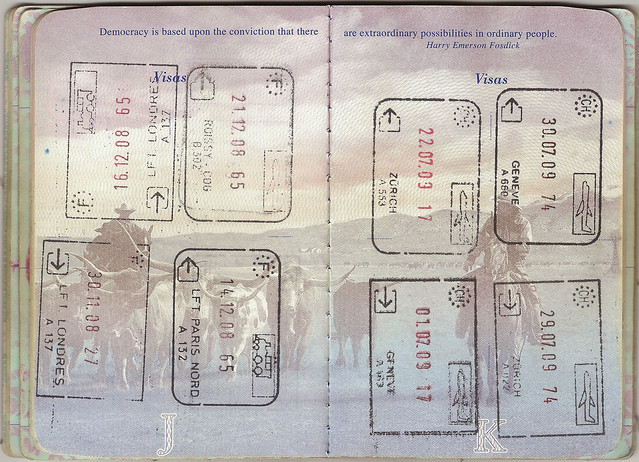

USA Passport: France, Switzerland


John Morrison Chapel Hill, NC
It seems fashionable to trash France these days. Bear some facts in mind.

1. They spend half what we do on health care with better results. And no one is heaved out onto the street because he can't pay an outrageously inflated hospital bill.

2. The French eat better than we do and have less obesity.

3. They scowl at "helicopter parenting" which is a rank weed in the landscape of American culture.

4. They have a strong belief that a balanced life is important. No, the overworked American is not more productive and he ain't that happy either.

Do they need to have a more agile economic system? Yes. But they don't need the meatgrinder we have relegated ourselves to as a (very sorry) nation.


Mike Roddy Yucca Valley, California
The French are better than we are, because they like to think in depth about anything whatsoever. Americans were always a little weak here, but now we're a joke. Only in America can a politician get in front of a camera, deny global warming, say he answers only to The Lord, and keep his hands in the trough. It's because the voters are too stupid to pay attention, and if we do, we're too lazy to call them on it and kick them out.

Maureen, I fear that you misunderstand ennui and unhappiness, too. French intellectuals for centuries have distrusted the happy, untroubled soul. It's because once you comprehend the idiocy and meaningless of the world, it should lead to despair, or you're not paying attention.

Further evidence of French superiority is Paris. The buildings are beautiful, and built to last. More important, even today's Frenchwomen have an unforced sexiness about them that makes our public idols like Aniston and Kardashian look like Walmart dolls. French women have full, sexy lips, but they're real, and they move, it's all instinct. When they think, on the other hand, it's with a functioning mind.

I think I'll move there. Marriage proposals from Paris accepted.


Larry Eisenberg nyc
Anatole France, Zola & Manet,
What a brilliant cultural display!
No centuries of slaves,
Or segregation knaves,
Grows more secular by the day.

Ms Dowd sees the French through her eyes,
Not kindly, her insights unwise,
Sees a land in distress,
Minus our Repub mess,
Chacun à son goût I surmise.


Clyde Wynant Pittsburgh, PA, USA
If the French are distressed, I can fully understand why, for they have much to lose. For many reasons, we don't. In the U.S., we measure history in decades, not centuries. We build ticky tacky malls and then tear them down a scan't twenty years later, only to be replaced by even more hideous public buildings. And our citizens applaud such "progress." To us, new is better. We never learned that newness is transitory....

One stroll through The Marais is more life-affirming than a day-long trudge through most American cities, where humans are considered a "problem" to be dealt with, so that the cars can hurtle forward at full speed and where buildings are built not to accomodate those beings, but to impress the Board of DIrectors.

Nostalgia for the past can be maudlin and pointless, when it seeks to evoke a "time that never was," but I believe the French know better.


George Michigan
I think this is exactly like talking only to people in Georgetown and the Upper East Side (which might be only one place in Paris) and then writing about how "Americans" are feeling about the world.


Jim Lockard Ventura County, CA
We just spent 6 weeks there - Paris, Lourdes, Bordeaux and Amboise - everything seemed just fine with those we spoke with. My sense is that the column focuses on a certain socio-economic level of the Parisian population. We heard laughter, saw couples embracing, and people enjoying themselves everywhere we went. And we did not encounter a single snooty waiter.


Carolyn Egeli Valley Lee, Md.
I don't blame the French for being upset. Globalization has ruined so many wonderful cultures, with its dreadful homogenizing of everything. Watching HGTV shows of international real estate is downright depressing over all. The same housing all over the world and the same businesses too, makes me sad. I love to visit Paris, and had some close friends there for many years. Paris is a treasure. And so is the population of the French. But then I love Europe. They seem to know how to live. They savor things.


Mary Scott NY
“We have this feeling that everything we were used to is disappearing and what we are offered is not as good.”

Ms. Dowd could, indeed, have been writing about the US.

"Hello, sadness" reflects the state of mind of so many Americans.


Rob DL Connecticut
What is most unsettling is that this article about a fragmented, fearful, and dissatisfied France can also apply to many nations in the West, including the United States.

The world today enjoys the highest standard of living it's ever known, but it sure doesn't feel like it. We see scientific breakthroughs that seem to belong to a different planet when compared to the many negative stories we have to endure everyday across the news. Computers, smartphones, and all these wonderful gadgets that facilitate our lives -- even entertaining us when we want -- are not enough to cloak what seems to be a very insecure world on the brink of something unpleasant.

I don't know what France needs. I don't know what we need. There is certain to be no silver bullet for any country's problems. But what I fear most, not just in France but in capitals across the globe, is a modern-day Robespierre with an appeal that's enough to tip the scales in favor of a reality we don't want.

Demagogues are the most destabilizing menaces in a depressed economy and culture. With a President here at home dipping in the polls, and a European Union that continues to struggle to justify why it shouldn't be dissolved, one can't help but feel a power vacuum starting to form. With high unemployment and one culture after the next bemoaning the loss of national identity, the climate seems right for a gifted orator to captivate the masses. If that happens, like history promises, we may be in for a long ride.


Kevin Rothstein Jarama Valley
The French will always have their culture; their art; their architecture; their food; their music.

Most of all, the French will always have Paris.

The French will also always have the best national anthem: 'La Marseillaise".

Although most of us are familiar with the music, here is a taste of some of the lyrics; food for thought, especially in these trying times:

To Arms, Citizens
Form Your Battalions
March, March
Let Impure Blood Water our Furrows

And of course, without French assistance, we would still be singing "God Save The Queen".

Vive France!! Vive America!!


Scott W Chapel Hill, NC
Maybe there is a correlation between happiness/contentness and mediocrity. Lots of Americans are very happy eating processed food at chain restaurants, but that does not mean the experience is better than eating like the French. The French just pay more attention to their food, wine, and public spaces, demanding the best and maybe always worrying the quality is slipping. If I had one day left to live, would I rather spend it in Paris, or . . .?


Doug Broome Vancouver
Ma chere Madame Dowd, to be pessimistic is to be French.
It is the Americans who pursue mindless happiness while the French are surrounded everywhere by the great slogan of the Revolution: Liberty, Equality, Fraternity (community). And equality means equality, so don't pity a whiner like Depardieu.
Americans worship their economic elites; the French worship their intellectual elites, regarding their billionaires as occasionally necessary evils to be taxed.
Madame, if you will ouvrez vos yeux, you will note that the French exhibit their pessimism over wonderful food and wine free of the tasteless toxicity of industrial agriculture.
And should existence weigh down on them, they have the world's best medical system to help them.
You refer to "unyielding judgments about talent and its locked labor market."
In the U.S. workers are disposable objects of the oligarchy. In France, workers have rights and neoconservatism is rightly despised as anti-human. The economy serves the people.
The highest universities, les grandes ecoles, are accessible only through merit. Like all of education, they are tuition free. The French are a people who watch intellectual discussion on television and where glorious theatre and opera offer cheap seats for the disadvantaged though the country is largely free of the poverty of America. Education starts at three, and is free.
What the French do not like is the gross materialism and maladroitness of Americans. They value liberty, equality, fraternity.


tom mcmahon millis ma
Perhaps if the French are in such bad straits we, the United States should help them. For all the French bashing, socialist calling, ill will names that are perpetrated upon the French by inconsiderate Americans. Maybe they should all remember if not for the French, the American revolution would not have succeeded. The French are a long and proud people, who have tolorated immense immigration form afar, An influx of devout Muslims, and Africans, have not complained too loudly about it. It has strained social services, furthered unemployment. The EEC is a mess. France insured birth of the United States, it being the 4th of July weekend what could be a more apropo time to say thank you in lieu of, oh I can't say it, flagged it gets me !


Mr. Grolsch Prospect, Kentucky
France is uniquely France and something America will never be. But, then, America is exceedingly uniquely America and something no other country (save maybe Canada, on a bad day) could ever be. I remember the slightly rude cab driver in Paris who, realizing how close to the line he had gone, directed his passenger-seat German Shepherd to bark "Au Revoir" to the nice Americans as we were delivered to Georges Pompidou Centre from the Champs Elysee. And for those for whom the cities of France are too much, God bless the French countryside and the villagers who welcome Americans even as the same villagers may scorn our country's politics but politely ask if we agree with our President. The 1%/47% phenomena are as present in major French cities as they are in their American counterparts, but Frenchmen and women have a maturity and an at least apparent wisdom about life that we do not. A wisdom my wife thinks comes from the frail little women carrying their daily baguettes on the sidewalks from the stores, their faces lined with the reality of World War II, its prelude and aftermath.


Rima RegasMission Viejo, CA
“We are connecting with nostalgia. What is nostalgia? Where the present doesn't agree with the hope that you got in the past.”

These words may have been uttered by a philosophical Frenchmen, but they are certainly applicable on this side of the pond. I keep hoping that the aftermath of the 2010 election that brought our own moroseness to the forefront, will be followed by the 2012 election spunk. We all need a big dose of it for election 2014, if we are to effect the needed changes that will make our present agree with the hope we had in the past.

As for the French? They'll snap out of it too. For all of their plaintive wails of the moment, their pride and ingenuity has always won the day. La Marsellaise, which every French citizen knows, contains these fighting words:

Tremblez, tyrans ! et vous, perfides,
L'opprobre de tous les partis,
Tremblez ! vos projets parricides
Vont enfin recevoir leur prix ! (bis)
Tout est soldat pour vous combattre,
S'ils tombent, nos jeunes héros,
La France en produit de nouveaux,
Contre vous tout prêts à se battre

--

Tremble, tyrants! and you, traitors,
The disgrace of all groups,
Tremble! Your parricidal plans
Will finally pay the price! (repeat)
Everyone is a soldier to fight you,
If they fall, our young heros,
France will make more,
Ready to battle you!

It's time we all snap out of our collective funk.


JT FLORIDA Venice, FL
In your column, you devote 176 words to the musings of a fashion designer's dentist on Avenue Hoche regarding his views about the current mindset of the French.

I would suggest that you get out and talk to average French people. While sipping espresso in the Jardin du Luxembourg with a professor who quantified a 20% "reduction of happiness" due to "unyielding judgments about talent and its locked labor markets", I wish you could have asked her to walk with you around different parts of Paris to see if the reality of meeting real French people squares with her conclusions. Better yet, do it yourself.

Also, go outside of Paris in the summer where French people go to enjoy their concept of "working to live" rather than "living to work." We can learn from the French.


Janice Badger Nelson Park City, Utah, from Boston
"There is but one Paris and however hard living may be here, and if it became worse and harder even – the French air clears up the brain and does good – a world of good." -Vincent Willem van Gogh

So true. Cannot wait to go back this summer.


reader, writer Northern NM
I love France and the French.
It's not the same as when I was there about a half century ago. Les Halles was still in existence. I saw Edith Piaf sing at the 'Bobino' with her ami Theo Sappo. Bud Powell was playing at the 'Blue Note'. And I was a student at the Sorbonne. I love the food, the architecture; the "je ne sais quoi".
Most of all they believe there are more important things than money.
Vive la France with all their imperfections.


simzap Orlando
To perk up their spirits maybe the French should visit Newark and Disneyland. In the one you have the industrial slag that's the end product of consumerism. In the other the banal silly escape that we allow ourselves to make believe the consumerism doesn't lead to the Rustbelt or Bangladesh. The French should feel lucky and proud. And, If they don't they only have to go out and see places that aren't as great as France.


virginia c. maxwell london
We spend half the year in a little French village in South West France - the picture you paint is unrecognizable to us. The markets, the excellent schools, the self sufficiency, the close family ties ..... the excellent hospitals and medical care, infrastructure in good shape --hmmmn


Jose Lopez Argentina
I prefer not to generalize but... Better read and educated people tend to think more comprehensively and by extension better understand the massive challenges that confront us as a species in the 21st century. I know both France and the US quite well and overall the French are far better read and educated than people in the US-- this is especially true in the humanities, philosophy, and the arts- the reflective fields. In France, critical thinking, complex objective analysis, and self reflection is highly valued. Unlike in the US, the French do not believe that there is a tech fix for all that ails you. As a species, we are in it up to our chins - some recognize it others don't.
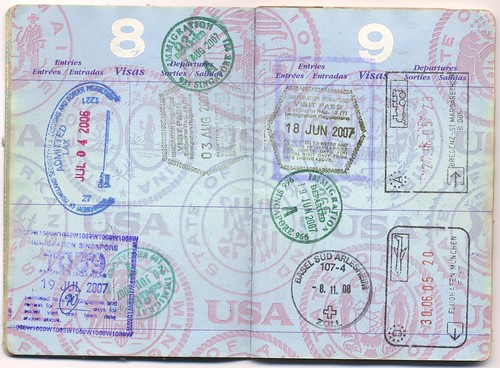


USA Passport: USA, Singapore, Austria, Germany, Switzerland


Stephen C. Joseph, MD Santa Fe, NM
As many have said above, Paris (especially Couture Paris) is not France, just as BosWash is not America.
As for all the downsides, Maureen, they are not, most unfortunately, unique to today's France.
What country is not currently disgusted by bad government, worried about aimless youth, distressed by shallow and meaningless 'entertainment', terrified by economic uncertainty, hapless at the zoom of technology, adrift in a world turned upside down?
The French are, and have always been, ahead of the global philosophical and emotional curves. And the love/hate between us and them are only two faces in self-reflecting mirrors.


Chris McMorrow Waltham, Mass.
According to Ms. Dowd, " The French are grieving their lost stature and glorious past, stretching back to the colonial empire, the Lumières, the revolution, Napoleon, even the Jazz Age writers and artists." I've got a secret for you, Maureen: the French have been grieving that for a long, long time, not just since Hollande.

During a recent 2-weeks vacation in Paris, my first trip back since my 20s, I was struck by several things that didn't jibe at all with what the guidebooks say about the French.

First, I was hard pressed to find anyone even remotely elegantly dressed. Paris was as slobby as many parts of the US.

Second, the food was simply not as good as I remember it. In fact, the Globe carried an article just last Sunday attesting to what my boyfriend and I had begun to suspect: Outside of a 5-star restaurant, many restaurants are all ordering their food pre-made to be heated up in microwaves. Mon Dieu! It explains why our repeated repasts of confit au canard, boeuf au poivre, et crème brulee, all had a certain sameness to them. The food "scandale" is so upsetting that the government is considering regulations to force restaurants to reveal the source of their menu options.

So, if the French seem more pessimistic than usual these days--and not just due to their recession--it's understandable why. Bad dress, bad food, and bad weather all in the same year? It's enough to make a grown Frenchman (and woman) cry.


William Dufort Montreal
“The French are very conceptual, very cerebral,” Manière said. “We need to have more than food and TV. In America, it is not treason of an ideal if you want to watch TV all day, whereas in France it is.”

That may be. But I beg to differ. I am what you wold call a French-Canadian. My French ancestor came here in the mid1600. We still speak French, my first language, as you may have noticed.

My family and I share an apartment in Sète, a town in the south of France, where I spend at least a few weeks a year. We do not meet the fashion people who you mingle with. But I am happy to count a lot of French citizens as friends. And, believe it or not, they are not what you describe. They are just normal people, like my friends, here in Montreal or in Vermont, where I used to have a boat on Lake Champlain. they, the French, have gotten over Napoleon years ago, so stop portraying them as some kind of zombies.

I don't really know what point is, but what I can tell you is this: People, in France, in America, in Canada and Quebec and the world over want peace and liberty.

Unfortunately, a lot of governments are on the wrong side of the equation.
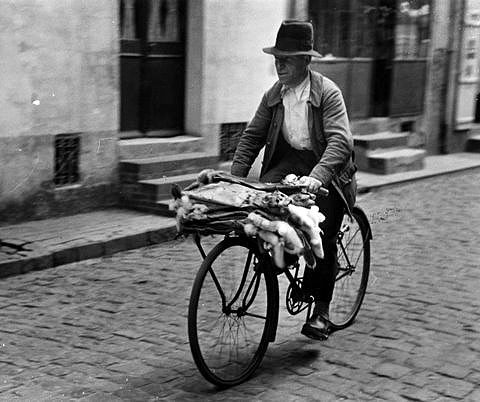
France: man on bicycle transporting animal hides (1934)

kila Oregon
Mlle. Dowd would probably have a less elitist take on the present French mentality if she left the chic arrondissements and went out to the 'burbs and the countryside and the smaller cities. That's where people do not feel that M. Depardieu's tax rate is so affreuse, that M. Hollande's socialist government should not have ministers with undeclared Swiss accounts and Mme Sarkozy shouldn't be flying on the public tab. The French aren't suffering from malaise. They are suffering from justifiable rage.


JT FLORIDA Venice, FL
We can learn from the French. After their debacle in Vietnam ended in 1954, the U.S. engaged in the same for its longest war until Afghanistan and the outcome in Vietnam was a loss of lives and prestige for the United States. The French correctly pointed out the folly of Iraq and while participating with the U.S. in Afghanistan, they urged caution about surges.

We are linked to France in so many respects. As you toss around a few French phrases in your column, be reminded that about two thirds of English comes from French.

Enjoy your time in France and please, before using words like 'rude' and 'malaise' to describe the French, talk to ordinary citizens about their lives and I think you will find that while they see many challenges ahead, the social critics in the fashion industry, films and even newspapers aren't always accurate.


Ellen Balfour Long Island
I believe the Germans have a word for this French malaise: Weltschmerz, which means world pain, a dissonance between what is and what one wants it to be. Sacre bleu! I am not French, but I do feel a kinship with their values.


B CA
Eh, bien: the ability to maintain traditional French culture has waned since the early 1990's. Part of l'ennui has been the creeping Americanization that began during that decade, from mergers and lay-offs to McDonald's and disposable to-go coffee cups.

The French are right to feel that France is no longer French. The problem is not immigrants or smoking bans, but global corporates taking over.

It's telling that Dowd interviewed not France's modern-day Emile Zola, but... a French management consultant. Vraiment.

Still, it's not over for the country that gave us Hugo, Flaubert, Balzac, and the beacon of truth, Zola. Grab your copy of Zola's "Germinal", Scott, we'll be waiting "aux barricades"!


gblico paris
Most of the negative reactions to Ms Dowd's column seem to be from people who have visited France but have really never lived there. In order to truly understand the French you need to live in France. Being a tourist or an otherwise occasional visitor won't cut it. My wife and I have lived in France for the past 10 years, a period during which we've gained invaluable insights and knowledge about a great country - enough to agree almost completely with everything Ms Dowd has said!


Jeanette Pontacq Point Reyes Station, CA
The French have indeed lost something they treasured ..... France. The former country is now directed from Bruxelles by unelected technocrats. The new President is unloved and boring. Elites genuflect before Germany and the United States. And their vaunted culture is about to disappear via the new free-trade deal.

The French people, like the Americans, thought they were electing someone who would change things for the better and pay attention to them. Instead, like us, they got the reverse.

But at least they still have wonderful cuisine, socialized medicine, long vacations (if they have work), and charming cities and villages. We should be so lucky.


Ben New York City
Many of the points Ms. Dowd raises are conceptually correct. The focus of this being in France is something I can only listen to. I've been to France 3 times, and sadly in Paris three times I've been food poisoned, robbed at gunpoint and nearly pushed off the observatory deck on the Eifful Tower. Having said that, I still esteem the Left bank and the world Henry Miller wrote about, if not glorified. It seems that globalization is eating away at the heartstrings of us all. I agree that IS a sad state...but...we are only in the opening innings of this game. The digital age is less than 20 years old and we need to see if the tearing away of culture is the burning of the forrest to purge disease so a bountiful prosperity can grow anew.

Or at least, I'd hope so.

The problem is we may NOT have an above ground culture for future generations because the WWW (that is, world without wonder) might take 1000 years to clean itself of the toxins we've spewed into the atmosphere.

We've all grown too quickly taking basic nature for granted. One day we shall not have basic resources...THEN the sadness of our current state shall be rationalized.


PT Taiwan
The France you see as a tourist and the France you experience as a resident are two different things. Case in point: I got terribly sick while studying in France and had to stay in the hospital for close to a month. The whole family panicked at the thought of an exorbitant medical bill since my travel insurance doesn't cover what they deem a non-emergency illness and my parents were preparing to take out some of their savings to pay for it when I was finally discharged. Much to our surprise, not only were I promptly enrolled in "Couverture Maladie Universelle" (Universal Illness Coverage), the hospital stay itself and all related medical costs were retroactively covered. More importantly, the French doctors who treated me took time to go over my medical history and diagnosed me with a rare genetic condition which had gone on unnoticed in my native country for several years since its onset.

I doubt my fate would be the same had I been studying English in an Anglo-Saxon country.


The 9th Waltham, MA
It's probably more that we're waking up to just how badly we've let the world slip away from us and fall into the hands of perhaps the most criminal set of governments we've ever been aware of. The best and worst of times, the summer of our discontent, heading for a winter of same, and sensing the chaos of communications that messes with all of nature's cicadian (sic,) rhythms (those 1ce-every-17-years cycles). And these are the times that try men's soles and heels, as we pound the pavement looking for jobs, hoping to find a way to walk the oceans or teleport ourselves, as we can't afford the fare Our manufacturing has been torpedoed by Bangalore, under-bid by Beijing, but one happy fella buys up rusting machines and parts from dead US plants and sells to China--his own Youth In Asia program, while over here we're heading for the real kind of euthanasia or, unwilling participants that we are, preparing for a walk on the genocide.

Who wouldn't feel morosité at the miseries we hired to run our government for us. A speaker of the housers claimed to repeal impeachment by incanting, "Impeachment is off the table." Our current president (was he jokin' us when he claimed to have lectured law students in Con. Law for a decade? He doesn't even know that you cannot amend the Constitution by secret "presidential findings, holdings, decision statements, or even by statute. And his attorney general is a holder of the view that "due process" and "judicial process" are distinguishable.



France vs. USA - Las Vegas

18.6.13

War on Syria

Mr Roland Dumas

In an interview with the French TV station LCP, former French minister for Foreign Affairs Roland Dumas said:
‘’ I’m going to tell you something. I was in England two years before the violence in Syria on other business. I met with top British officials, who confessed to me that they were preparing something in Syria.
This was in Britain not in America. Britain was organizing an invasion of rebels into Syria. They even asked me, although I was no longer minister for foreign affairs, if I would like to participate.
Naturally, I refused, I said I’m French, that doesn’t interest me.’’
Dumas went on give the audience a quick lesson on the real reason for the war that has now claimed the lives of tens of thousands of people.
‘’This operation goes way back. It was prepared, preconceived and planned… in the region it is important to know that this Syrian regime has a very anti-Israeli stance.
Consequently, everything that moves in the region- and I have this from the former Israeli prime minister who told me ‘we’ll try to get on with our neighbours but those who don’t agree with us will be destroyed.
It’s a type of politics, a view of history, why not after all. But one should know about it.’’
Dumas is a retired French foreign minister who is obliged to use discretion when revealing secrets which could affect French foreign policy. That is why he made the statement ‘I am French, that doesn’t interest me’.  He could not reveal France’s role in the British plan as he would be exposing himself to prosecution for revealing state secrets.
There have been many disinformation agents in the British and French press, many of them well known ‘leftist’ war correspondents and commentators, who have tried to pretend that Israel secretly supports Assad.  Those who make such arguments are either stupid, ignorant or deliberate disinformation agents of NATO and Israel.
Israel’s support for Al Qaeda militants in Syria has even been admitted by the mainstream press. For example, Germany’s Die Welt newspaper published a report on June 12th on Israel’s medical treatment of the Al Qaeda fighters.
Israel planned this war of annihilation years ago in accordance with the Yinon Plan, which advocates balkanization of all states that pose a threat to Israel. The Zionist entity is using Britain and France to goad the reluctant Obama administration into sending more American troops to their death in Syria on behalf of Tel Aviv.
Of all the aggressor states against Syria, Israel has been the quietest from the start. That is because Laurent Fabius, Francois Holland, William Hague and David Cameron are doing their bidding by attempting to drag Israel’s American Leviathan into another ruinous war so that Israel can get control of the Middle East’s energy reserves, eventually replacing the United States as the ruling state in the world. It has also been necessary for Tel Aviv to remain silent so as not to expose their role in the ‘revolutions’, given the fact that the Jihadist fanatics don’t realize they are fighting for Israel.
This is the ideology of Zionism which cares no more for Jews than it does for its perceived enemies.   The Jewish colony is determined to become a ruling state in the Middle East in the insane delusion that this will enable it to replace the United States as a global hegemon, once the US collapses fighting Israel’s wars.
Israeli Prime Minister once told American talk show host Bill Maher that the reason why Israel always wins short conflicts, while the United States gets bogged down in endless wars. ‘’ The secret is that we have America’’, he said.
But Israel is itself slowly collapsing. If one excludes the enslaved Palestinian population, the Jewish state still has the highest level of poverty in the developed world with more and more Jews choosing to leave the ‘promised’ land, a garrison state led by mad men, an anti-Semitic entity threatening to engulf the world in war and destruction. Israel cares no more about its own working class Jews than any other ethnic community.
In fact, if the Likudnik crooks running the Israeli colony get their way, working class Israelis will be among the first to pay as they are conscripted to fight terrorists created by their own government. With orthodox Jews protesting in the streets of New York against Israel and Haredi Jewish minority opposing Israel’s rampant militarism, Zionism is coming under increased attack from Jewish religious authorities and non-Zionist Jews both inside and outside of the occupied territories.
This is not the first time that Roland Dumas has spoken out against wars of aggression waged by successive French regimes. In 2011 he revealed that he had been asked by the United States when he was foreign minister in the Mitterrand administration to organize the bombing of Libya. On that occasion the French refused to cooperate.  Dumas, a lawyer by profession, offered to defend Colonel Gaddafi, at the International Criminal Court in the event of his arrest by Nato.
Dumas was also vocal in condemning France’s brutal neo-colonial bombing of the Ivory Coast earlier in 2011, were death squads and terrorists similar to those later deployed in Libya and Syria were unleashed upon the Ivoirian population in order to install a IMF puppet dictator Alassane Quattara in power. Gbagbo was described as one of the greatest African leaders of the past 20 years by Jean Ziegler, sociologist and former member of the Advisory Committee of the UN Human Rights Council.
Gbagbo had plans to nationalize banks and wrest control of the country’s currency from the colonial finance institutions in Paris. He also wanted to roll back many of the worst effects of IMF restructuring by nationalizing industries and creating a functioning, universal free health service. All of this threatened the interests of French corporations in the former French colony. So, the Parisian oligarchy went to work to find a suitable replacement as caretaker of their Ivoirian colony.
They sent in armed terrorist gangs, or ‘rebel’s in the doublespeak of imperialism, who murdered all before them while the French media blamed president Gbagbo for the violence that ensued. Gbagbo and Gaddafi had opposed Africom, the Pentagon’s plan to recolonize Africa. That was another reason for the  2011 bombing of their two African countries.
The formula is always the same. Imperialism backs ‘rebels’, whenever its interests are threatened by regimes that love their country more than foreign corporations.  One should not forgot that during the Spanish Civil War of 1936, General Franco and his cronies were also ‘rebels’ and they, like their counterparts in Libya in 2011, were bombed to power by foreign powers, replacing a progressive, republican administration with fascism.
There are pro-Israeli fanatics in France who have used the analogy of the Spanish Civil War as justification for intervention in Libya and Syria. The pseudo-philosopher Henry Bernard Levy is one of them.  Of course, the ignoramus Levy doesn’t realize that the reason France, England and the USA did not officially intervene in the Spanish Civil War is because they were covertly helping the ‘rebels’ from the start. They enabled arms shipments to the Francoist ‘rebels’ while preventing arms deliveries to the Spanish government, who, like Syria today, were helped by Moscow. Anyone who has studied the Spanish Civil War knows that all the imperialist countries wanted Franco as a bulwark against communism.
There is nothing imperialism loves more than a rebel without a cause. What imperialism hates, however, are revolutionaries. That is why the ‘rebels’ which imperialism sends into other countries to colonize them on behalf of foreign banks and corporations, have to be marketed as ‘revolutionaries’ in order to assure the support of the Monty Python brigade of petty-bourgeois, ‘ leftist’ dupes such as Democracy Now! and their ilk.
Dumas is not the only top French official to denounce the New World Order.  Former French ambassador to Syria Michel Raimbaud wrote a book in 2012  entitled ‘Le Soudan dans tous les états’, where he revealed how Israel planned and instigated a civil war in South Sudan in order to balkanize a country led by a pro-Palestinian government. He also exposed the pro-Israeli media groups and ‘human rights’ NGOS who created the ‘humanitarian’ narrative calling for military intervention by the United States in the conflict.
The subject was covered extensively by African investigative journalist Charles Onana in his 2009 book, Al-Bashir & Darfour LA CONTRE ENQUÊTE.
There are many more retired French officials who are speaking out about the ruinous policies of this French government, including the former head of French domestic intelligence Yves Bonnet. There have also been reports of dissent in the French armed forces and intelligence apparatus.
After the assassination of Colonel Gaddafi in October 2011, the former French ambassador to Libya Christian Graeff told French radio station France Culture that it was responsible for the diffusion of lies and war propaganda on behalf of Nato throughout the war.  Graeff also warned the broadcasters that such disinformation could only work on the minds of serfs but not in a country of free minds.
The power of the Israeli lobby in France is a subject rarely discussed in polite circles. In France there is a law against questioning or denial of the holocaust. However, denial of the Korean holocaust, Guatemalan holocaust, Palestinian holocaust, Indonesian holocaust and the dozens of other US/Israeli supported genocides is not only perfectly legal but is the respectable norm.
The same lobby which introduced the Loi Gayssot in 1990, effectively ending freedom of expression in France, would also like to ban any independent investigations of genocides whose narratives they have written, such as the Rwanda genocide, where Israel played a key role in supporting the ‘rebels’ led by Paul Kagame, who invaded Rwanda from Uganda from 1991 to 1994, leading to the genocide of both Tutus and Tutsis. Many serious scholars have written about the Rwandan genocide, which the Israel lobby repeatedly uses as a case study to justify ‘humanitarian’ intervention by Western powers.  The Zionist thought police would like to see such authors prosecuted for ‘negating’ imperialism’s disgusting lies on African conflicts.
Now, the Israeli Lobby is forcing the (their) French government to prosecute twitter messages which the lobby deems ‘anti-Semitic’. This is one further step towards the creation of a totalitarian state where any criticism of imperialism, foreign wars, racism, oppression, perhaps eventually capitalism itself could fall under the rubric of ‘anti-Semitism’.
These people are sick, and those who cow down to them are sicker. Perhaps the etymology of sickness, a word cognate with the German Sicherheit (security) according to dictionary.com, is not a coincidence. For what is particularly sick about our society is the cult of security,  endless surveillance, ubiquitous cameras, the cult of the all seeing eye, the prurient gaze as part of the incessant discourse on terrorism by those who specialize in the training of the very terrorists they claim to be protecting us from.  Whether or not the words security and sickness are linguistically related, they are certainly cognate in a philosophical sense.
Roland Dumas and others like him should be highly commended for having to guts to say what so many others are too morally corrupt, too weak and cowardly to admit.
As the French government and its media agencies drum up hysteria for war on Syria, Roland Dumas, now in the twilight of his years, is warning people of the consequences of not understanding where Israel is leading  the world. Will enough people heed the warning?

11.6.13

Fees should only be charged from gains, not from the portfolio principal

JEFF SOMMER, in the NYTimes article 'For Retirees, a Million-Dollar Illusion,' when discussing our material needs in old age, informs us that 'A MILLION dollars isn’t what it used to be.'


Occupy Government Oakland
This is what 30 years of Republican economic policy have wrought: lower taxes for corporations and the rich, union-busting, 401k plans instead of pensions, serial bubble-busting markets, capped by the great recession. America used to be a rich country. Now we can't afford to pay the help.

Isn't it time to give the country back to the people?


FSB Iowa
The number of responses to this simple factual article indicates the scope of the problem. Some of the responders never earned much, others saved carefully but lost in the collapse of pensions or the markets, others inherited, others had no families willing or able to help, others are relatively prosperous but even that's not enough under present conditions, others are prosperous but they worry anyway. Their responses reveal the fact that most older people in this country worry quite a bit about money, with cause.

The problem is the SYSTEM. I was fortunate to spend some of my teaching life in Denmark and France. Unlike me, my colleagues never worried about their financial future. They worried about their parents' health, their children's careers, or how they wished to spend their leisure time, but fear of the lack of money never entered their minds. They were free! Their reputedly burdensome tax rate was about 10% higher than ours. 10%! Think about it--full health care, child care, disability, unemployment insurance, excellent public transportation, good retirements, and no need to help your neighbor who can't get food stamps. . . .

This they did with less total income than the US and despite the ravages of two continental wars. This shows what a communal system with the will to provide for human needs can accomplish


Mr. Smith 2


RC MN

By transferring trillions of tax dollars to the banking industry, the self-serving Fed has suppressed interest on savings, which in turn has inhibited spending, investment, and growth. This massive transfer of wealth to the 1% is responsible for the current recession (the coincident effect on jobs is shown at http://economix.blogs.nytimes.com/2013/05/03/keeping-up-not-getting-ahead), targets particularly the middle classes and seniors, and is a major factor in the time bomb of failing retirement plans for middle class savers who can't risk the stock market casino, despite the Fed trying to push them into it. Fed policy is also embedded with corollary events designed to transfer wealth to the 1% well into the future (for example fees and long-term interest payments), and has become a long-term structural impediment to middle-class retirement.


ALR NYC
Why all the sour grapes in the comments relating to the retirement income of two civil service retirees? What's the difference in their benefit package and yours? It's likely that the more generous pension plan stemmed from collective bargaining--something that 's dying in this country because younger workers sneer at the concept of unions. Yet, they have a strong sense of entitlement.

Public employees are the most highly unionized segment of the US work force. Maybe that explains the fact that they enjoy superior benefits? Quit your covetous whining and stop forcing this country into a race to the bottom. Demand a defined pension and improved benefits for yourselves instead of carping about the injustice of people who worked hard throughout their careers leading a relatively secure, non-elaborate retirement.

If you want to criticize imbalance and injustice, turn your sights toward the bankers, politicians, and 1%ers who want to render the middle class obsolete by brainwashing you that a civil service pension earned (not bestowed ) after a career if hard work is immoral. Being able to retire at a reasonable age with sufficient assets should not be a luxury.


PH NY
“The bottom line is that people at nearly all levels of the income distribution have undersaved."

I disagree. In order to save one needs to have enough to save. I grew up middle class (one parent was a teacher) yet we saved, went on vacations and had enough to get by.

With the demise of pensions and with the majority of income going more and more to just the uppermost few people have less and less to save - yet need to save even more. Add in a bad economy, harsh times and that's what is seen today. It will only get worse with union bashing and even fewer pensions.

The US is rapidly heading towards a 21st century version of feudalism, with corporate overloards and an ultra-rich oligarchy.


Hipolito Hernanz Portland, OR
The way we compensate investment management firms is totally corrupt. Fees should only be charged from earnings, not from the portfolio principal. They can and do charge fees for the privilege of losing your money.


d. lawton Florida
Most workers do not have "professions", they have jobs. They are not the bosses, they do not make the decisions, they have no say in their hours or working conditions, and the US is a worker abusing country and culture. That's why people in their late seventies and eighties CAN'T continue working, and your ideas are completely unrealistic.


Josey Michigan
So my money was in iras, and group funds, both were wiped out to less than a $3,000. balance. I was downsized, and out of work since 2009, my husband has been on 32 hour weeks at work, and his ira is worth less than $1,000. a year for years worked, as a large chunk of it was lost in 2008.. How can we possibly follow all these saving for retirement suggestions? We are really struggling now to make ends meet. We live simple, no credit. I garden, can food, sew, cook from scratch, very basic life style. The future is bleak and we have no options except to watch it all play out. Trillions of dollars of retirees money was lost in 2008. Yet that is ignored nothing has changed, so how can our kids be sure they won't get ripped off by the banks as well???????


thebigmancat New York, NY
Wow - I never thought of working past 65! Because nobody over the age of 45 can get hired as anything but a greeter at Wal Mart. When will SOMEONE debunk this retire at 70 nonsense?? Unless you are an attorney or a famous writer, you're on the ice floe by 65 at the outside. More like 55. Please NY Times - give me a break already!


Realist New York
I am curious, what planet do these writers live on. I am 59 and even thou all my friends worked hard and did not live it up like myself we don't even come close to having a 1 million in the bank. for us it will be work until we drop dead, no retirement.
So because of 30 years of trickle down wealth we are worse off than our parents even thou we did the right thing. the stock market and banks made sure that we would never make enough off our savings. When i was kid in the 60s i could have a saving account that earned 6% interest and your telling me bonds make 2.2% what a joke. we were robbed.


FunnyAboutMoney Private
Some of us are not crazy about the prospect of working until we drop in the traces.

If you're happy in your job, be our guest!

Oh...btw...baby boomers may be needed, but in the current age-hostile atmosphere in the US, you may be sure we will not be hired. An academic laid off at 64, I tried to land jobs that ranged from "looks like the job description was written with me in mind" to hilariously menial. Finally one dean admitted there was no chance his or any other college would hire someone of may age into a full-time position with a living wage. It would be nice of all us old bats and buzzards could get work, but reality is different from nice. Alas.


Shirley Abbott Tomkievicz New York, NY
I worked ten years past 65.. Had no pension or 410K from my job. Did have IRAs, funded by me. I used Vanguard and Fidelity and followed all the rules for conservative investing, being assured that if I was a good little girl and followed the rules, I could count on 5% safely. Got taken to the cleaners by the bankers in 2008. Pulled out just in time to save a bit. Without social security I would be in real trouble. Now I keep reading ads and getting mailings urging me to trust the same sharks. With what is left. The market is an excuse for picking the pockets of small investors.


GinaB North Carolina
I've been poor my whole life. I am relatively highly educated, having put myself through the University of Michigan for a BA in English and then on with an MFA from Western Michigan University. I am single, childless, and have few family members. Not the most popular gal in the universe or even a room, I might finally be able to buy a house in about three years. That house is all I will have and savings and the 6% that's taken from my pay for a pension and so on. Not a million, nothing close, and alone I will remain (I can tell by now, age 47). The United States isn't my favorite country in the world because I don't come from a normal family or upbringing and therefore I've felt rather unaccepted here my whole life (I've lived in other countries for a try). I've never fit it or felt secure here. More often I have felt judged and alone, still I am educated, hard working, but honest to a fault. And as I write this I realize not one word matters. None of this matters. Slowly we become more invisible until finally we're gone. And like memories this million-not-even-close can't be taken with.

the right way?

carrobin New York

Having come to New York at age 24 to build a career in the publishing field, I have few savings and a very small pension at age 69. Fortunately, a few years in the editorial side of a financial firm helped to boost my social security in the long run, but only a larger-than-expected inheritance from my father gave me some hope of coping with retirement. I'm now working as a temp at a publishing company and can't afford to stop working without giving up most of the perks of living in Manhattan--but I'm not ready to return to the sultry doldrums of South Carolina, either. I don't know how anybody can afford to "retire" these days.


ed g Warwick, NY
The rule of one is usually the proof that this rule is bogus.

Americans like every other group are moved by the story of the success of one and ignore the fact that many multiples of that one case were failures.

Try to think of it this way: if everyone could be a success at making money, that is we all were millionaires, then the new level of poverty would be having a million.

The answer is not accumulation of wealth beyond any reasonable need but public policy that everyone is deserving, entitled and due a minimum regarding opportunity, resources, housing, employment, jobs, retirement, etc.

And that there is a moral, economic, social and ethical point where those having more than that point (i.e. $5,000,000) must yield it for the common good.

Unrealistic? Unfair? Unchristian?

Of course should you accept the rules of the games defined by sociopaths who are like the mentally directed hoarders seen on TV. Making money, especially excessive amounts of paper with pictures of dead presidents is unethical, undemocratic, poor economics and sinful.

Not sure an alternative is needed? Then justify the condition of the world and most of the six billion or so lost souls crawling around on the surface of this rock called earth.

We don't need royalty via blood or wealth. And we don't need to be forgiven for something called sin. We need equality and respect and a new direction to correct the horrors of powerlessness and poverty.


York ME kittery ME
What a laughable article this is.

Bernanke has utterly destroyed the bond market.....1-3% returns now? "Tapering" is going to destroy the value of bonds out there. Holders will be wiped out.

All done to herd people into stocks....which Bernanke has succeeded in kiting to the moon...great. What happens to these folks when the markets "correct"? Wiped out.

Oh, cash, yeah, great.....the great Bernank has now started a currency war worldwide with the constant printing......what happens when the great Bernank panics and prints more? What happens Ben?

Not to worry tho, right? You and the gang of six big TBTF banks are busy ramming thru floating rates for Money Market funds, and controls on withdrawals when panic sets in.....so you can wipe those folks out as well......

And precious metals.....you guys took care of those with the manipulated smashing of the metals market in early April.....a ton of paper but no metal. Complete farce. But hey, you scared the American public away from this one last safe haven here! And the really wealthy are getting to sock metals away at rock bottom prices.

And that's what counts? Right Ben?

You, Mr. Bernanke, have it absolutely locked for them. So the real interesting article would have been about what you plan to do after you leave the Fed early next year.....back to Princeton, or a lovely corner office somewhere that you have to show up at just once or twice a year.....

NYT....its time to start writing the truth.....


Blog Archive