13.2.11

Where is the American activism?
Perspectives

Bob Herbert, the distinguished NYTimes editorialist, looks at the crowds in Cairo and asks where is the American equivalent (When Democracy Weakens: While Egyptians celebrate, we should look at the American democracy...)


RT Koenig
Memphis TN
Maybe it's time the American people took a lesson from the people of Egypt and take to the streets. Maybe it's time that the poor and middle class working people of America staged their own Day of Rage. Maybe it's time for a million unemployed workers or the millions who have lost their homes to a recession sparked by corporate greed to march on Wall Street.
Just this week we learn that JPMorgan Chase, one of the banks responsible for the recession and the recipient of millions in bailout money, defrauded thousands of American servicemen and their families. In some cases, the second largest bank in the US illegally foreclosed on U.S. servicemen and their families. If this latest outrage doesn't spark protests, then perhaps we are no longer capable of outrage.
A Day of Rage cannot overlook Washington, where as Herbert has noted so eloquently, neither party is representing the interests of the poor, the unemployed and the underemployed. Americans fortunate enough to still have jobs need to stand together in protest lest they be next.
It's time to get off the couch and take to the streets. As the people of Egypt have shown us, even the powerful cannot afford to ignore millions united for change, freedom and fairness.
Mel Presley
Roskilde, Denmark
There are only two factions that stand in the way of a second American revolution, a true political revolt to end rule by the corporate dollar and restore democracy.

One is partisan cheerleaders for the Republican political cause.

The other is partisan cheerleaders for the Democrat political cause.

The Times' readership seems to divide itself about 10 percent to 90 percent, respectively, in favor of these two opposing camps. There's virtually nobody at all with enough common sense to see that we'll never find our way out of the woods, and away from plutocracy, until we all reject BOTH.

Street protests won't work in America as they have in Cairo, because we face a far more entrenched enemy than the Egyptians. But there's one thing that would. We need to form a temporary, single party of national unity with the sole purpose of having it write a Constitutional amendment to mandate modern, multiparty voting and an end to private funding of campaigns. If we all elect its candidates, and boycott all those of our fraudulent two-party system, we'll have the mother and father of confrontations on our hands, and if the sitting powers attempt to annul the election results, we might even start a civil war. But I can't see any other way to restore rule by the people - which is what democracy is supposed to be in the first place.
Greg Shimkaveg
Oviedo, Florida
Mr. Herbert, I don't disagree with you. But consider this: where were the disadvantaged and disenfranchised last November? I am a local Democratic Party offficer down here in Florida. I worked for and financially supported a lot of candidates, hundreds of hours and over a thousand dollars. On November 2nd, 2010 I worked the polls. Who showed up? Angry white guys in pickup trucks. Literally scowling as they drove in. Who didn't show up, despite being phoned and visited and mailed? Young people, union people, women, ethnic and racial minorities. I stood in front of a polling place in a middle-class and let's say unpretentious part of the county. The registration breakdown was evenly split between Democrats and Republicans. There were lots of diverse people on the rolls. And who bothered to make a difference? Mostly white, mostly male, and overwhelmingly Republican voters.

So we reap what we sew. A decennial election, as you know, controls who decides redistricting. Our Legislature is now filibuster-proof Republican and we have a 2-to-1 Republican Congressional delegation, in a state with a 300,000 Democratic registration plurality. Despite two Constitutional Amendments that did pass requiring fair districts, the Legislature is busy Gerrymandering to keep themselves and their party in solid control until at least 2020.

So, thanks to all those who sat on their hands in November. And as you point out, Mr. Herbert, they'll be the ones most likely to suffer all the more. But they are not just blameless victims. 
joseph parmetler
austria
The USA is not a democracy any more. Or is there anyone int he US government who represents the 40 million poor in the country? Is there anyone who represents the unemployed?
Is there anyone who represents the fading middle classes who are fighting for their economic survival?
Look at the cabinet of the president? They all represent big money.
Look at the Republicans in Congress: the poor, the unemployed do not even exist for them; if they keep on as they do now, Republicans will advance Egyptian conditions in the USA.
This is a corporatocracy or plutocracy.
LAS
Redmond, WA
The executive class holds American workers hostage by threatening to move jobs out of state or out of the country if their demands aren't met. Politicians, in fear of more job losses, then try to weaken the labor unions and accommodate the corporations' desires. Local TV stations are quick to publicize mass layoffs or plant shutdowns and blame them on public officials and labor unions.

States governments are set in competition with each other for the lowest tax rates. In Washington State the unemployment insurance tax rate was tied to the unemployment tax rate. With the increase in unemployment, the tax rate went up and a 36% increase was mandated, 36% above the current rate of slightly more than 1%. Business interests fought this and we all heard that 36% figure, even though the public did not hear that it was 36% of 1%. The unemployment tax fund was solvent, so the legislature canceled the tax increase. However, no one, not even the labor unions, even mentioned using the state's surplus to create a Tier V extension for the 99ers. As a result, the unemployment tax was reduced while there were 38,000 99ers in January, with 4000 more people per month reaching the end of their unemployment compensation with no job opportunities. The prevention of the tax increase was given away without any conditions requiring the hiring of the unemployed. Whatever slight power the state held, it threw away. This tax reduction was tacked onto the bill authorizing the continuation of the federal unemployment benefits extensions just as, in the other Washington, tax cut extensions were attached to the continuation of the federal unemployment extensions.

The corporations holler "Jump!" and public officials ask, "How high?" but it appears to be a lose-lose proposition for workers affected by mass layoffs.
SC
Indiana, PA
Even though it's hard to recall now, Americans did recently show the world that democracy works in this country--with the amazing 2008 grassroots campaign to elect Barack Obama. During the campaign, massive numbers of new voters came to the polls, and the country witnessed a groundswell of democratic participation.

BUT President Obama has betrayed that democratic movement. He has betrayed all of us who supported him in an effort to take this country back from the corporate, financial and military elite. It's sickening and grotesque to watch as Obama continually caves into their demands--the latest being his administration's proposal to drastically cut (by half) home heating assistance to the poor. Instead of pushing back, Obama has revealed himself to be a push-over. Obama has given up so much ground to the right-wing fanatics, that it will take another massive democratic movement to regain that ground. Let's hope the Egyptian people find better leadership, one who truly advocates for democratic and economic transformation that benefits ALL people, not just the wealthy and powerful. The Egyptians are leading the way now.
lure1
O'ahu
Oh cry me a river. I was on line the other day at the supermarket. A woman was using food stamps while yapping on her iPhone.

46% of all poor households actually own their own homes. The average home owned by persons classified as poor by the Census Bureau is a three bedroom house with one and a half baths, a garage, and a porch or patio
.
76% of poor households have air conditioning. By contrast, 30 years ago, only 36 percent of the entire U.S. population enjoyed air conditioning.

Only 6% of poor households are overcrowded. More than two thirds have more than two rooms per person.
The average poor American has more living space than the average individual living in Paris, London, Vienna, Athens, and other cities throughout Europe. (These comparisons are to the average citizens in foreign countries, not to those classified as poor.)

Nearly three quarters of poor households own a car; 30 percent own two or more cars.

97% of poor households have a color television; over half own two or more color televisions.

78% have a DVD player; 62% have cable or satellite TV reception.

73% own microwave ovens, more than half have a stereo, and a third have an automatic dishwasher.

As a group, America's poor are far from being chronically undernourished. The average consumption of protein, vitamins, and minerals is virtually the same for poor and middle class children and, in most cases, is well above recommended norms. Poor children actually consume more meat than do higher income children and have average protein intakes 100 percent above recommended levels. Most poor children today are, in fact, supernourished and grow up to be, on average, one inch taller and 10 pounds heavier that the GIs who stormed the beaches of Normandy in World War II.

While the poor are generally wellnourished, some poor families do experience hunger, meaning a temporary discomfort due to food shortages. According to the U.S. Department of Agriculture (USDA), 13% of poor families and 2.6% of poor children experience hunger at some point during the year. In most cases, their hunger is shortterm. 89% of the poor report their families have "enough" food to eat, while only 2 percent say they "often" do not have enough to eat.

Overall, the typical American defined as poor by the government has a car, air conditioning, a refrigerator, a stove, a clothes washer and dryer, and a microwave. He has two color televisions, cable or satellite TV reception, DVD player, and a stereo.

His home is in good repair and is not overcrowded. By his own report, his family is not hungry and he had sufficient funds in the past year to meet his family's essential needs. While this individual's life is not opulent, it is equally far from the popular images of dire poverty conveyed by the press, liberal activists, and politicians.

Of course, the living conditions of the average poor American should not be taken as representing all the poor. There is actually a wide range in living conditions among the poor. For example, over a quarter of poor households have cell phones and telephone answering machines, but, at the other extreme, approximately one tenth have no phone at all. While the majority of poor households do not experience significant material problems, roughly a third do experience at least one problem such as overcrowding, temporary hunger, or difficulty getting medical care.

The best news is that remaining poverty can readily be reduced further, particularly among children. There are two main reasons that American children are poor: Their parents don't work much, and fathers are absent from the home.

In good economic times or bad, the typical poor family with children is supported by only 800 hours of work during a year: That amounts to 16 hours of work per week. If work in each family were raised to 2,000 hours per year the equivalent of one adult working 40 hours per week throughout the year nearly 75% of poor children would be lifted out of official poverty.

Father absence is another major cause of child poverty. Nearly two thirds of poor children reside in single parent homes; each year, an additional 1.3 million children are born out of wedlock. If poor mothers married the fathers of their children, almost three quarters would immediately be lifted out of poverty.

What bothers Herbert and his fellow travelers is that America doesn't satisfy his infantile delusions of a what perfect society should be. I hate to break it to you Mr. Herbert but in every society there have always been poor people. And there always will be. There have also always have been rich people who enjoy privileges. That's not gonna change either. But by all means, keep banging you spoon on the table of your high chair crying "poverty, tax cuts for the rich etc". It's futile but hilarious. Hope and change!


dc lambert
nj

As jobs are continually shipped overseas and we work ourselves to the bone, too scared that we will be next, too exhausted to think about it, the only thing that holds our entire economy together is fear: Fear that our credit scores will plummet and we won't be able to borrow money to survive. Fear that we will be next, that there but for the grace of God and bankers go I. What happens when the worst happens and our fear is realized, and our credit rating IS destroyed and we cannot borrow money anymore?

My good friend is in this situation and finds it liberating. She will be losing her house and has filed for bankruptcy. She cannot borrow money but, as she says, her 'credit score was already shot.' Suddenly she's 'rich.' She isn't paying for her mortgage as she forecloses. She is an educated lawyer but went under when her credit card companies jacked up the interest rates to over 30% when they thought she was late one month. (She had actually paid a month in advance since she was going away for a month, but they'd misapplied her payments and it took too long to straighten out.) Soon her interest rates were unsustainable and she slipped behind. She stopped paying, they refused to work something out, they harassed her and tried to get her to be afraid instead --but eventually, after years, she just stopped paying, and filed for bankruptcy.

People talk of a 'revolution' against the plutocracy, and imply pitchforks and torches. What if our revolution instead is to upend our entire economic system, which is based on usurious loans the banks strongarm us into having to take? I myself have always considered myself frugal but I simply could not function without borrowing. My children could not go to college, I could not drive myself to work or own a home or maintain it, or even a washer/dryer without borrowing.

Banks use our credit scores as giant sticks, but what if people stopped caring about the sticks? What if everyone altogether went into foreclosure? Or didn't care about their credit card scores--just as it is meaningless for the committee to declare everyone culpable in the banking disaster, so it's meaningless if everyone has a rotten credit score.

I don't think people would do this on purpose, because the risks are too great for most. But as jobs continue to be shipped overseas, and our Republican legislature continues to propose slashes to education, basic services, infrastructure, and so on, it seems that it would only take a very little for a tipping point ot be reached, and for the bulk of people to slip and fall into the quicksand of 'bad credit' and foreclosure.

Once that happens, our entire economy, based on borrowing - 'getting and spending' - will be pulled into the wake as more and more houses foreclose and more and more people go bankrupt and can't borrow. Since the chances of this happening are very high, and since the Republicans want to nudge it into being even more likely, one has to ask: Who is pulling the strings here? In whose interest is it that the American economy go under? My motto is to always follow the money. Here we see not only naked plutocracy, not only a plutocracy that cares nothing at all for the economy on which its based, but a plutocracy that, by its OWN decisions (joined with right wing politicians) is actively working to destroy the American economy on all levels, infrastructure, jobs, and debt. Why? This is the larger question.

6.2.11

not understood by a fearful and proudly ignorant population

Wallflowers at the Revolution
By FRANK RICH

A month ago most Americans could not have picked Hosni Mubarak out of a police lineup. American foreign policy, even in Afghanistan, was all but invisible throughout the 2010 election season. Foreign aid is the only federal budget line that a clear-cut majority of Americans says should be cut. And so now — as the world’s most unstable neighborhood explodes before our eyes — does anyone seriously believe that most Americans are up to speed? Our government may be scrambling, but that’s nothing compared to its constituents. After a near-decade of fighting wars in the Arab world, we can still barely distinguish Sunni from Shia.

The live feed from Egypt is riveting. We can’t get enough of revolution video — even if, some nights, Middle West blizzards take precedence over Middle East battles on the networks’ evening news. But more often than not we have little or no context for what we’re watching. That’s the legacy of years of self-censored, superficial, provincial and at times Islamophobic coverage of the Arab world in a large swath of American news media. Even now we’re more likely to hear speculation about how many cents per gallon the day’s events might cost at the pump than to get an intimate look at the demonstrators’ lives.

Perhaps the most revealing window into America’s media-fed isolation from this crisis — small an example as it may seem — is the default assumption that the Egyptian uprising, like every other paroxysm in the region since the Green Revolution in Iran 18 months ago, must be powered by the twin American-born phenomena of Twitter and Facebook. Television news — at once threatened by the power of the Internet and fearful of appearing unhip — can’t get enough of this cliché.

Three days after riot police first used tear gas and water hoses to chase away crowds in Tahrir Square, CNN’s new prime-time headliner, Piers Morgan, declared that “the use of social media” was “the most fascinating aspect of this whole revolution.” On MSNBC that same night, Lawrence O’Donnell interviewed a teacher who had spent a year at the American school in Cairo. “They are all on Facebook,” she said of her former fifth-grade students. The fact that a sampling of fifth graders in the American school might be unrepresentative of, and wholly irrelevant to, the events unfolding in the streets of Cairo never entered the equation.

The social networking hype eventually had to subside for a simple reason: The Egyptian government pulled the plug on its four main Internet providers and yet the revolution only got stronger. “Let’s get a reality check here,” said Jim Clancy, a CNN International anchor, who broke through the bloviation on Jan. 29 by noting that the biggest demonstrations to date occurred on a day when the Internet was down. “There wasn’t any Twitter. There wasn’t any Facebook,” he said. No less exasperated was another knowledgeable on-the-scene journalist, Richard Engel, who set the record straight on MSNBC in a satellite hook-up with Rachel Maddow. “This didn’t have anything to do with Twitter and Facebook,” he said. “This had to do with people’s dignity, people’s pride. People are not able to feed their families.”

No one would deny that social media do play a role in organizing, publicizing and empowering participants in political movements in the Middle East and elsewhere. But as Malcolm Gladwell wrote on The New Yorker’s Web site last week, “surely the least interesting fact” about the Egyptian protesters is that some of them “may (or may not) have at one point or another employed some of the tools of the new media to communicate with one another.” What’s important is “why they were driven to do it in the first place” — starting with the issues of human dignity and crushing poverty that Engel was trying to shove back to center stage.

Among cyber-intellectuals in America, a fascinating debate has broken out about whether social media can do as much harm as good in totalitarian states like Egypt. In his fiercely argued new book, “The Net Delusion,” Evgeny Morozov, a young scholar who was born in Belarus, challenges the conventional wisdom of what he calls “cyber-utopianism.” Among other mischievous facts, he reports that there were only 19,235 registered Twitter accounts in Iran (0.027 percent of the population) on the eve of what many American pundits rebranded its “Twitter Revolution.” More damning, Morozov also demonstrates how the digital tools so useful to citizens in a free society can be co-opted by tech-savvy dictators, police states and garden-variety autocrats to spread propaganda and to track (and arrest) conveniently networked dissidents, from Iran to Venezuela. Hugo Chávez first vilified Twitter as a “conspiracy,” but now has 1.2 million followers imbibing his self-sanctifying Tweets.

This provocative debate isn’t even being acknowledged in most American coverage of the Internet’s role in the current uprisings. The talking-head invocations of Twitter and Facebook instead take the form of implicit, simplistic Western chauvinism. How fabulous that two great American digital innovations can rescue the downtrodden, unwashed masses. That is indeed impressive if no one points out that, even in the case of the young and relatively wired populace of Egypt, only some 20 percent of those masses have Internet access.

That we often don’t know as much about the people in these countries as we do about their Tweets is a testament to the cutbacks in foreign coverage at many news organizations — and perhaps also to our own desire to escape a war zone that has for so long sapped American energy, resources and patience. We see the Middle East on television only when it flares up and then generally in medium or long shot. But there actually is an English-language cable channel — Al Jazeera English — that blankets the region with bureaus and that could have been illuminating Arab life and politics for American audiences since 2006, when it was established as an editorially separate sister channel to its Qatar-based namesake.

Al Jazeera English, run by a 35-year veteran of the Canadian Broadcasting Company, is routinely available in Israel and Canada. It provided coverage of the 2009 Gaza war and this year’s Tunisian revolt when no other television networks would or could. Yet in America, it can be found only in Washington, D.C., and on small cable systems in Ohio and Vermont. None of the biggest American cable and satellite companies — Comcast, DirecTV and Time Warner — offer it.

The noxious domestic political atmosphere fostering this near-blackout is obvious to all. It was made vivid last week when Bill O’Reilly of Fox News went on a tear about how Al Jazeera English is “anti-American.” This is the same “We report, you decide” Fox News that last week broke away from Cairo just as the confrontations turned violent so that viewers could watch Rupert Murdoch promote his new tablet news product at a publicity event at the Guggenheim Museum in New York.

Unable to watch Al Jazeera English, and ravenous for comprehensive and sophisticated 24/7 television coverage of the Middle East otherwise unavailable on television, millions of Americans last week tracked down the network’s Internet stream on their computers. Such was the work-around required by the censorship practiced by America’s corporate gatekeepers. You’d almost think these news-starved Americans were Iron Curtain citizens clandestinely trying to pull in the jammed Voice of America signal in the 1950s — or Egyptians desperately seeking Al Jazeera after Mubarak disrupted its signal last week.

The consequence of a decade’s worth of indiscriminate demonization of Arabs in America — and of the low quotient of comprehensive adult news coverage that might have helped counter it — is the steady rise in Islamophobia. The “Ground Zero” mosque melee has given way to battles over mosques as far removed from Lower Manhattan as California. Soon to come is a national witch hunt — Congressional hearings called by Representative Peter King of New York — into the “radicalization of the American Muslim community.” Given the disconnect between America and the Arab world, it’s no wonder that Americans are invested in the fights for freedom in Egypt and its neighboring dictatorships only up to a point. We’ve been inculcated to assume that whoever comes out on top is ipso facto a jihadist.

This week brings the release of Donald Rumsfeld’s memoir. The eighth anniversary of the invasion of Iraq is to follow. As we took in last week’s fiery video from Cairo — mesmerizing and yet populated by mostly anonymous extras we don’t understand and don’t know — it was hard not to flash back to those glory days of “Shock and Awe.” Those bombardments too were spectacular to watch from a safe distance — no Iraqi faces, voices or bodies cluttered up the shots. We lulled ourselves into believing that democracy and other good things were soon to come. It took months, even years, for us to learn the hard way that in truth we really had no idea what was going on.

Marie Burns
Fort Myers, Florida
In another New Yorker article, Malcolm Gladwell makes a strong case that social media do not a revolution make. He cites as a prime example the 1960 Greensboro lunch counter demonstration that grew exponentially within days, even though the only "social medium" in those days was the telephone. Gladwell explains that "high risk social activism" like the Greensboro sit-in (and the Egyptian uprising) "requires deep roots and strong ties." Reading a stranger's tweet that such-and-such is an atrocity -- even if it is -- doesn't make you want to risk your life for somebody else's problem. People show up at these high-risk events because the issues have deep meaning to them AND they have friends who share their beliefs and are participating in the demonstrations.

One of the minor upsides to the Egyptian uprising has to be all the Americans who suddenly discovered Al Jazeera was a news organization that knocked itself out to get the news on the air, even in English, despite the best efforts of our friend and dictator Hosni Mubarak. As Liz Sly wrote in the Washington Post, since the uprising began, Al Jazeera's "phone lines have been cut, nine of its staffers have been detained at various times, its satellite signal has been repeatedly blocked and on Friday, al-Jazeera said..., a 'gang of thugs' stormed its bureau, smashing equipment and setting it ablaze."

Sly added, "... in what represents perhaps an ultimate act of defiance to the effort to shut the network down, demonstrators in the square have rigged up a giant screen so that even those protesting can follow al-Jazeera's supposedly banned coverage."

I have no doubt the international media, including Al Jazeera, are responsible for saving many Egyptian lives. Mubarak's Plan B, demonstrated most forcefully on Wednesday & Thursday, was to take out the media so the government could proceed with more brutal measures against its own people. The media's success, which required incredible bravery on the parts of reporters, photojournalists & crews, exposed Mubarak & Co., and caused them to back off in the face of international condemnation. If ordinary Egyptian people are the heroes of Tahrir Square, the media are a darned close second.

So thank you again to Nicholas Kristof, Nicholas Kulish, Souad Mekhennet, and all the other Times reporters & other media personnel who risked their own lives to report the news and, in so doing, saved Egyptian lives.

The Constant Weader at www.RealityChex.com


Karen Garcia
New Paltz, NY
It is indeed laughable that our clueless mass media attributed the Egyptian uprising to Twitter and Facebook, when 40 percent of that country's people live on $2 a day and must spend 40 percent of their incomes on food. I can just envision the poor hungry hordes clutching their Blackberries and i-Phones as they plan their next insurrectional step.

Al-Jazeera may not be carried by the corporate American media, but that hasn't stopped millions of Americans tuning in via their laptops and PCs. As a matter of fact, most Americans get their news from the Internet these days, where a whole new world of unbiased, uncompromised-by-the-government sources of information are available. There is Truth-Out, Pro-Publica, Alternet, as well as countless other blogs and links throughout global cyberspace. We don't have to watch millionaire TV anchor Brian Williams hover helplessly in the background, as Richard Engel and Rachel Maddow tell it like it is. From the establishment side of things, Nicholas Kristof's daily New York Times dispatches have put a human face on the revolution through his heartbreaking interviews with ordinary Egyptians.

Tweets are for twits who don't have the attention spans to care about the difference between Sunni and Shia. Leave Facebook and Twitter to the likes of the Sarah Palins of the world who have nothing substantive to say. In her case, though, crow-like cackles would be a more apt description than innocuous little tweets.

Meanwhile, the USA, after more than a week of its "delicate tightrope" balancing act of not wanting to side with the Mubarak government, is siding with the Mubarak government in its obvious status-quo seeking "transition to Democracy." Hillary Clinton, the Goldwater Girl of yesteryear, has even resorted to repeating a Fox News rumor of an assassination attempt on torturer and dictator-in-waiting Suleiman. When all else fails, the Policeman of the World will use the fear factor (Islamophobia) to hasten the transfer of puppet strings from one USA-bribed despot to the next. Keeping the Suez Canal open for all that oil bound for our shores trumps the human rights of the Egyptian people. And even without benefit of American social media, the people in the square are aware of what's going on. Word of mouth and human-to-human contact still rule. Contrary to popular belief, the world can go on without with Facebook.

http://kmgarcia2000.blogspot.com/
 
 
geek
MA
Frank, excellent summarizing of last week's events. I see the problem in the US as two-fold, one being the prism of Israel through which everyone views all that goes on in the Middle East and North Africa part of the world. This distorted view reflects in out foreign policy as well.

The second point is that we are so used to the US being an active interferer/player in everybody's affairs that we expect immediate and instant reaction, by our diplomats, by our administration, and by our journalists and media. All these past 11 days, the media has been blaming Obama administration for being "tardy", for not doing enough, OMG what will happen to Israel? Without realizing that Egypt is an ancient civilization and a very mature and sophisticated one at that. The Egyptians are totally capable of creating their own revolution in their own terms. They are energized, they need time, we as observers can voice our support, but we should not interfere in their affairs. If they need help, let them ask. Let us not make another Iraq mistake. Lord, so much bloodshed, when the Iraqis are so capable to do their own revolution, they too are an ancient civilization, wisdom runs in their veins. Why did we have to cause so much pain?
 
 
Gemli
Boston
I suppose Americans in general suffer from the conservative disease of assuming that nations in turmoil probably deserve it. Those folks over there shouldn’t have let themselves be manipulated or exploited by their government. If the wealth of their country has been stolen by a few powerful individuals, and if jobs and resources are meted out by a handful of well-connected corporations, well, they asked for it. If religion is used as a force to interfere in citizens’ private lives, they should refuse to accept it. If they get their information from news media that have ties to the government, or that make outrageous, inflammatory partisan pontifications, or knowingly spread false information, they should change the channel and look for alternative sources. When Twitter and Facebook reduce information to short blurbs, or embed so much advertising in the content that the content is lost, they should know enough to unplug themselves and start communicating in full sentences again.

And when other nations look at us and shake their heads, we should forgive them for assuming that we deserve what we get, too.


20 spruce
MA
Our American civilization currently is more docile than Egypt's. We have lots to protest against, but remain uncharacteristically subdued.

The N.S.A. is enabled to spy into our private communications without warrant and in conflict with the Fourth Amendment. I didn't go out and protest. Did you?

The President campaigns against "stupid" wars, but he continues to wage an abysmal and stupid war in Afghanistan. No substantial demonstrations have followed.

Wall Street continues to bonus its nasty double-dealing crooks while the rest of us try to cough up enough money to keep our schools running with class sizes under 30. No protests in my town.

The Supremes mock the Constitution in Bush v Gore, followed ten years later by Citizens United. Which is more unbelievable, the decisions or the lack of protest?

Mr. Obama does Bush and Cheney one better by proclaiming he can keep Guantanimo prisoners jailed, even if found innocent in an American court of law! Again, no protests. (But then, these people are "the other," so of course we needn't worry about them.)

I have enormous respect for the Egyptians' courage. We, too, have been a courageous people in the past hundreds of years. May we find our way again, even if it finds us in the streets contending for what is right and honorable and undeniably American.


Maani
New York, N.Y.

I agree with Rich on his second point, but not on his first.

There is no question that the U.S. MSM has a very "1984" quality to it: "Who controls the past controls the future; Who controls the present controls the past." By not permitting access to Al Jazeera English (and other alternative media sites), the U.S. MSM has, as Rich points out, created a kind of "media blackout" of anything that is not U.S.-based (with the notable exception of the BBC).

However, I vehemently disagree with Rich's cavalier dismissal of social media as a crucial element in the events occuring in North Africa and the Middle East. It may be true that only 20% of Egyptians have Facebook or Twitter. But I would bet that among those in Tahrir Square and other gathering sites in Egypt, a wildly disproportionate number are among those 20 percent. As well, there is absolutely no argument that the very first protest in Tunisia - the one that effectively began the ENTIRE upheaval throughout the region, the protest tied to the self-immolation of a frustrated vendor - was set up via social networking; that non-connected citizens also participated is almost certainly the result of the "connected" spreading plans of the protest by word of mouth.

However, Rich's biggest faux pas is his central claim that social media could not have been a major underlying factor in Egypt because when the Egyptian government shut down the Internet (and access to social networking), the crowds only got bigger. It apparently doesn't occur to Rich that he has it exactly backward: it was BECAUSE people who had formerly had access to social media no longer DID that they were even ANGRIER, and, again, used word of mouth to increase their numbers.

Ultimately, Rich is wrong about social media's impact on the upheaval in the region. But he is correct that Americans have become "dumbed down" - particularly re foreign policy and foreign affairs - by a tightly controlled media that wants to "control the present."


Sandy Lewis
Lewis Family Farm, Essex, New York
Outrage and a Facebook Page That Gave It a Voice, Jennifer Preston, page A10, February 6th, 2011, The New York Times: If there is a face to the revolt that has sprouted in Egypt, it may be the face of Khaled Said.

That 28-year-old Egyptian businessman was pulled from an Internet cafe in Alexandria last June by two plainclothes police officers who beat him to death in the lobby of a residential building after they learned that he had posted a video on his personal blog showing them with illegal drugs.

The Egyptian police and security services have a well-earned reputation for brutality and snuffing out political opposition. But in Mr. Said, they unwittingly chose the wrong target.

Within five days of his death, an anonymous human rights activist created a Facebook page — We Are All Khaled Said — that posted cellphone photos from the morgue of his battered and bloodied face, the video of the corrupt police officers and other YouTube videos contrasting his corpse with pictures of his bright and smiling face from happier days. By mid-June, 130,000 people joined the page to get and share updates about the case.

It became and remains the biggest dissident Facebook page in Egypt, even as protests continue to sweep the country, with more than 473,000 users, and it has helped spread the word about the demonstrations in Egypt, which were ignited after a revolt in neighboring Tunisia toppled the government there.

“There were many catalysts of the uprising,” said Ahmed Zidan, an online political activist marching toward Tahrir Square for a protest last week. “The first was the brutal murder of Khalid Said.”

The Tunisian rebellion was set off after a fruit vendor, Mohamed Bouazizi, burned himself to death after being humiliated by the police. His desperate act led to protests, which were recorded on mobile phones, posted on the Internet, shared on Facebook and eventually broadcast by Al Jazeera.

But Mr. Said’s death may be the starkest example yet of the special power of social networking tools like Facebook even — or especially — in a police state. The Facebook page set up around his death offered Egyptians a rare forum to bond over their outrage about government abuses.

“Prior to the murder of Khaled Said, there were blogs and YouTube videos that existed about police torture, but there wasn’t a strong community around them,” said Jillian C. York, the project coordinator for the OpenNet Initiative of the Berkman Center for the Internet and Society at Harvard University. “This case changed that.”

While it is almost impossible to isolate the impact of social media tools from the general swirl of events that set off the popular uprisings across the Middle East, there is little doubt that they provided a new means for ordinary people to connect with human rights advocates trying to amass support against police abuse, torture and the Mubarak government’s permanent emergency laws allowing people to be jailed without charges.

Facebook and YouTube also offered a way for the discontented to organize and mobilize — and allowed secular-minded young people to seize the momentum from Egypt’s relatively neutered, organized opposition.

Far more decentralized than political parties, the strength and agility of the networks clearly caught Egyptian authorities — and American intelligence analysts — by surprise, even as the Egytian government quickly attempted to shut them down.

Mr. Said, who was from a middle-class family and worked in the import-export business, was not an activist or involved in politics: he was simply offended by the corruption he saw. After police officials lied to his family, saying he was involved in drugs and died of asphyxiation from swallowing a package of marijuana while in police custody, witnesses went public, telling their stories in YouTube videos. Cellphone photos of Mr. Said’s shattered and broken face began to circulate online and provided evidence that eventually authorities could not ignore.

“What made this case different is that Khaled Said was just an ordinary person,” said Gamal Eid, 47, a lawyer and executive director of the Arabic Network for Human Rights Information in Cairo. “He was just a guy who found evidence of corruption and he published it. Then when people learned what happened to him, when people saw pictures of his face, people got very angry.”

Mr. Eid said that Facebook, YouTube, Twitter and mobile phones made it easy for human rights advocates to get out the news and for ordinary people to spread and discuss their outrage about his death in a country where freedom of speech and the right to assemble are limited and the government monitors newspapers and state television.

“He is a big part of our revolution,” said Hudaifa Nabawi, a 20-year-old student in Tahrir Square on Saturday.“ Khalid Said was a special case. He didn’t belong to any faction, and he didn’t do anything wrong. He became the way to focus our perceptions around the oppression that all the youth all face


N. Ray
North Carolina
I was among the many tuned in for hours via laptop to Al Jazeera English for something of a real look at Egypt. As I watched I was impressed by the bravery of the AJE crews and the professionalism of their production. I also marveled that such a fresh window on the world was available in America only to those with both the equipment and curiosity to find and open it on the internet. And this in a "free" country, with a sizable Muslim population.

It is a measure of the pinched imperialism afflicting many Americans that we believe that a desperately poor Arab population is capable of revolt only because the white man has provided new and wonderful communication tools. Over the years, dictators much worse than Moubaric have been dumped by populations without any access to so much as a telephone.

However, the unavailability here of news outlets such as AJE, and the active hostility to them by the Fox News faction of our population, is yet more indicative of how deeply Americans have adopted an imperial outlook on the world. While AJE zeroed in on the drama in the streets, most of our domestic commentary centered on what sort of government would replace that currently running Egypt, and whether the new bosses would be friendly to the US, or to our extension in the Middle East, Israel, as usual, as though it were the 51st state. The running subtext was a near hysteria that some sort of jihadist regime would come to power. Beck offered that a caliphate would soon engulf the entire Middle East and North Africa, and maybe even Europe. American narcissism was on display in full color. It was all about us. A few words were spared for the poor in Egypt who have finally decided they have taken enough. But for the most part, the folks forcing the changing with their blood and courage were treated as little more than the chorus, occupying the streets while the stars of the show within the Egyptian and American governments got a "transition" all worked out and maintained stability. Heaven forbid that those Egyptian protesters should somehow derail our economic recovery.

Our narrative seemed to ask just who needs worry much over facts ordering the lives of little people in a poor part of the world that seems to cause us nothing but trouble, when we have so many interests to attend to world wide. Many Americans don't know and don't want to know about the problems of these foreigners. After all, the sun never sets on a real empire and the work at the acquisition of the resources necessary to sustain it. Most Americans seem to have accepted the difficulties of running their own, but they've also lost patience with and sympathy for the predictable efforts by the oppressed out there to improve their lives. Our own revolutionary ideals of freedom and liberty seem to have become little more than words spoken but not understood by a fearful and proudly ignorant population.

...is a Prague Spring in the Middle East, are the U.S., Britain and the EU now going to play the role of the old Soviet Union?

Ike Solem
CA
"As the United States and leading European nations threw their weight behind the Egyptian vice president’s attempt to defuse a popular uprising..."

Try replacing "defuse" with "violently crack down on" maybe?

Isn't this the also same General Omar Suleiman who was deeply involved in the 'secret' CIA proxy rendition-torture program of the past decade? The person closest to Mubarak? How is that not like removing Stalin and installing Beria in his place?

Suleiman and Mubarak should both be encouraged to leave the country immediately, and a rapid election schedule should be implemented, with the Egyptian military serving a temporary peacekeeping role.

From PBS, 2007:

CIA’s Confirmed Proxy Dentention Facility Prisons in Egypt:

1. Tora Prison , South of Cairo

". . . Infamous for decades, the prison has held thousands of the country’s security detainees. . . . Most prisoners are transferred to Tora after their interrogations have been completed, and it is only at this point that a detainee becomes an officially recognized prisoner. Generally, after any injuries from torture have healed, detainees may receive visits from their family or lawyer. . ."

2. State Security Investigations Stations, Lazoghly

". . .Located behind black-painted walls and defended by machine-gun nests on each corner, Lazoghly Square is one of the country’s most notorious addresses. Rounded up in early morning raids, political dissidents and Islamists are often taken here first for processing and, according to consistent accounts from former inmates, for torture. . . [which] involves prisoners being beaten, suspended over the edge of doors by arms tied behind their backs, subjected to cigarette burns and electric shocks, sexually harassed, deprived of sleep and food, and forced to watch relatives being tortured."

3. Mukhabarat al-Aama Headquarters, Cairo

"Situated in the Abdeen area of Cairo, Mukhabarat al-Aama is the headquarters of the General Intelligence and Security Services, headed by General Omar Suleiman. The Mukhabarat usually receives rendered detainees for initial interrogation. . . "

4. State Security Investigations National Headquarters, Nasr City

". . . a torture room is also allegedly close to the [50] cells so that detainees, even when not being tortured themselves, were privy to the constant screams of others."

It's now obvious that the U.S. "plan to bring democracy to Middle East" (endorsed by the G8, no less) was just window dressing to justify the war for oil in Iraq (where police just fired on protesters, another Tunisia-inspired situation being ignored by U.S. media).

Apparently, the last thing our Washington-Wall Street nexus wants is democratic outbreak upsetting their corrupt kickback-based economic relations in countries like Egypt and Saudi Arabia - and the center of that corruption appears to lie in the U.S. State Department, the ones pushing this ludicrous plan. Obama and Mubarak are looking more and more Carter and the Shah of Iran - and that's not a very good sign.

Of course, their larger concern is probably the spread of democratic uprisings to other countries across the region - the "domino effect."

Curiously, the last time the "domino effect" was mentioned in U.S. foreign policy circles was with respect to the spread of communism across Southeast Asia - so is democracy the new communism? Likewise, if this is a Prague Spring in the Middle East, are the U.S., Britain and the EU now going to play the role of the old Soviet Union?

31.1.11

Reflections on our Egypt ways and means

Paolo Martini
Milan, Italy

This is not the first time that the US has supported a brutal dictatorship abroad in the interests of denying its "enemies" control, however legitimate. The opposition, largely Islamic but not fanatical, is smart not to try to cash in on its popular base immediately, as the US and Israel don't want them in power, and it would give them an excuse to support a military takeover. A secular figure now and the Islamic Brotherhood after the first truly free election. Does the US really value democracy outside its own borders, or does it take a more pragmatic approach (voting's good, but not when you elect someone we don't like, like Hamas or Allende)? We shall see.
Iqbal
Karachi, Pakistan
Many of the readers’ comments (albeit not the majority of comments on the Times’ blogosphere) indicate that they are viewing the current events in Egypt either through the prism of what happened in Iran or its likely impact on Israel. Many of these commenters who assume that the Islamists will be triumphant in Egypt, as well they might be in a free and fair election but this is certainly not a given are, I dare say, probably ignorant of the difference between a Shia or Sunni Muslim (Iran having largely a Shia population and Egypt largely a Sunni one) or the fact that in many of the larger Islamic countries (by population) in which elections have been held the Islamists have not fared well. To wit, in Indonesia the share of the Islamic parties in parliamentary elections declined from 38 percent in 2004 to under 26 percent in 2009. In Bangladesh the share of the vote in the 2008 parliamentary elections for the right wing Jamaat-e-Islami was under 5 percent. And in that poster boy for Islamic extremism, my country Pakistan, the share of the vote bank for the out-and-out Islamic parties in 2008 was a resounding 3 percent, down from the 10 percent high water mark that the religious right attained in 2002. The point here is that people may profess any religion but when push comes to shove they vote on ‘bread and butter’ issues especially in countries where the bulk of the population is living on the margins of bare survival.

Let us also remember that the much reviled rule by the Ayatollahs in Iran was not an inevitable historical outcome. Events might have evolved differently if successive US governments had not given the Shah of Iran and his dreaded goon squad, Savak, a free hand to stifle all dissent and murder and/or torture all opponents after the toppling of the elected government of Mohammad Mosaddegh in 1953 with the assistance of the CIA. Maybe, just maybe, Iran would have traveled along a different historical trajectory sans the Shah’s reign of terror.

And this is not about Israel and its relationship with Egypt. This is about the Egyptian people’s struggle to restore their fundamental right to democratic freedoms and human dignity. If Israel wants security and stability in the region then it must make a sincere attempt to negotiate with the Palestinians for the formation of a viable Palestinian state. So far they have not done so as is amply demonstrated by the contents of the leaked ‘Palestine papers’ published by the Guardian. Anything less will only store up problems for the future till such time that another ‘black swan’ event erupts.


Burkeman111
Boston
Gee- pretty soon- the only "Islamic totalitarian" governments will be those allied with the US- like those that were installed by the US in Iraq and Afghanistan. Tell us again all you serious and responsible two party lock-steppers- all you mainstream liberals and conservatives- tell us all about how the US is bestest most moralist greatest number one-ness country in the world that just acts out of the goodness of our bigger and better hearts for the whole wide world? Still gonna tell yourselves that fairy tale?

And where are our "leaders" on this? Well- given the fact that American leaders actually have the nerve to demand that their puppets in Afghanistan and Iraq thank America for invading them- and tell them that they must "earn our presence" in the countries- well- let's just say- that reality and common human decency are not evident in Washington (or much of America for that matter.)
Tom
St. Louis
Who was the moron who shipped tear gas canisters to Egypt with "Made in the USA" stamped all over it? Now we've got Egyptians picking the darn things up in the street and showing them to the international press and the world. If you are planning on providing the tools to autocratic regimes to crush democratic movements (which I don't advocate), at least show a little Machiavellian craft and stamp something like "Made in China" or "Made in North Korea" on them. Really, there isn't much left these days that is stamped "Made in the USA"....let's not be known for not producing much more than tear gas canisters anymore.
SqueakyRat
Providence RI
It's not easy to see how thousands of prisoners could have broken out of four different prisons without the government's acquiescence.
Neocynic
New York, NY
Is the American agenda in the Middle East doomed?

In order of importance: for Israel, Iraq, Iran, Saudi Arabia, Lebanon, and incidentally, even Afghanistan, all major foci of American interests and diplomatic initiative, this populist coup d'etat bodes nothing but disaster and defeat for US hegemony, and its principle agents, in the region.

Israel now faces alone the real prospect of a two-front future war with the loss of its last "partner in peace", and thus must begin to make huge domestic sacrifices in preparation for same; Shiite Iraq and Iran, enjoying the rock-solid support of their people (with the every-ready and convenient cement of anti-Americanism), will now encourage further "people's revolutions" in subversion of their Sunni American stooge rivals; Saudi Arabia, one of the most brutal, backward, and authoritarian (hence, unstable) regimes in the world, must be even now stocking up on tear gas and tasers in anticipation of this "democratic fever" infecting its people; Hezbollah in Lebanon and Hamas in Gaza must be near giddy at the prospect that their truly majoritarian populist support will now, finally, democratically, bring them almost immediate political power. Indeed, the aftershocks of this Egyptian earthquake shall be felt as far afield as Kabul, where similarly corrupt and despotic Quislings, on seeing America unable to maintain so major a player as Mubarak in power (what with billion-dollars bribes and Pentagon protegees), are now busily googling extradition-free bailiwicks to which to absquatulate to with billions of our tax dollars.

Let freedom ring!

Power to the People!

It has never, ever been a good thing for America's militarist elite wherever and whenever such chants have broken out in earnest and with real effect and meaning.
Tynan Kelly
Beirut, Lebanon
Be very, very wary of progress in Egypt. It's problems are far deeper than a corrupt government. Egypt can't move on alone. It can't with even the help of a unified Arab world. Please don't think "Facebook" has led to people being able to change things more quickly. Rather, it allows them to demonstrate how angry many are. ElBaradei may be well educated, but most Egyptians are not (even those with a college degree). It's far easier to be loud and angry, to criticize than it is to know how to implement such change. Does anyone remember the "popular revolution" in Lebanon five years ago? Things are different now, because Syria is gone, but there are many views on the quality of this difference. Don't only think of Egypt in the weeks to come, but what it is going to be in five years.
WillT26
Durham, NC
We are a secular society in America. That is why people work on Christmas Day (which is a Christian religious holiday) and Easter. We are so secular that Christian churches pay taxes (wait a minute- they don't). And none of our leaders preach their religion to the public. Our Courts do not consider, or post, the Ten Commandments (yes they do) and our leaders do not swear on a Bible (yes they do). Our national songs, and money, do not reference a Christian god (yes they do).
So what if Egyptian democracy means Muslims (Islamists) get elected? We elect Christians all the time. Many people here, in America, vote for the most Christian candidate. Last time I checked Israel elects Jewish leaders.
I just cannot understand the fear of Muslims and Islam. I live in a country where 90+% of the convicted murderers in prison are Christian. Should Christians be afraid of themselves? Timothy McVeigh was a Christian. Should we ban Christians from holding office? Our Christian Presidents have started every war in our history. Our Christian leaders have owned people like property. Why just single out Islam?
Give the Egyptians the chance to elect a representative government. They may surprise us and vote for leaders who will be concerned about helping the people. They at least deserve the chance to try.
Our leaders aren't very good at taking care of our country- why should they be allowed to have any say in Egypt?
postgradny
New York
Before anyone gets too excited by the gesture of the Islamists to support a secular leader, and "democracy," let us not forget the Iranian experience. A similar scenario was launched by the Iranian Islamists wherein they “partnered” with the democracy and freedom seeking university students and professors, along with the communists and the Islamists, (tricking them all), only to have the rug pulled out from under them as the real agenda took hold, the academics and the communists were suppressed and then swept aside once the Islamists took control of the military and police.

Iran today is a brutal totalitarian theocracy worse than what it replaced, with women's rights turned back to the middle ages, where women are stoned to death for adultery, where people who engaged in protests or who challenged the regime in any way are jailed or disappear, or are labeled spies or traitors and executed. Where Iran was a center of learning and higher education with a vibrant professional class and economy prior to the takeover by the ayatollahs, and a staunch ally of the US and the west, the Islamic extremists now in control have turned Iran into the major facilitator of terror and instability in the region, creating a network of satellite client states and client terror operatives with a stagnant economy, despite its immense energy wealth.

What is needed in Egypt is to defuse the emotional momentum and rush to change and bring about a measured, sequential process where a transition to real democracy can take place without the risk of it being hijacked by the Muslim Brotherhood. Some kind of national transitional congress proportionately representing the different components of Egyptian society should be convened over the next several months, after being carefully formed through interim meetings with the reconfigured version of the current government. The current government should commit itself to such a process leading to democracy, including a clear and definitive outline of the steps so as to defuse the emotions and transform them into positive, constructive actions.
RT
New York, NY
According to a friend that was in Tahrir yesterday and reached via landline last night, Baradei's back was to the majority of protesters and his face was toward journalists. The reason for the crowd to "surge toward Baradei" was because of the assembled reporters. Why twist these facts in the story? Baradei is largely unknown in Egypt, and those that know him often mention his love of five-star hotels. 
*********************************

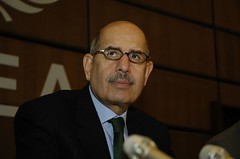
IAEA Director General Mohammad El-Baradei WASHINGTON — When President Obama unexpectedly won the Nobel Peace Prize in 2009, one predecessor was quick to applaud his selection for the award.

“I could not have thought of any other person that is more deserving of the Nobel Peace Prize than Barack Obama,” Mohamed ElBaradei, then the director general of the International Atomic Energy Agency, said in a videotaped statement. He went on to praise Mr. Obama’s commitment “to restore moral decency” to the lives of people around the world.

But on Sunday, Mr. ElBaradei, now a prominent face of the opposition on the streets of Cairo, was sounding a different tune. “The American government cannot ask the Egyptian people to believe that a dictator who has been in power for 30 years will be the one to implement democracy,” Mr. ElBaradei told CBS’s “Face the Nation.” He called the United States’ refusal to openly abandon President Hosni Mubarak of Egypt “a farce.”

Mr. ElBaradei, 68, had a fractious relationship with the Bush administration, one so hostile that Bush officials tried to get him removed from his post at the atomic watchdog agency. But as Egypt’s powerful Muslim Brotherhood and the secular opposition on the streets of Cairo have increasingly coalesced around Mr. ElBaradei to negotiate on their behalf, the Obama administration is scrambling to figure out whether he is someone with whom the United States can deal.

********************************

29.1.11

After Tunisia, Egypt is shaking; What is the US official line?
Apparently, that democracy can only be for capital(ists)!

President Obama, say the 'D-Word'


US appears to shy away from talk about democracy in Middle East, despite historic anti-government rallies in ally Egypt

Mark LeVine

Obama has 'sought to equate Egypt's protesters and government as equally pitted parties in the growing conflict' [AFP]

It's incredible, really. The president of the United States can't bring himself to talk about democracy in the Middle East. He can dance around it, use euphemisms, throw out words like "freedom" and "tolerance" and "non-violent" and especially "reform," but he can't say the one word that really matters: democracy.

How did this happen? After all, in his famous 2009 Cairo speech to the Muslim world, Obama spoke the word loudly and clearly - at least once.

"The fourth issue that I will address is democracy," he declared, before explaining that while the United States won't impose its own system, it was committed to governments that "reflect the will of the people... I do have an unyielding belief that all people yearn for certain things: the ability to speak your mind and have a say in how you are governed; confidence in the rule of law and the equal administration of justice; government that is transparent and doesn't steal from the people; the freedom to live as you choose. Those are not just American ideas, they are human rights, and that is why we will support them everywhere."

"No matter where it takes hold," the president concluded, "government of the people and by the people sets a single standard for all who hold power."

Simply rhetoric?

Of course, this was just rhetoric, however lofty, reflecting a moment when no one was rebelling against the undemocratic governments of our allies - at least not openly and in a manner that demanded international media coverage.

Now it's for real.

And "democracy" is scarcely to be heard on the lips of the president or his most senior officials.

In fact, newly released WikiLeaks cables show that from the moment it assumed power, the Obama administration specifically toned down public criticism of Mubarak. The US ambassador to Egypt advised secretary of state Hillary Clinton to avoid even the mention of former presidential candidate Ayman Nour, jailed and abused for years after running against Mubarak in part on America's encouragement.

Not surprisingly, when the protests began, Clinton declared that Egypt was "stable" and an important US ally, sending a strong signal that the US would not support the protesters if they tried to topple the regime. Indeed, Clinton has repeatedly described Mubarak as a family friend. Perhaps Ms Clinton should choose her friends more wisely.

Similarly, president Obama has refused to take a strong stand in support of the burgeoning pro-democracy movement and has been no more discriminating in his public characterisation of American support for its Egyptian "ally". Mubarak continued through yesterday to be praised as a crucial partner of the US. Most important, there has been absolutely no call for real democracy.

Rather, only "reform" has been suggested to the Egyptian government so that, in Obama's words, "people have mechanisms in order to express legitimate grievances".

"I've always said to him that making sure that they are moving forward on reform - political reform, economic reform - is absolutely critical for the long-term well-being of Egypt," advised the president, although vice-president Joe Biden has refused to refer to Mubarak as a dictator, leading one to wonder how bad a leader must be to deserve the title.

Even worse, the president and his senior aides have repeatedly sought to equate the protesters and the government as somehow equally pitted parties in the growing conflict, urging both sides to "show restraint". This equation has been repeated many times by other American officials.

This trick, tried and tested in the US discourse surrounding the Israeli-Palestinian conflict, is equally nonsensical here. These are not two movements in a contest for political power. Rather, it is a huge state, with a massive security and police apparatus that is supported by the world's major superpower to the tune of billions of dollars a year, against a largely young, disenfranchised and politically powerless population which has suffered brutally at its hands for decades.

The focus on reform is also a highly coded reference, as across the developing world when Western leaders have urged "reform" it has usually signified the liberalisation of economies to allow for greater penetration by Western corporations, control of local resources, and concentration of wealth, rather than the kind of political democratisation and redistribution of wealth that are key demands of protesters across the region.

Al Jazeera interview says it all

An Al Jazeera English interview on Thursday with US state department spokesman PJ Crowley perfectly summed up the sustainability of the Obama administration's position. In some of the most direct and unrelenting questioning of a US official I have ever witnessed, News Hour anchor Shihab al-Rattansi repeatedly pushed Crowley to own up to the hypocrisy and absurdity of the administration's position of offering mild criticism of Mubarak while continuing to ply him with billions of dollars in aid and political support.

When pressed about how the US-backed security services are beating and torturing and even killing protesters, and whether it wasn't time for the US to consider discontinuing aid, Crowley responded that "we don't see this as an either or [a minute later, he said "zero sum"] proposition. Egypt is a friend of the US, is an anchor of stability and helping us pursue peace in the Middle East".

Each part of this statement is manifestly false; the fact that in the midst of intensifying protests senior officials feel they can spin the events away from openly calling for a real democratic transition now reveals either incredible ignorance, arrogance, or both.

Yet this is precisely an either/or moment. Much as former US president Bush declared in the wake of the 9/11 attacks, we can either be "with or against" the Egyptian people. Refusing to take sides is in fact taking sides -the wrong side.

Moreover, Crowley, like his superiors, refused to use the word democracy, responding to its use by anchor al-Rattansi with the word "reform" while arguing that it was unproductive to tie events in Egypt to the protests in other countries such as Tunis or Jordan because each has its own "indigenous" forces and reasons for discontent.

That is a very convenient singularisation of the democracy movements, which ignores the large number of similarities in the demands of protests across the region, the tactics and strategies of protest, and their broader distaste and distrust of the US in view of its untrammelled support for dictatorships across the region.

Systematic silence

Ensconced in a system built upon the lack of democracy - not just abroad, but as we've seen in the last decade, increasingly in the US as well - perhaps president Obama doesn't feel he has the luxury of pushing too hard for democracy when its arrival would threaten so many policies pursued by his administration.

Instead, "stability" and "reform" are left to fill the void, even though both have little to do with democracy in an real sense.

Perhaps Obama wants to say the D-word. Maybe in his heart he hopes Mubarak just leaves and allows democracy to flourish. By all accounts, the president is no ideologue like his predecessor. He does not come from the political-economic-strategic elites as did Bush, and has no innate desire to serve or protect their interests.

Feeling trapped by a system outside his control or power to change, maybe president Obama hopes that the young people of the Arab world will lead the way, and will be satisfied by congratulations by his administration after the fact.

But even if accurate, such a scenario will likely never come to pass. With Egyptians preparing to die in the streets, standing on the sidelines is no longer an option.

A gift that won't be offered again

The most depressing and even frightening part of the tepid US response to the protests across the region is the lack of appreciation of what kind of gift the US, and West more broadly, are being handed by these movements. Their very existence is bringing unprecedented levels of hope and productive activism to a region and as such constitutes a direct rebuttal to the power and prestige of al-Qaeda.

Instead of embracing the push for real democratic change, however, surface reforms that would preserve the system intact are all that's recommended. Instead of declaring loud and clear a support for a real democracy agenda, the president speaks only of "disrupting plots and securing our cities and skies" and "tak[ing] the fight to al-Qaeda and their allies", as he declared in his State of the Union address.

Obama doesn't seem to understand that the US doesn't need to "take the fight" to al-Qaeda, or even fire a single shot, to score its greatest victory in the "war on terror". Supporting real democratisation will do more to downgrade al-Qaeda's capabilities than any number of military attacks. He had better gain this understanding quickly because in the next hours or days the Egypt's revolution will likely face its moment of truth. And right behind Egypt are Yemen, Jordan, Algeria, and who knows what other countries, all looking to free themselves of governments that the US and its European allies have uncritically supported for decades.

If president Obama has the courage to support genuine democracy, even at the expense of immediate American policy interests, he could well go down in history as one of the heroes of the Middle East's Jasmine winter. If he chooses platitudes and the status quo, the harm to America's standing in the region will likely take decades to repair.

Mark LeVine is a professor of history at UC Irvine and senior visiting researcher at the Centre for Middle Eastern Studies at Lund University in Sweden. His most recent books are Heavy Metal Islam (Random House) and Impossible Peace: Israel/Palestine Since 1989 (Zed Books).

James S.
Seattle, WA
I think it is mistaken in calling these massive protests "revolutions," even in the case of Tunisia where the head of state was actually thrown out.

A revolution isn't throwing out a government; it's what happens after you overthrow the government. It requires a balancing act of carrying out the mandate of the people while retaining order. A spontaneous uprising can be the beginning of a revolution, but it's not the end or even the middle of a revolution. If you don't have anything to replace the ousted regime with, you'll simply end up with another authoritarian to fill the vacuum.

In a previous article Cohen compared the speed of mobilization in Tunisia with Castro's years in the Sierra Maestra, arguing that social networking technology did in days what it took years to happen in Cuba. But this comparison is deeply flawed. Castro spent those years creating a sustained popular momentum, building lasting political alliances/networks, defeating utterly Batista's forces, establishing a new military force to replace them, carrying out tentative reforms in the countryside and planning for the post-war period That's the kind of work that goes into any lasting revolution.

Since the end of the Cold War, US policy makers have leaped at every opportunity to call any government-toppling mass uprising a "revolution," especially when they were favorable to us (as in the former Eastern Bloc/Soviet satellite countries). This has now extended to our authoritarian allies in the Arab world. But all of these so-called revolutions are already in danger of petering out or being crushed under tighter restrictions from new and existing authoritarian governments. And that's because few of them have the leadership, ideology or planning in place to permanently take charge and implement reform--I hope for the best in Egypt, but I think it's going to go the way of Iran, the last "revolutionary" hot spot. All the social networking technology in the world isn't going to change that. Only by building real, permanent alliances, creating comprehensive programs, and sustaining long-term public action will these groups become true revolutionaries--and that's not going to happen through Facebook alone.

I do believe that all this can be the beginning of revolutions, especially with the heavy-handed suppression tactics we're seeing from the states. As any historical revolutionary will tell you, it's often the brutality of the state against reformists and protesters that leads to more radical and subversive action from the people. Spontaneous uprisings are important in a revolution, but they're only one component of the larger public struggle.

It's simply too early to call what we're seeing in North Africa revolutionary. There were people claiming that the post-election protests in Iran were part of a revolution, and we see how that worked out. The events unraveling now are, at most, the first tentative steps toward revolutions.

27.1.11

On being competitive

Obama had a dream, or was told so.  It's about competitiveness.  Here's the grassroots level view:

Barbara Rubin
Ca.

Forgive my economic naivete but it would appear that 'competitiveness' is effectively being quashed by industry itself. The monopolization of major industries by transnational corporations appears to view the world as a single trough from which only their approved subsidiaries can feed. Trade associations agree to offer inferior products of a uniform nature to the public at prices set for declining levels of income. Falling wages are arranged by the same groups which serve as major employers around the world. If true competitiveness were the goal, wages would reflect the desire for consumers to have more disposable income.

Until farmers can re-use seeds and their own crops (potatoes are grown from potatoes), they aren't able to compete with one another. Their revenues are always going to belong largely to the vendor of those seeds and attendant technologies required to bring them to 'fruition' in chemically laden fields. Feudalism lives in modern times.

As agribusiness and energy cartels dictate changes to our very eco-system, other industries deal with that 'fall-out'. Developers are dealing with contaminated lands and diminishing supplies of clean water. Building trades are dependent upon inexpensive toxic construction materials from the US and China to house increasingly impoverished populations with low budgets for housing units. These materials can't be exported to Europe where they've learned the costs of ignoring safety (largely through providing universal health care).

Clothing manufacturers, producers of processed foods - what industry can actually boast a large array of competitive businesses falling under these major umbrellas? Competition lies in who can pay the least to workers, offer the fewest benefits and substitute cost-saving chemical treatments to make products look shiny. Worker benefits are provided by the public in medicaid and housing vouchers for working families! Low 'competitive' prices of toxic goods and services are made up with costs paid in physician offices and tax funded disability insurance.

I hope President Obama speaks to competitiveness among 'modest' businesses which will benefit from employing local residents. Seeing that transnational corporations pay taxes in every nation offering them markets is a start. Ending NAFTA requirements that nations pay companies for losses of profits if harmful products are banned is another way to end the stranglehold of monopolies ready to sue nations for such reasonable measures.

Competitiveness lies with dreams of earning a mere million in profits rather than billions. Companies used to compete to achieve sustainability of their operations for future generations. Now a golden parachute rewards those aiming to make a 'quick killing' and get out while they can do so.

Quick killing indeed. The cemeteries are filling up quite nicely.

Barbara Rubin
www.armchairactivist.us


Rod Adams
Forest, VA

My hope is that President Obama is thinking about lessons learned on the basketball court when he is talking about competitiveness. I also hope that he figures out a way to tell Americans that becoming competitive in a given endeavor is not magical, not easy, not not quick. It is, however, one of the most rewarding things you can do.

If you are wondering why America seems to be having some difficulty of late, I highly recommend reading Amy Chua's book titled "Battle Hymn of the Tiger Mother". If you do not have time to read the book, at least read the article that she published last week in the Wall Street Journal titled "Why Chinese Mothers are Superior." When you read either one, look past the specific stereotypes and consider how much work it takes to encourage and enable achievement. Think about the fact that China has about 700 million "Chinese mothers."

Then think about what you personally did in school or what you did to encourage your own children to learn to achieve. Take some responsibility if you recognize that you have been a part of a very lazy period in American history when people have taken for granted that we are a "rich country" and have acted a bit like privileged royalty without investing much effort into becoming capable of competing.

We certainly have some hard working achievers remaining. Apple, Google, and Facebook engineers are creating wonderful technological marvels, college football players invest many hours of sweat and muscle strain, and Westinghouse engineers are creating marvelous nuclear power plants that are being sold all around the world. However, there are also a lot of soft minds and bodies out there.

There is no reason in the world why a third world teenager should be able to out-compete an American worker who had access to at least 12 years of taxpayer supported schooling. If nothing else, the American worker should have a huge advantage by being able to speak and write the English language with native fluency.

English is, after all, the world's business language. Our math and science achievement should be second to none; we probably control at least half of the world's total computing power. If it is not, we should not blame the government or even our teachers - they are providing adequate learning opportunities; it is up to the students and the parents to make sure that the experience takes and knowledge gets transferred.

I grew up as part of the American generation inspired to compete by Sputnik. We raced to the moon, built more that 140 nuclear powered submarines in less than 10 years and built enough nuclear power stations to supply more electricity than the entire grid supplied in 1960 in just 2 decades. Then we got complacent. We stopped studying quite as hard, stopped taking the "hard" courses like calculus and physics, and started giving all participants a trophy.

We can change, we can compete, and we can refuse to put our pension funds or 401Ks into the hands of people who invest in companies like GE that send our jobs overseas. We do not need to become a larger exporter, we simply need to become more self-sufficient, proud of NOT taking a handout, and proud of contributing our fair share to the development of our communities.

That includes recognizing that paying taxes is a responsibility; we need our various levels of government to function well in order to enable the general prosperity, ensure healthy education systems, ensure transportation networks that can deliver goods and services on time, and ensure that we are not choked by our own refuse. I am not blaming American workers so much as blaming the managers and executives who have been taking the easy path and think that capturing as much taxpayer money as possible is the right way to run their businesses. No self-respecting competitive athlete thinks that they can win a championship by outsourcing their work outs.

I hope that is the competitiveness pep talk that President Obama has in mind, though his recent additions to his team do not give me much optimism. He needs to up his game with regard to the drafting process.

Rod Adams
Publisher, Atomic Insights


Tim Kane
Mesa, Az

Competitiveness is not the problem -at this time.

A quick look at the CIA World Factbook online almanac shows that the United States has the greatest productivity in the world, other than the world itself, and the highest per capita productivity in the world for any nation with over 7 million people.

The problem is a lack of demand. We have a lack of demand because we've had 30 years of supply side bias policies that have caused wealth, money, to be sequestered -according to Reagan's former budget director, David Stockman, that's $40 trillion dollars (up from $9 trillion 30 years ago) from the commercial economy by the uber-wealthy in this country.

This is a nation based on one governing principle: free contract.


In any society based upon free contract, only one thing matters: bargaining power.

What you earn, is, quite frankly a function of your bargaining power.

From 1945 to 1972, productivity went up 100% and all segments of society advanced equally. The reason being - bargaining power. For workers that meant labor unions. Since 1972, GNP has gone up 150% yet the median wage is flat.

The problem again is bargaining power. Working class and middle class people have been coaxed into surrendering their bargaining power over to the uber-wealthy in the illusive pursuit of cultural war issues.

The word chumps comes to mind. Take abortion: many middle class people vote Republican over the idea of prohibition of abortion alone, even though the nation that has the lowest rate of abortion in the world, the Netherlands, abortion is both largely legal and largely free.

Chumps, I dare say: The culture wars ended in 1790 with the passage of the Bill of Rights amendments to the constitution: you and everyone else gets to do what they like so long as it doesn't affect anyone else, that is to say your right's end where another's begin, and that includes privacy. Yet people freely vote to surrender their bargaining power over culture war issues.

Here's another curious aspect of this: values (and that would include morals) is a middle class phenomenon. As the movie "It's a Wonderful Life" suggested, when the middle class contracts, immorality expands. So while people are surrendering their bargaining power over moral issues, they are actually causing the middle class to contract, and as a result they are actually causing immorality to increase.

The founding father's knew all about this. They gave us the Bill of Rights to end the culture wars. They gave us a system based on free contract that would ensure that there would be a permanent class war. But they also gave us democracy to ensure that the playing field upon which bargaining would take place would be fairly level. In essence, Democracy is political socialism: one man, one vote.

For 80 years the system worked. In 1860 the U.S. had the broadest distribution of wealth the world had ever seen - despite 3 million of its citizens being bound in servitude. In 1860, we went to war to free up those 3 million. Yet, 25 years after the successful freeing of the slaves, wealth was more concentrated than ever. What happened? The invention of the modern limited liability corporation, in 1862 - remember, Lincoln was a republican and a lawyer to railroad interests. The founding father's hadn't anticipated corporations.

Corporations are an ownership collective. As a collective, they have immense bargaining power over individuals. Their creation caused an immediate imbalance in the distribution of wealth which we are still struggling with today.

And the founding fathers couldn't imagine the ability of corporation's (and the uber-wealthy that they spawned) ability to use their vase resources in unimaginable ways (including buying up most media outlets) to influence people into undermining their own bargaining power. Some how they've managed to convince large swaths of people that collective ownership is virtuous, but collective labor is evil.

Want to fix the economy? Increase demand. Want to increase demand? work on redistributing bargaining power back to the people. You know, we the people. Yes, the 'we the people' that's in the preamble of the constitution. Please note, there is no mention whatsoever of corporations in the constitution - therefor they have no claim to rights over citizens, at all.

The problem is, I'm not sure Obama fathoms any of this at all, and if he does, I'm not sure he comes down on the side of the public (people) on this. He just extended tax cuts to the uber-rich for the slightest of pretext - keeping unemployment insurance going (as if Republicans would let a nation of gun owners loose out on the streets with no jobs, no income and nothing left to lose). By the way those weren't really tax cuts - you can't cut taxes when you have a deficit, what Obama, and Bush before him, really did was use the faith and credit of the United States government to underwrite a loan from communist China on behalf of the rich.

3.1.11

The social construction of US economic revival and its discontents

According the a select few, the US economy will continue its improvement into 2011...


EdB
Livermore, CA

The NY Times and Washington mistake a collection of vague nice-sounding buzz words for leadership. The effectiveness of recent similarly vague policies has consistently evaporated in spite of the power attributed to their awesome dollar amounts. That's because policies that would solve our problems aren't just about money and marketing. The solutions actually have to attack real systemic issues, not merely paint them over.

Has Obama achieved a lot? In name perhaps, but not in reality. DADT? Mostly irrelevant in this time of economic hardship. Financial reform? Formerly big banks are now bigger banks, with about the same level of risk. Health care reform? Well, it's more expensive, anyway. Campaign finance reform? Immediately ejected like the political gambit it apparently was. Housing? Many formerly unaffordable houses are *still* unaffordable, and the best the government can seem to do is throw money at the problem and pray. As far as I can tell, it won't be over until there's no more cash to squeeze from anyone who was trying to be prudent.

This dark joke is getting darker, but not funnier. If I were you NY Times editorial board, I'd drop the dreamy editorials and start pushing your people to dig in the dirt a lot harder. There is a world of corruption to root out in our New Byzantium, and you have yet to admit that to yourselves.


Eric
Wisconsin

We have reached a point where there is little consensus on what will work to fix the economy. In a big part we are ignoring the reality of what the world is like in 2011 and pretending that it is 1955 and think that we dominate the world almost completely from an economic standpoint.

If you look at the articles about ending the filibuster people think that if we just do things it will fix things. Legislative actions can make things worse. If you look at the bills that the news media hailed as triumphs of bipartisanship, they were filled with dirty deals that are part of our troubles.

The extension of the tax cuts included a deal to extend ethanol subsidies and increase the allowable levels in gasoline to 15%. And this is just after Al Gore admitted his 1998 tie breaking vote in the Senate to continue subsidies back then was a fraud only used to try to promote his 2000 presidential bid among farm voters. Science and economics don't matter when it comes to ideology on either side of the political divide. It only matters to stand for the principle of getting elected or reelected.

We ignore the fact that health care and higher education are getting too expensive for people to afford regardless of how we pay for it. Unlimited insurance mandates from the states sound good until you realize that they price people out of coverage. Providing student loans to pay for tuition that has risen at almost twice the rate of health costs over the last 30 years creates debts too high for many people to ever payback and have a life style even equal to what their parents had.

We pretend that the longer lifespans we now enjoy won't bankrupt us or make the math on social security, medicare, and pension fund solvency faulty.

Building expensive and unreliable wind turbines that help jack up the cost of power hurts manufacturing competitiveness is a phony solution to environmental problems. Just look at how Scotland is importing electricity from France because their big reliance on Wind has proven hugely unreliable.

Fantasy thinking does not work. Part of that is our politicians thinking that 3000 page bills can even create workable rules to run our country. They don't seem to mind since these unworkable bills create plenty of work for their fellow lawyers while they crush the lively-hood opportunities for the rest of us.

Unfortunately we may need a greater collapse to clean out the unrealistic excesses of the last 40 years. I just see a lot of pain before we decide to what is necessary.


Karen Garcia
New Paltz, NY

The inequality in this country is literally killing people, but to hear the politicians and the pundits blather, prosperity is just around the corner. Corporate profits were up 20 percent last quarter, Christmas retail sales spiked by 5 percent and Congress passed a whole bunch of legislation at the last minute to much media fanfare and shameless self-congratulation.

Despite the so-called health care reform legislation passed last year, the number of uninsured Americans has increased to more than 50 million, according to the U.S. Census Bureau. The main factor leading to this major loss of coverage is loss of employer-funded health care. While almost 17 percent of the population at large is now uninsured, it gets worse further down the income scale; Census figures reveal that fully a quarter of people with incomes under $25,000 have no health coverage at all.

When President Obama made his back-room deals with the for-profit insurers and drug companies to get his watered-down bill passed, he traded away universal coverage - right away - for a smooth ride through Congress and future corporate campaign donations. So we are worse off than ever, because widespread benefits won't take effect until 2014. People with pre-existing conditions can't afford to buy into those much-touted high risk pools. Sick people still can't afford to go to the doctor and are getting sicker and dying at higher rates than even before "reform." And all to please some corrupt politicians and their corporate puppet masters - all to worship at the altar of fiscal responsibility by making suffering people wait another three years before getting government subsidies to further enrich the insurance companies - which, by the way, remain immune from anti-trust laws.

But perhaps that's the whole idea - make people wait long enough,and maybe a lot of them will conveniently die. There's a name for what the United States calls its joke of a safety net, and it's Social Darwinism. We should probably just give up the pretense and rename Washington, D.C. : "Wall Street-upon-Potomac."

But there is one ray of hope: the first Boomers are hitting retirement this year, and the vast majority of them think the country is headed down the tubes. They'll have plenty of time on their hands to relive the glory days of anti-government protests. Never underestimate the intelligence and clout of the over-60s to bring about that change we can all believe in. Perhaps the retirees can embark on second careers as civil disobedience mentors to the unemployed Gen Xers. Trusting government is no longer an option. Believing in ourselves and our own power is the only sane choice we have left. There is one percent of them, and 99 percent of us.


wannabeworker
USA

I completely agree with these findings ['Want a happy, healthy country? Focus on reducing inequality.'] I've been looking for work for nine months and am feeling more estranged and disconnected from society than I ever thought I could. All of my relationships are strained--family, friends, people I network with, people I used to work with--because they have jobs, money, and an identity, and I do not. They are stable, independent, and happy. I am not. They participate in society. I do not. We previously had plenty enough in common to enjoy one another's company. Now, what on earth do we have to talk about?

The wealthy also have much richer lives than ever before because more is possible today than ever before--wealthy people are enjoying all the unbelievable achievements of modern man, including every wonderful gadget you could ever imagine, age treatments, medical advances, travel anywhere and everywhere, great clothes, great cars, etc. But poor people today are just as poor as poor people ever were. The lifestyles of the working and the non-working are so vastly different, they might as well be living on different planets.

My heart aches every day for the return of jobs in America. This topic should remain in NYT headlines until that happens.

Blog Archive